Nedocromil
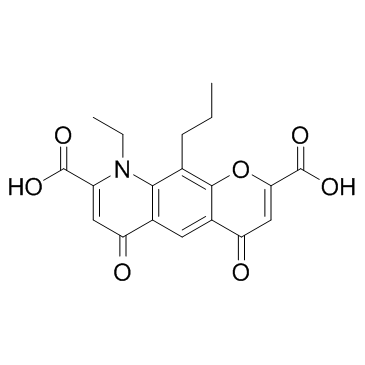
Nedocromil structure
|
Common Name | Nedocromil | ||
|---|---|---|---|---|
| CAS Number | 69049-73-6 | Molecular Weight | 371.341 | |
| Density | 1.5±0.1 g/cm3 | Boiling Point | 645.5±55.0 °C at 760 mmHg | |
| Molecular Formula | C19H17NO7 | Melting Point | 299ºC | |
| MSDS | Chinese USA | Flash Point | 344.2±31.5 °C | |
| Symbol |

GHS07 |
Signal Word | Warning | |
Use of NedocromilNedocromil suppresses the action or formation of multiple mediators, including histamine, leukotriene C4 (LTC4), and prostaglandin D2 (PGD2). |
| Name | nedocromil |
|---|---|
| Synonym | More Synonyms |
| Description | Nedocromil suppresses the action or formation of multiple mediators, including histamine, leukotriene C4 (LTC4), and prostaglandin D2 (PGD2). |
|---|---|
| Related Catalog | |
| Target |
Histamine LTC4 PGD2 |
| In Vitro | Nedocromil inhibits the release of histamine, LTC4, and PGD2 from mast cells challenged with antigen (with IC30 values of 2.1 μM, 2.3 μM, and 1.9 μM, respectively) and with anti-human IgE (IC30 values of 4.7 μM, 1.3 μM, and 1.3 μM, respectively)[1]. |
| In Vivo | Nedocromil-treated diabetic mice show significantly improved heart function compared with controls. The contractility and relaxation forces show similar improvements. However, the cardiac function of Nedocromil-treated diabetic mice remains significantly impaired when compared with normal mice. Nedocromil can significantly improve cardiac function in mice with diabetic cardiomyopathy, but the treatment cannot restore normal function[2]. |
| Animal Admin | Mice[2] 8-12 weeks old C57/BL6 male mice between 23-25 g receive intraperitoneal (i.p.) injections of 50 mg/kg Streptozotocin (STZ), dissolved in 100 mM citrate buffer pH 4.5, for five consecutive days. Diabetic mice (13-week-old) are randomly divided into three groups: 1) untreated group; 2) Nedocromil group, with Nedocromil released at the rate of 30 mg/kg per day from a subcutaneous (s.c.) pellet implantation; and vehicle group, with an inactive pellet implanted. Normal mice (non-diabetic) and normal mice that receive Nedocromil (30 mg/kg per day) are also included in this study for comparison. All sample groups included 15 mice (n=15)[2]. |
| References |
| Density | 1.5±0.1 g/cm3 |
|---|---|
| Boiling Point | 645.5±55.0 °C at 760 mmHg |
| Melting Point | 299ºC |
| Molecular Formula | C19H17NO7 |
| Molecular Weight | 371.341 |
| Flash Point | 344.2±31.5 °C |
| Exact Mass | 371.100494 |
| PSA | 126.81000 |
| LogP | 2.52 |
| Appearance of Characters | white to beige |
| Vapour Pressure | 0.0±2.0 mmHg at 25°C |
| Index of Refraction | 1.641 |
| Storage condition | 2-8°C |
| Water Solubility | DMSO: soluble2mg/mL, clear (warmed) |
|
Estrogen inhibits mast cell chymase release to prevent pressure overload-induced adverse cardiac remodeling.
Hypertension 65(2) , 328-34, (2015) Estrogen regulation of myocardial chymase and chymase effects on cardiac remodeling are unknown. To test the hypothesis that estrogen prevents pressure overload-induced adverse cardiac remodeling by i... |
|
|
Diagnostic accuracy of the bronchodilator response in children.
J. Allergy Clin. Immunol. 132(3) , 554-559.e5, (2013) The bronchodilator response (BDR) reflects the reversibility of airflow obstruction and is recommended as an adjunctive test to diagnose asthma. The validity of the commonly used definition of BDR, a ... |
|
|
This asthma treatment has a lasting side effect in children.
J. Fam. Pract. 62(9) , 500-2, (2013) A new study finds that when children with asthma use inhaled corticosteroids, the effect on growth may not be temporary, as once thought. |
| Nedocromil |
| Nedocromilum |
| 9-Ethyl-4,6-dioxo-10-propyl-6,9-dihydro-4H-pyrano[3,2-g]quinoline-2,8-dicarboxylic acid |
| FPL 59002KP |
| 4H-Pyrano[3,2-g]quinoline-2,8-dicarboxylic acid, 9-ethyl-6,9-dihydro-4,6-dioxo-10-propyl- |
| 9-ethyl-6,9-dihydro-4,6-dioxo-10-propyl-4H-pyrano(3,2-g)quinoline-2,8-dicarboxylic acid |
| Nedocromilo [Spanish] |
| Nedocromilum [Latin] |
| Tilade |
| Nedocromilo |
| 9-ethyl-4,6-dioxo-10-propylpyrano[3,2-g]quinoline-2,8-dicarboxylic acid |
| 4,6-Dioxo-1-ethyl-10-propyl-4H,6H-pyrano[3,2-g]quinoline-2,8-dicarboxylic acid |
| Nedocromil [USAN:BAN:INN] |
| Alocril |