GPR
Modify Date: 2025-08-25 12:09:56
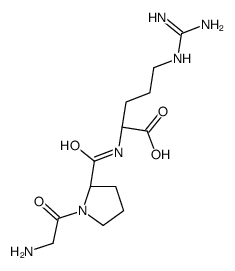
GPR structure
|
Common Name | GPR | ||
|---|---|---|---|---|
| CAS Number | 47295-77-2 | Molecular Weight | 328.36700 | |
| Density | N/A | Boiling Point | N/A | |
| Molecular Formula | C13H24N6O4 | Melting Point | N/A | |
| MSDS | N/A | Flash Point | N/A | |
Use of GPRGPR is a three amino acid peptide. GPR can rescue cultured rat hippocampal neurons from Aβ-induced neuronal death by inhibiting caspase-3/p53 dependent apoptosis. GPR can be used for the research of Alzheimer's disease (AD). |
| Name | (2S)-2-[[(2S)-1-(2-aminoacetyl)pyrrolidine-2-carbonyl]amino]-5-(diaminomethylideneamino)pentanoic acid |
|---|---|
| Synonym | More Synonyms |
| Description | GPR is a three amino acid peptide. GPR can rescue cultured rat hippocampal neurons from Aβ-induced neuronal death by inhibiting caspase-3/p53 dependent apoptosis. GPR can be used for the research of Alzheimer's disease (AD). |
|---|---|
| Related Catalog | |
| In Vitro | GPR (1-100 μM; 24 h, 48 h) prevented Aβ-mediated increase in lactate dehydrogenase (LDH) release[1]. GPR (50 μM; 24 h, 48 h) prevents Ah-mediated inhibition of neuronal MTT reduction[1]. GPR (50 μM; 3 days) prevents Aβ-mediated increase in p53-positive cells[1]. GPR (50 μM; 24 h) effectively prevented the Aβ-mediated activation of caspase-3[1]. Apoptosis Analysis[1] Cell Line: p53-positive cells Concentration: 50 μM Incubation Time: 3 days Result: Inhibited Ah-induced increase in numbers of p53-positive neurons. |
| Molecular Formula | C13H24N6O4 |
|---|---|
| Molecular Weight | 328.36700 |
| Exact Mass | 328.18600 |
| PSA | 178.12000 |
| LogP | 0.43820 |
| InChIKey | JYPCXBJRLBHWME-IUCAKERBSA-N |
| SMILES | NCC(=O)N1CCCC1C(=O)NC(CCCN=C(N)N)C(=O)O |
| Glycylprolylarginine |
| Gly-pro-arg |
The content on this webpage is sourced from various professional data sources. If you have any questions or concerns regarding the content, please feel free to contact service1@chemsrc.com.
- Shanghai Nianxing Industrial Co., Ltd
- China
- Product Name: Palmitic acid
- Price: Check
- Purity: 98.0%
- Delivery: 10 Day
- Contact: Yang
- Email: sales@echemcloud.com
- Nanjing Peptide Biotech Ltd
- China
- Product Name: H-Gly-Pro-Arg-OH
- Price: ¥Inquiry/10g ¥Inquiry/100g ¥Inquiry/1kg ¥Inquiry/10kg
- Purity: 98.0%
- Delivery: 7 Day
- Contact: jom


- Email: chenglong.fan@njpeptide.com
Get all suppliers and price by the below link: