Triethoxyoctylsilane
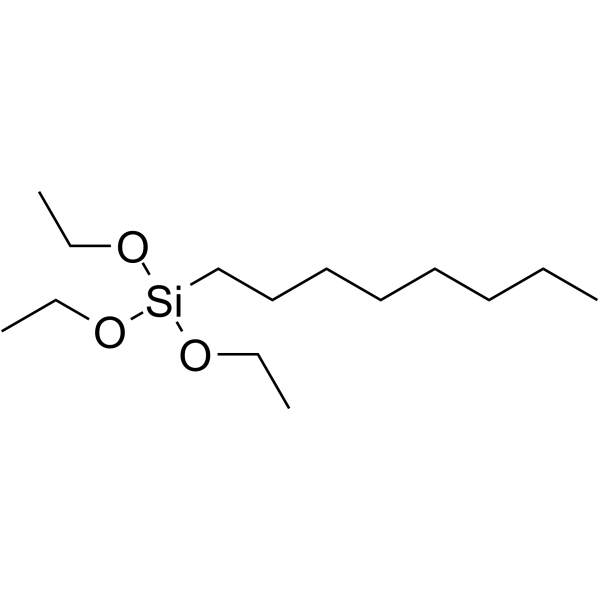
Triethoxyoctylsilane structure
|
Common Name | Triethoxyoctylsilane | ||
|---|---|---|---|---|
| CAS Number | 2943-75-1 | Molecular Weight | 276.488 | |
| Density | 0.9±0.1 g/cm3 | Boiling Point | 224.4±8.0 °C at 760 mmHg | |
| Molecular Formula | C14H32O3Si | Melting Point | -40ºC | |
| MSDS | Chinese USA | Flash Point | 101.3±21.3 °C | |
| Symbol |

GHS07 |
Signal Word | Warning | |
Use of TriethoxyoctylsilaneTriethoxyoctylsilane is a silane coupling agent. Triethoxyoctylsilane can be used in plastics applications[1][2]. |
| Name | Triethoxyoctylsilane |
|---|---|
| Synonym | More Synonyms |
| Description | Triethoxyoctylsilane is a silane coupling agent. Triethoxyoctylsilane can be used in plastics applications[1][2]. |
|---|---|
| Related Catalog | |
| References |
| Density | 0.9±0.1 g/cm3 |
|---|---|
| Boiling Point | 224.4±8.0 °C at 760 mmHg |
| Melting Point | -40ºC |
| Molecular Formula | C14H32O3Si |
| Molecular Weight | 276.488 |
| Flash Point | 101.3±21.3 °C |
| Exact Mass | 276.212067 |
| PSA | 27.69000 |
| LogP | 5.45 |
| Vapour Pressure | 0.1±0.4 mmHg at 25°C |
| Index of Refraction | 1.428 |
| InChIKey | MSRJTTSHWYDFIU-UHFFFAOYSA-N |
| SMILES | CCCCCCCC[Si](OCC)(OCC)OCC |
| Water Solubility | reacts |
| Symbol |
GHS07 |
|---|---|
| Signal Word | Warning |
| Hazard Statements | H315-H319-H335 |
| Precautionary Statements | P261-P305 + P351 + P338 |
| Personal Protective Equipment | Eyeshields;full-face respirator (US);Gloves;multi-purpose combination respirator cartridge (US);type ABEK (EN14387) respirator filter |
| Hazard Codes | Xi:Irritant; |
| Risk Phrases | R36/37/38 |
| Safety Phrases | S26-S36-S37/39 |
| RIDADR | NONH for all modes of transport |
| WGK Germany | 1 |
| RTECS | VV6695500 |
| HS Code | 29310095 |

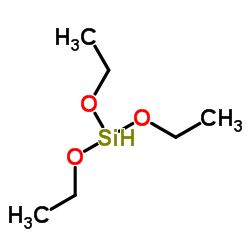
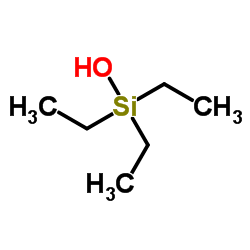

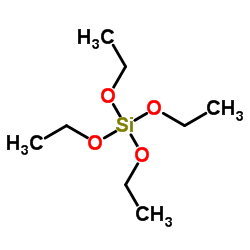

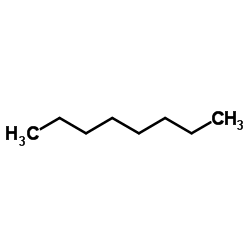


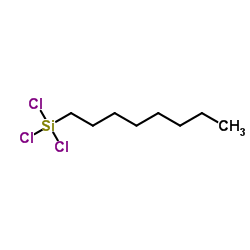
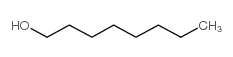 CAS#:111-87-5
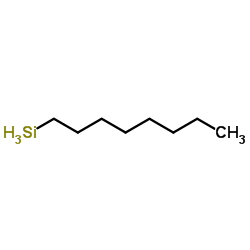 CAS#:871-92-1
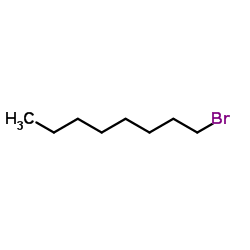 CAS#:111-83-1
| HS Code | 2931900090 |
|---|---|
| Summary | 2931900090. other organo-inorganic compounds. VAT:17.0%. Tax rebate rate:13.0%. Supervision conditions:AB(certificate of inspection for goods inward,certificate of inspection for goods outward). MFN tariff:6.5%. General tariff:30.0% |
|
Silanization-Based Zeolite Crystallization: Participation Degree and Pathway.
Chemistry 21 , 12161-70, (2015) A clear and deep understanding of zeolite crystallization with the addition of organosilane is desirable for the reasonable design and preparation of hierarchical zeolites. Herein, the effects of diff... |
|
|
Effects of Tailored Surface Chemistry on Desorption Electrospray Ionization Mass Spectrometry: a Surface-Analytical Study by XPS and AFM.
J. Am. Soc. Mass Spectrom. 26 , 1311-9, (2015) Since it was proposed for the first time, desorption electrospray ionization-mass spectrometry (DESI-MS) has been evaluated for applicability in numerous areas. Elucidations of the ionization mechanis... |
|
|
Deposition of wafer-scale single-component and binary nanocrystal superlattice thin films via dip-coating.
Adv. Mater. 27 , 2846-51, (2015) Single-component and binary nanocrystal superlattices are assembled over wafer-scale areas using the dip-coating method. A series of measurements are performed to confirm superlattice assembly. This s... |
| dynasylanocteo |
| prosil9234 |
| triethoxyoctylsilane |
| MFCD00039883 |
| CO9835 |
| prosil9202 |
| EINECS 220-941-2 |
| n-Octyltriethoxysilane |
| octyltriethoxysilane |
| Silquest A-137 |
| Octyl(triethoxy)silane |
| Triethoxy-n-octylsilane |
| y9187 |
| Silane, triethoxyoctyl- |
| A 137 |
| Triethoxy(octyl)silane |
| silquesta137 |
| U-222 |
| Triethoxycaprylylsilane |
| CH3(CH2)7Si(OEt)3 |
| (octyl)triethoxysilane |
The content on this webpage is sourced from various professional data sources. If you have any questions or concerns regarding the content, please feel free to contact service1@chemsrc.com.
- Shanghai Nianxing Industrial Co., Ltd
- China
- Product Name: Triethoxyoctylsilane
- Price: Check
- Purity: 97.0%
- Delivery: 10 Day
- Contact: Yang
- Email: sales@echemcloud.com
- Shanghai Jizhi Biochemical Technology Co., Ltd
- China
- Product Name: Triethoxyoctylsilane
- Price: ¥98.0/100ml ¥248.0/500ml
- Purity: 98.0%
- Delivery: Inquiry
- Contact: Liu jia


- Email: 2130147988@qq.com
- DC Chemicals Limited
- China
- Product Name: Triethoxycaprylylsilane
- Price: $Inquiry/100mg $Inquiry/250mg $Inquiry/500mg
- Purity: 98.0%
- Delivery: 3 Day
- Contact: Tony Cao
- Email: sales@dcchemicals.com
- Dayang Chem (Hangzhou) Co., Ltd.
- China
- Product Name: Triethoxyoctylsilane
- Price: $Inquiry/100g $Inquiry/1kg $Inquiry/100kg $Inquiry/1000kg
- Purity: 98.0%
- Delivery: Inquiry
- Contact: Ms Wang
- Email: enquiry@dycnchem.com
- Henan Tianfu Chemical Co., Ltd.
- China
- Product Name: Triethoxyoctylsilane
- Price: $Inquiry/1kg $Inquiry/25kg $Inquiry/1000kg $Inquiry/10ton
- Purity: 99.0%
- Delivery: Inquiry
- Contact: Anson
- Email: info@tianfuchem.com
- Zhongshan Xingrui Chemical Co. , Ltd.
- China
- Product Name: Triethoxyoctylsilane
- Price: ¥Inquiry/25kg
- Purity: 98.0%
- Delivery: Inquiry
- Contact: Wang Jie
- Email: 3096638339@qq.com
Get all suppliers and price by the below link:
Triethoxyoctylsilane suppliers
Reference only. check more Triethoxyoctylsilane price