D-erythro-Sphingosine hydrochloride
Modify Date: 2025-09-10 22:25:21
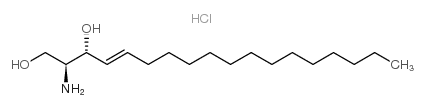
D-erythro-Sphingosine hydrochloride structure
|
Common Name | D-erythro-Sphingosine hydrochloride | ||
|---|---|---|---|---|
| CAS Number | 2673-72-5 | Molecular Weight | 335.95300 | |
| Density | N/A | Boiling Point | N/A | |
| Molecular Formula | C18H38ClNO2 | Melting Point | N/A | |
| MSDS | N/A | Flash Point | N/A | |
Use of D-erythro-Sphingosine hydrochlorideD-erythro-Sphingosine (Erythrosphingosine) hydrochloride is a specific TRPM3 activator. D-erythro-Sphingosine also induces retinoblastoma protein dephosphorylation[1][2]. |
| Name | D-erythro-Sphingosine hydrochloride |
|---|---|
| Synonym | More Synonyms |
| Description | D-erythro-Sphingosine (Erythrosphingosine) hydrochloride is a specific TRPM3 activator. D-erythro-Sphingosine also induces retinoblastoma protein dephosphorylation[1][2]. |
|---|---|
| Related Catalog | |
| Target |
TRPM3 Retinoblastoma protein |
| In Vitro | Extracellular application of D-erythro-Sphingosine (20 μM) induces an increase in [Ca2+]i in TRPM3-transfected HEK293 cells within 20 to 30 s after start of application, whereas nontransfected control cells (NT) shows only very small responses[1]. D-erythro-Sphingosine (10 μM) induces currents through TRPM3[1]. Induction of retinoblastoma protein dephosphorylation by D-erythro-Sphingosine (500 nM; 24 h) precede inhibition of growth and a specific arrest in the G0/G1 phase of the cell cycle[2]. |
| Molecular Formula | C18H38ClNO2 |
|---|---|
| Molecular Weight | 335.95300 |
| Exact Mass | 335.25900 |
| PSA | 66.48000 |
| LogP | 5.42650 |
| InChIKey | YDIHJJLAPMAISR-ZNWYJMOFSA-N |
| SMILES | CCCCCCCCCCCCCC=CC(O)C(N)CO.Cl |
| d-sphingosine hcl |
The content on this webpage is sourced from various professional data sources. If you have any questions or concerns regarding the content, please feel free to contact service1@chemsrc.com.
- Shanghai Nianxing Industrial Co., Ltd
- China
- Product Name: D-erythro-Sphingosine hydrochloride
- Price: Check
- Purity: 98.0%
- Delivery: 10 Day
- Contact: Yang
- Email: sales@echemcloud.com
- Nanjing Peptide Biotech Ltd
- China
- Product Name: D-Erythro-Sphingosine Hydrochloride
- Price: ¥Inquiry/10g ¥Inquiry/100g ¥Inquiry/1kg ¥Inquiry/10kg
- Purity: 98.0%
- Delivery: 7 Day
- Contact: jom


- Email: chenglong.fan@njpeptide.com
- Dayang Chem (Hangzhou) Co., Ltd.
- China
- Product Name: D-SPHINGOSINE HCL
- Price: $Inquiry/100g $Inquiry/1kg $Inquiry/100kg $Inquiry/1000kg
- Purity: 98.0%
- Delivery: Inquiry
- Contact: Ms Wang
- Email: enquiry@dycnchem.com
Get all suppliers and price by the below link: