(R,S)-CHPG
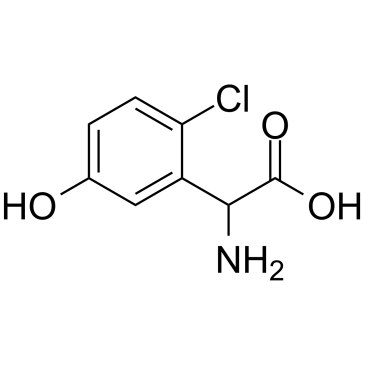
(R,S)-CHPG structure
|
Common Name | (R,S)-CHPG | ||
|---|---|---|---|---|
| CAS Number | 170846-74-9 | Molecular Weight | 201.60700 | |
| Density | N/A | Boiling Point | N/A | |
| Molecular Formula | C8H8ClNO3 | Melting Point | N/A | |
| MSDS | Chinese USA | Flash Point | N/A | |
| Symbol |

GHS07 |
Signal Word | Warning | |
Use of (R,S)-CHPGCHPG is a selective mGluR5 agonist, and attenuates SO2-induced oxidative stress and inflammation through TSG-6/NF-κB pathway in BV2 microglial cells[1]. CHPG protects against traumatic brain injury (TBI) in vitro and in vivo by activation of the ERK and Akt signaling pathways[2]. |
| Name | 2-amino-2-(2-chloro-5-hydroxyphenyl)acetic acid |
|---|---|
| Synonym | More Synonyms |
| Description | CHPG is a selective mGluR5 agonist, and attenuates SO2-induced oxidative stress and inflammation through TSG-6/NF-κB pathway in BV2 microglial cells[1]. CHPG protects against traumatic brain injury (TBI) in vitro and in vivo by activation of the ERK and Akt signaling pathways[2]. |
|---|---|
| Related Catalog | |
| Target |
mGluR5 NF-κB ERK Akt |
| In Vitro | CHPG (10-500 µM; 24 hours) significantly increases the cell viability and decreases the LDH release after SO2 derivatives treatment[1]. CHPG (0.5 mM; 30 mins ) protects BV2 cells against SO2-induced apoptosis[1]. CHPG (0.5 mM; 30 mins) treatment alone increases the expression of TSG-6 in both mRNA and protein levels[1]. Cell Viability Assay[1] Cell Line: BV2 microglial cells Concentration: 10, 50, 100 and 500 µM Incubation Time: 24 hours Result: Increased the cell viability. Apoptosis Analysis[1] Cell Line: BV2 microglial cells Concentration: 0.5 mM Incubation Time: 30 mins Result: Protected BV2 cells against SO2-induced apoptosis. Western Blot Analysis[1] Cell Line: BV2 microglial cells Concentration: 0.5 mM Incubation Time: 30 mins Result: Increased the expression of TSG-6 in both mRNA and protein levels. |
| In Vivo | CHPG (injection; 250 nM; for 7 days) reduces significantly cerebral lesion volume[2]. Animal Model: Adult Sprague-Dawley male rats weighing 280-320 g[2] Dosage: 250 nM Administration: Injection; for 7 days Result: Reduced significantly cerebral lesion volume. |
| References |
| Molecular Formula | C8H8ClNO3 |
|---|---|
| Molecular Weight | 201.60700 |
| Exact Mass | 201.01900 |
| PSA | 83.55000 |
| LogP | 1.83030 |
| InChIKey | UNIDAFCQFPGYJJ-UHFFFAOYSA-N |
| SMILES | NC(C(=O)O)c1cc(O)ccc1Cl |
| Symbol |
GHS07 |
|---|---|
| Signal Word | Warning |
| Hazard Statements | H315-H319-H335 |
| Precautionary Statements | P261-P305 + P351 + P338 |
| Personal Protective Equipment | dust mask type N95 (US);Eyeshields;Gloves |
| Hazard Codes | Xi |
| Risk Phrases | R36/37/38 |
| Safety Phrases | S26 |
| RIDADR | NONH for all modes of transport |
|
mGluR5 in the nucleus accumbens shell regulates morphine-associated contextual memory through reactive oxygen species signaling.
Addict. Biol. 20 , 927-40, (2015) Emerging evidence indicates that metabotropic glutamate receptor 5 (mGluR5) critically modulates drug and drug-related behaviors. However, the role of mGluR5 in the opiate-induced contextual memory re... |
|
|
Modulatory effects of activation of metabotropic glutamate receptors on GABAergic circuits in the mouse thalamus.
J. Neurophysiol. 113 , 2646-52, (2015) Metabotropic glutamate receptors (mGluRs) are widely distributed in the central nervous system and modulate the release of neurotransmitters in different ways. We have previously shown that activation... |
|
|
Stimulation-evoked Ca2+ signals in astrocytic processes at hippocampal CA3-CA1 synapses of adult mice are modulated by glutamate and ATP.
J. Neurosci. 35(7) , 3016-21, (2015) To date, it has been difficult to reveal physiological Ca(2+) events occurring within the fine astrocytic processes of mature animals. The objective of the study was to explore whether neuronal activi... |
| Pregnanolone |
| CHPG |
| 2-chloro-5-hydroxyphenylglycine |