D-Menthol
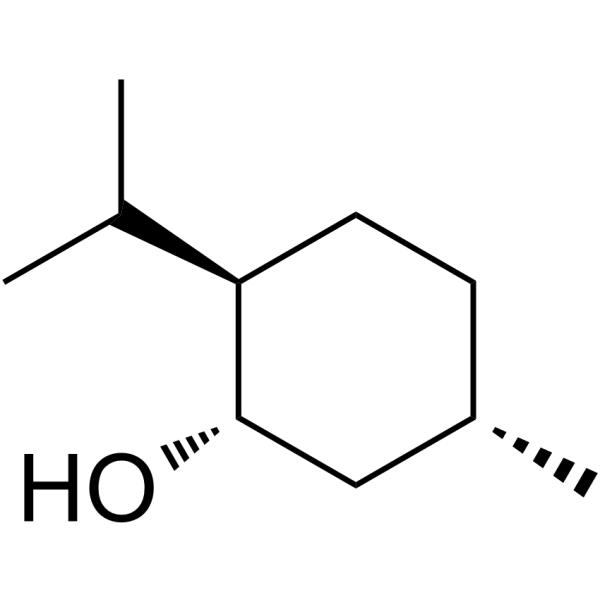
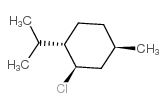
D-Menthol structure
|
Common Name | D-Menthol | ||
|---|---|---|---|---|
| CAS Number | 15356-60-2 | Molecular Weight | 156.265 | |
| Density | 0.9±0.1 g/cm3 | Boiling Point | 215.4±8.0 °C at 760 mmHg | |
| Molecular Formula | C10H20O | Melting Point | 43-44ºC | |
| MSDS | Chinese USA | Flash Point | 93.3±0.0 °C | |
| Symbol |


GHS05, GHS07 |
Signal Word | Danger | |
Use of D-Menthol(+)-Menthol (D-Menthol) is one of the optical isomers of Menthol. (+)-Menthol can reduce the electrically evoked contractions of rat phrenic hemidiaphragm in vitro. Local anaesthetic activity. (+)-Menthol can also inhibit the growth of Microcystis aeruginosa cells[1][2][3]. |
| Name | (+)-menthol |
|---|---|
| Synonym | More Synonyms |
| Description | (+)-Menthol (D-Menthol) is one of the optical isomers of Menthol. (+)-Menthol can reduce the electrically evoked contractions of rat phrenic hemidiaphragm in vitro. Local anaesthetic activity. (+)-Menthol can also inhibit the growth of Microcystis aeruginosa cells[1][2][3]. |
|---|---|
| Related Catalog | |
| In Vitro | (+)-Menthol (0.0001-0.1 μg/ml) reduces the electrically evoked contractions of rat phrenic hemidiaphragm dose-dependently in vitro, up to complete abolishment of contractions. [1]. |
| References |
[2]. Galeotti N, et al. Menthol: a natural analgesic compound. Neurosci Lett. 2002 Apr 12;322(3):145-8. |
| Density | 0.9±0.1 g/cm3 |
|---|---|
| Boiling Point | 215.4±8.0 °C at 760 mmHg |
| Melting Point | 43-44ºC |
| Molecular Formula | C10H20O |
| Molecular Weight | 156.265 |
| Flash Point | 93.3±0.0 °C |
| Exact Mass | 156.151413 |
| PSA | 20.23000 |
| LogP | 3.20 |
| Vapour Pressure | 0.0±0.9 mmHg at 25°C |
| Index of Refraction | 1.457 |
| Symbol |
GHS05, GHS07 |
|---|---|
| Signal Word | Danger |
| Hazard Statements | H315-H318-H335 |
| Precautionary Statements | P261-P280-P305 + P351 + P338 |
| Personal Protective Equipment | dust mask type N95 (US);Eyeshields;Gloves |
| Hazard Codes | Xi: Irritant; |
| Risk Phrases | R37/38;R41 |
| Safety Phrases | S26-S36/37/39 |
| RIDADR | NONH for all modes of transport |
| WGK Germany | 2 |
| RTECS | OT0700000 |
| HS Code | 2906199090 |
| Precursor 6 | |
|---|---|
| DownStream 10 | |
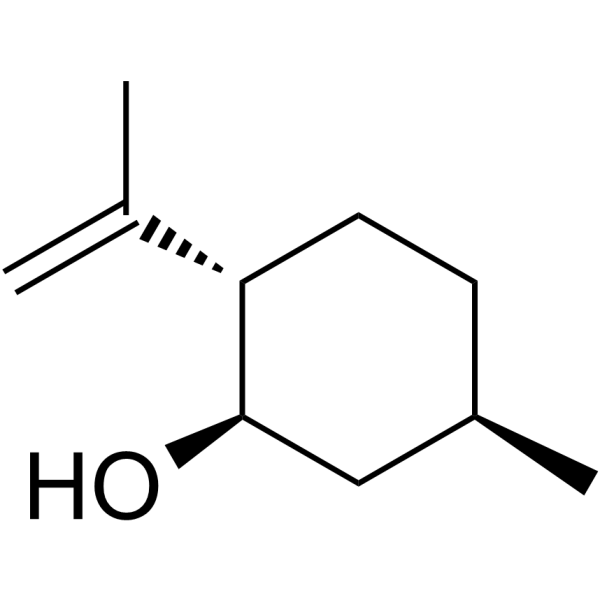 CAS#:89-79-2
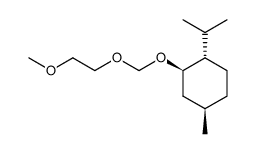 CAS#:87770-96-5
![2,5-bis[(1S,2R,5S)-2-isopropyl-5-methylcyclohexyloxycarbonyl]terephthalic acid Structure](https://image.chemsrc.com/caspic/186/1036899-59-8.png) CAS#:1036899-59-8
CAS#:1036899-59-8![(1S,3S,4R)-p-menth-3-yl (S)-6,7-dichloro-2,3-dibenzo[b]furan-2-carboxylate Structure](https://image.chemsrc.com/caspic/306/118166-32-8.png) CAS#:118166-32-8
CAS#:118166-32-8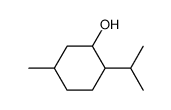 CAS#:15356-70-4
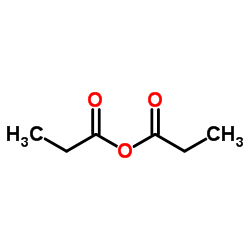 CAS#:123-62-6
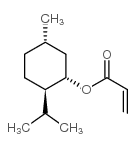 CAS#:108945-28-4
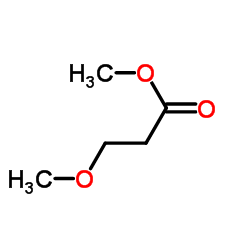 CAS#:3852-09-3
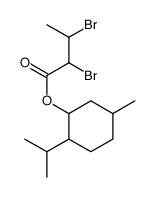 CAS#:109977-83-5
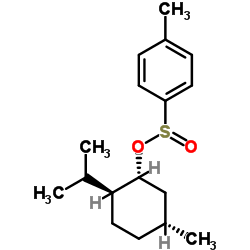 CAS#:91796-57-5
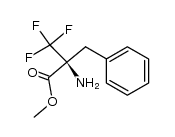 CAS#:184636-50-8
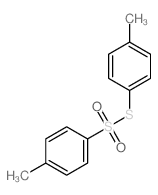 CAS#:2943-42-2
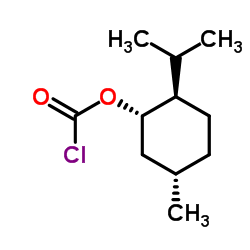 CAS#:7635-54-3
 CAS#:103128-76-3
 CAS#:16052-40-7
 CAS#:16052-42-9
| HS Code | 2906199090 |
|---|---|
| Summary | 2906199090. cyclanic, cyclenic or cyclotherpenic alcohols. VAT:17.0%. Tax rebate rate:13.0%. . MFN tariff:5.5%. General tariff:30.0% |
|
Activation of human 5-hydroxytryptamine type 3 receptors via an allosteric transmembrane site.
Mol. Pharmacol. 87(1) , 87-95, (2015) In common with other members of the Cys-loop family of pentameric ligand-gated ion channels, 5-hydroxytryptamine type 3 receptors (5-HT3Rs) are activated by the binding of a neurotransmitter to an ext... |
|
|
Corneal sensory nerve activity in an experimental model of UV keratitis.
Invest. Ophthalmol. Vis. Sci. 55(6) , 3403-12, (2014) To produce in guinea pigs a UV-induced keratitis, to analyze the effects of this pathology on corneal nerve activity.In anesthetized animals, one eye was exposed to 254 nm UV-C radiation (500-1000 mJ/... |
|
|
Effects of menthol on tobacco smoke exposure, nicotine dependence, and NNAL glucuronidation.
Cancer Epidemiol. Biomarkers Prev. 18(1) , 35-41, (2009) Menthol is a controversial cigarette additive because its physiologic or pharmacologic effects may possibly increase the risk for cancer and its targeted market is the Black community. In a community-... |
| 1S,3S,4R-(+)-menthol |
| (1S,2R,5S)-5-methyl-2-(1-methylethyl)cyclohexanol |
| Menthol, (1S,3S,4R)-(+)- |
| Cyclohexanol, 5-methyl-2-(1-methylethyl)-, (1S,2R,5S)- |
| Cyclohexanol, 5-methyl-2- (1-methylethyl)-, (1α,2β,5α)- |
| Cyclohexanol, 5-methyl-2-(1-methylethyl)-, (1α,2β,5α)- |
| MFCD00062983 |
| (1S,2R,5S)-2-Isopropyl-5-methylcyclohexanol |
| Menthol |
| (+)-Menthol |
| (+)-p-Menthan-3-ol |
| EINECS 239-387-8 |
The content on this webpage is sourced from various professional data sources. If you have any questions or concerns regarding the content, please feel free to contact service1@chemsrc.com.
- Shanghai Nianxing Industrial Co., Ltd
- China
- Product Name: D-Menthol
- Price: Check
- Purity: 99.0%
- Delivery: 10 Day
- Contact: Yang
- Email: sales@echemcloud.com
- Shanghai Jizhi Biochemical Technology Co., Ltd
- China
- Product Name: D-Menthol
- Price: ¥338.0/25g ¥108.0/5g
- Purity: 99.0%
- Delivery: 1 Day
- Contact: Liu jia


- Email: 2130147988@qq.com
- Dayang Chem (Hangzhou) Co., Ltd.
- China
- Product Name: (+)-Menthol
- Price: $Inquiry/100g $Inquiry/1kg $Inquiry/100kg $Inquiry/1000kg
- Purity: 98.0%
- Delivery: Inquiry
- Contact: Ms Wang
- Email: enquiry@dycnchem.com
Get all suppliers and price by the below link: