PGLa
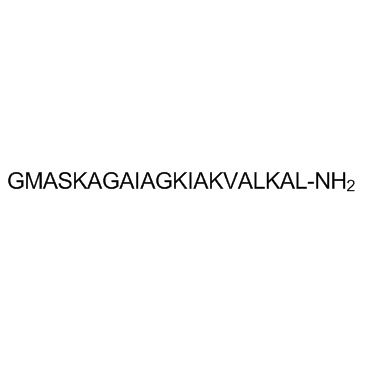
PGLa structure
|
Common Name | PGLa | ||
|---|---|---|---|---|
| CAS Number | 102068-15-5 | Molecular Weight | 1968.45000 | |
| Density | N/A | Boiling Point | N/A | |
| Molecular Formula | C88H162N26O22S | Melting Point | N/A | |
| MSDS | USA | Flash Point | N/A | |
Use of PGLaPGLa is an antimicrobial peptide. PGLa is known to be bacteriostatic against both Gram-positive and Gram-negative bacteria. |
| Name | gly-met-ala-ser-lys-ala-gly-ala-ile-ala-gly-lys-ile-ala-lys-val-ala-leu-lys-ala-leu-nh2 |
|---|---|
| Synonym | More Synonyms |
| Description | PGLa is an antimicrobial peptide. PGLa is known to be bacteriostatic against both Gram-positive and Gram-negative bacteria. |
|---|---|
| Related Catalog | |
| Target |
Anti-bacteria[1] |
| In Vitro | PGLa is known to be bacteriostatic against both Gram-positive and Gram-negative bacteria (Escherichia coli, Pseudomonas aeruginosa, Streptococcus pyogenes, and Staphylococcus aureus), without much selectivity between the two types of bacterial cells. PGLa is synthesized as a native (the wild type) peptide and as a mutant with a norleucine instead of methionine at position 2Met (designated PGLa(Nle)). |
| References |
| Molecular Formula | C88H162N26O22S |
|---|---|
| Molecular Weight | 1968.45000 |
| Exact Mass | 1967.21000 |
| PSA | 800.72000 |
| LogP | 4.65010 |
| InChIKey | PJRSUKFWFKUDTH-UHFFFAOYSA-N |
| SMILES | CCC(C)C(NC(=O)C(C)NC(=O)CNC(=O)C(C)NC(=O)C(CCCCN)NC(=O)C(CO)NC(=O)C(C)NC(=O)C(CCSC)NC(=O)CN)C(=O)NC(C)C(=O)NCC(=O)NC(CCCCN)C(=O)NC(C(=O)NC(C)C(=O)NC(CCCCN)C(=O)NC(C(=O)NC(C)C(=O)NC(CC(C)C)C(=O)NC(CCCCN)C(=O)NC(C)C(=O)NC(CC(C)C)C(N)=O)C(C)C)C(C)CC |
| Personal Protective Equipment | Eyeshields;Gloves;type N95 (US);type P1 (EN143) respirator filter |
|---|---|
| RIDADR | NONH for all modes of transport |
|
Synergistic transmembrane insertion of the heterodimeric PGLa/magainin 2 complex studied by solid-state NMR.
Biochim. Biophys. Acta 1788 , 1667-1679, (2009) The skin secretions of amphibians are a rich source of antimicrobial peptides. The two antimicrobial peptides PGLa and magainin 2, isolated from the African frog Xenopus laevis, have been shown to act... |
|
|
Synergistic insertion of antimicrobial magainin-family peptides in membranes depends on the lipid spontaneous curvature.
Biophys. J. 104(6) , L9-11, (2013) PGLa and magainin 2 (MAG2) are amphiphilic antimicrobial peptides from frog skin with known synergistic activity. The orientation of the two helices in membranes was studied using solid-state (15)N-NM... |
|
|
Rapid-prototyped and salt-leached PLGA scaffolds condition cell morpho-functional behavior.
J. Biomed. Mater. Res. A 85(2) , 466-76, (2008) Three dimensional scaffolds microfabricated using pressure-assisted microsyringe (PAM) with controlled geometry and porous membranes obtained using salt leaching were both tested with three different ... |
| PGLa |