211513-37-0
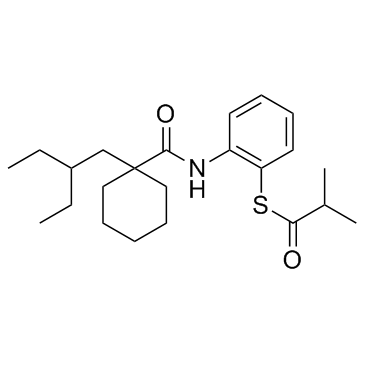
211513-37-0 structure
- Name: Dalcetrapib
- Chemical Name: Dalcetrapib
- CAS Number: 211513-37-0
- Molecular Formula: C23H35NO2S
- Molecular Weight: 389.59500
- Catalog: Biochemical Inhibitor Metabolism CETP inhibitor
- Create Date: 2018-08-03 18:25:20
- Modify Date: 2026-07-01 17:55:28
-
Dalcetrapib (JTT-705; RO-4607381) is a rhCETP inhibitor with IC50 of 0.2 μM that increases the plasma HDL cholesterol. IC50 value: 0.2 uM [1]Target: CETPin vitro: Dalcetrapib modulates CETP activity. Dalcetrapib induces a conformational change in CETP, when added to human plasma. CETP-induced pre-β-HDL formation in human plasma is unchanged by Dalcetrapib ≤3 μM and increased at 10 μM. Dalcetrapib statistically and significantly increases pre-β-HDL formation [1]. Dalcetrapib achieves 50% inhibition of CETP activity in human plasma at a concentration of 9 μM [2]. Dalcetrapib inhibits the CETP activity of media in HepG2 in a dose-dependent manner [3].in vivo: Treatment with Dalcetrapib leads to significant increases in HDL-C levels. In hamsters injected with [3H]cholesterol-labeled autologous macrophages Dalcetrapib significantly increases fecal elimination of both [3H]neutral sterols and [3H]bile acids. Dalcetrapib increases plasma HDL-[3H]cholesterol [1]. Dalcetrapib has 95% inhibition of CETP activity in male Japanese white rabbits at an oral dose of 30 mg/kg. Dalcetrapib increases the plasma HDL cholesterol level by 27% and 54%, respectively, when given at oral doses of 30 mg/kg or 100 mg/kg once a day for 3 days to male Japanese white rabbits [2].
| Name | Dalcetrapib |
|---|---|
| Synonyms |
JTT-705
Unii-3D050liq3h S-[2-({[1-(2-Ethylbutyl)cyclohexyl]carbonyl}amino)phenyl] 2-methylpropanethioate Dalcetrapib Propanethioic acid, 2-methyl-, S-[2-[[[1-(2-ethylbutyl)cyclohexyl]carbonyl]amino]phenyl] ester |
| Description | Dalcetrapib (JTT-705; RO-4607381) is a rhCETP inhibitor with IC50 of 0.2 μM that increases the plasma HDL cholesterol. IC50 value: 0.2 uM [1]Target: CETPin vitro: Dalcetrapib modulates CETP activity. Dalcetrapib induces a conformational change in CETP, when added to human plasma. CETP-induced pre-β-HDL formation in human plasma is unchanged by Dalcetrapib ≤3 μM and increased at 10 μM. Dalcetrapib statistically and significantly increases pre-β-HDL formation [1]. Dalcetrapib achieves 50% inhibition of CETP activity in human plasma at a concentration of 9 μM [2]. Dalcetrapib inhibits the CETP activity of media in HepG2 in a dose-dependent manner [3].in vivo: Treatment with Dalcetrapib leads to significant increases in HDL-C levels. In hamsters injected with [3H]cholesterol-labeled autologous macrophages Dalcetrapib significantly increases fecal elimination of both [3H]neutral sterols and [3H]bile acids. Dalcetrapib increases plasma HDL-[3H]cholesterol [1]. Dalcetrapib has 95% inhibition of CETP activity in male Japanese white rabbits at an oral dose of 30 mg/kg. Dalcetrapib increases the plasma HDL cholesterol level by 27% and 54%, respectively, when given at oral doses of 30 mg/kg or 100 mg/kg once a day for 3 days to male Japanese white rabbits [2]. |
|---|---|
| Related Catalog | |
| References |
| Density | 1.066 g/cm3 |
|---|---|
| Boiling Point | 528.912ºC at 760 mmHg |
| Molecular Formula | C23H35NO2S |
| Molecular Weight | 389.59500 |
| Flash Point | 273.676ºC |
| Exact Mass | 389.23900 |
| PSA | 71.47000 |
| LogP | 6.74960 |
| Hazard Codes | Xi |
|---|