271780-64-4
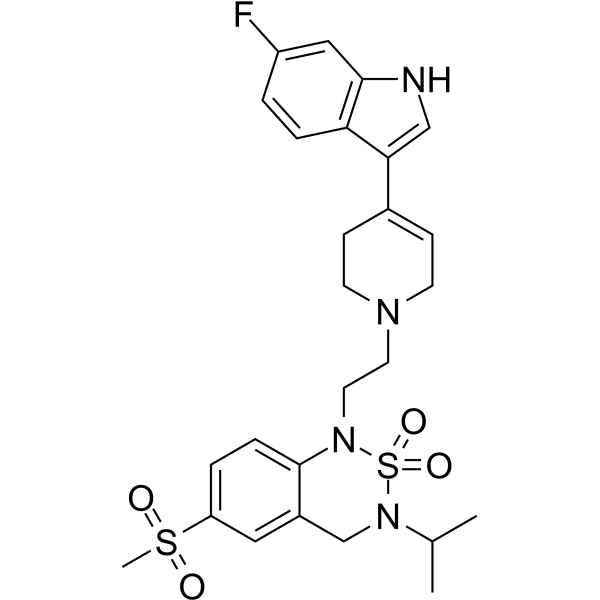
271780-64-4 structure
- Name: LY 393558
- Chemical Name: 1-[2-[4-(6-fluoro-1H-indol-3-yl)-3,6-dihydro-2H-pyridin-1-yl]ethyl]-6-methylsulfonyl-3-propan-2-yl-4H-2λ6,1,3-benzothiadiazine 2,2-dioxide
- CAS Number: 271780-64-4
- Molecular Formula: C26H31FN4O4S2
- Molecular Weight: 546.67700
- Catalog: Signaling Pathways GPCR/G Protein 5-HT Receptor
- Create Date: 2018-12-25 10:25:35
- Modify Date: 2026-07-18 11:02:06
-
LY393558 is a potent and orally active inhibitor of the 5-HT transporter and an antagonist of 5-HT1B and 5-HT1D receptors. LY393558 increase the extracellular levels of 5-HT in mice model frontal cortex. LY393558 can be used for researching depression[1].
| Name | 1-[2-[4-(6-fluoro-1H-indol-3-yl)-3,6-dihydro-2H-pyridin-1-yl]ethyl]-6-methylsulfonyl-3-propan-2-yl-4H-2λ6,1,3-benzothiadiazine 2,2-dioxide |
|---|---|
| Synonyms |
1-[2-[4-(6-Fluoro-1H-indol-3-yl)-3,6-dihydro-1(2H)-pyridinyl]ethyl]-3,4-dihydro-3-(1-methylethyl)-6-(methylsulfonyl)-1H-2,1,3-benzothiadiazine-2,2-dioxide
1H-2,1,3-BENZOTHIADIAZINE, 1-[2-[4-(6-FLUORO-1H-INDOL-3-YL)-3,6-DIHYDRO-1(2H)-PYRIDINYL]ETHYL]-3,4-DIHYDRO-3-(1-METHYLETHYL)-6-(METHYLSULFONYL)-, 2,2-DIOXIDE 1-{2-[4-(6-Fluoro-1H-Indol-3-Yl)-3,6-Dihydro-1(2H)-Pyridinyl]Ethyl}-3-Isopropyl-6-(Methylsulfonyl)-3,4-Dihydro-1H-2,1,3-Benzothiadia zine 2,2-Dioxide LY-393558 |
| Description | LY393558 is a potent and orally active inhibitor of the 5-HT transporter and an antagonist of 5-HT1B and 5-HT1D receptors. LY393558 increase the extracellular levels of 5-HT in mice model frontal cortex. LY393558 can be used for researching depression[1]. |
|---|---|
| Related Catalog | |
| In Vivo | LY393558 (1-20 mg/kg; p.o., single) raises extracellular levels of 5-HT to 200-250% at 1 mg/kg in guinea pigs model, while levels of 5-HT to approximately 1500% at the highest dose 20 mg/kg[1]. LY393558 (20 mg/kg; p.o., single) completely abolishes the reduction of levels of 5-HT induced by tetrodotoxin (1μM) in guinea pigs model[1]. LY393558 (1-20 mg/kg; p.o., single) significantly increases extracellular levels of 5-HT in rats model[1]. LY393558 (5 mg/kg/day; p.o., 21 days) can still elicit a further increase in extracellular 5-HT in chronic treatment[1]. Animal Model: Female Dunkin Hartley guinea pigs (350-400 g)[1] Dosage: 1-20 mg/kg Administration: p.o., single Result: Extracellular levels of 5-HT reached 200-250% at 1 mg/kg, while levels of 5-HT reached approximately 1500% at the highest dose 20 mg/kg. Animal Model: Female Dunkin Hartley guinea pigs (350-400 g)[1] Dosage: 20 mg/kg Administration: p.o., single Result: Completely abolished the reduction of levels of 5-HT induced by tetrodotoxin (1μM). Animal Model: Male Lister Hooded rats (290-320 g)[1] Dosage: 1-20 mg/kg Administration: p.o., single Result: Significantly increased extracellular levels of 5-HT. Animal Model: Male Lister Hooded rats (290-320 g)[1] Dosage: 5 mg/kg/day Administration: p.o., 21 days Result: Still elicited a further increase in extracellular 5-HT in chronic treatment. |
| References |
| Molecular Formula | C26H31FN4O4S2 |
|---|---|
| Molecular Weight | 546.67700 |
| Exact Mass | 546.17700 |
| PSA | 110.55000 |
| LogP | 5.87740 |