2351898-91-2
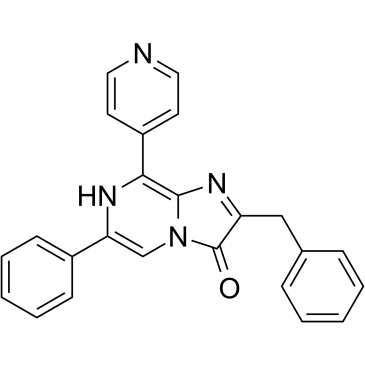
2351898-91-2 structure
- Name: 8pyDTZ
- Chemical Name: 8pyDTZ
- CAS Number: 2351898-91-2
- Molecular Formula: C24H18N4O
- Molecular Weight: 378.43
- Catalog: Research Areas Others
- Create Date: 2020-04-23 08:57:21
- Modify Date: 2026-07-01 13:10:53
-
8pyDTZ is a pyridyl diphenylterazine (DTZ) analog and an ATP-independent pyridyl substrate of LumiLuc luciferase. 8pyDTZ exhibits spectrally shifted emission and improved water solubility. 8pyDTZ has excellent biocompatibility and superior in vivo sensitivity. 8pyDTZ can be used for in vivo luminescence imaging[1].
| Name | 8pyDTZ |
|---|
| Description | 8pyDTZ is a pyridyl diphenylterazine (DTZ) analog and an ATP-independent pyridyl substrate of LumiLuc luciferase. 8pyDTZ exhibits spectrally shifted emission and improved water solubility. 8pyDTZ has excellent biocompatibility and superior in vivo sensitivity. 8pyDTZ can be used for in vivo luminescence imaging[1]. |
|---|---|
| Related Catalog | |
| In Vitro | 8pyDTZ (1711 μM) enhances the water solubility by 13-fold from DTZ (131 μM). Compared to DTZ, 8pyDTZ (compounds 3c) is able to emit red-shifted chemiluminescence or bioluminescence. 8pyDTZ shows the most red-shifted emission and red-shifted photons can penetrate through tissue better[1]. LumiLuc-8pyDTZ in human embryonic kidney (HEK) 293T cells transiently expressing the luciferase is evaluated. The LumiLuc-8pyDTZ pair produces ∼3-5-fold more bioluminescence than teLuc-8pyDTZ. To compare far-red emission intensities of bioluminescent reporters, HEK 293T cells in the presence of a 600-700 nm band pass filter are imaged. At substrate concentrations from 6.25 to 100 μM, LumiLuc-8pyDTZ consistently produces 1.6-3.9-fold higher photon flux than teLuc-DTZ. No ATP perturbation is observed from 8pyDTZ-treated, LumiLucexpressing cells[1]. |
| In Vivo | LumiLuc-8pyDTZ pair is compared with several benchmark reporters in a tumor xenograft mouse model. LumiLuc-8pyDTZ shows high sensitivity and does not need organic cosolvents for in vivo administration. LumiScarlet-8pyDTZ is comparable to Akaluc-AkaLumine, the brightest ATP-dependent luciferase-luciferin pair, for detecting cells in deep tissues of mice[1]. |
| References |
| Molecular Formula | C24H18N4O |
|---|---|
| Molecular Weight | 378.43 |