MG-132
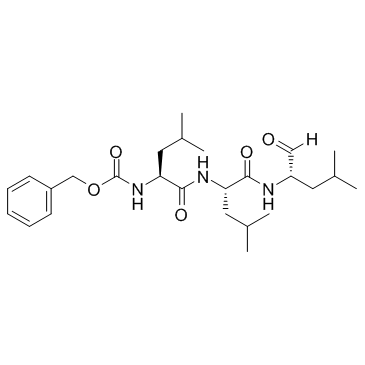
MG-132 structure
|
Common Name | MG-132 | ||
|---|---|---|---|---|
| CAS Number | 133407-82-6 | Molecular Weight | 475.621 | |
| Density | 1.1±0.1 g/cm3 | Boiling Point | 682.0±55.0 °C at 760 mmHg | |
| Molecular Formula | C26H41N3O5 | Melting Point | 80-84℃ (DEC.) | |
| MSDS | USA | Flash Point | 366.3±31.5 °C | |
Use of MG-132MG-132 is a potent, reversible, and cell-permeable 20S proteasome inhibitor which inhibits proteasomal chymotrypsin-like peptidase activity with an IC50 of 24.2 nM. |
This table lists Chinese names, IUPAC names and various aliases of this chemical substance.
| Name | N-benzyloxycarbonyl-L-leucyl-L-leucyl-L-leucinal |
|---|---|
| Synonym | More Synonyms |
This table contains bioactivity, target information and biological‑assay experimental data of this compound.
| Description | MG-132 is a potent, reversible, and cell-permeable 20S proteasome inhibitor which inhibits proteasomal chymotrypsin-like peptidase activity with an IC50 of 24.2 nM. |
|---|---|
| Related Catalog | |
| Target |
IC50: 24.2 nM (chymotrypsin-like activity)[1] |
| In Vitro | Dose-dependent inhibition of cell growth is observed in HeLa cells with an IC50 of approximately 5 μM MG132 for 24 h. MG132 inhibits the growth of HeLa cells via inducing the cell cycle arrest as well as triggering apoptosis[2]. MG-132 inhibits C6 glioma cell proliferation in a time- and dose-dependent manner (the IC50 value at 24 h is 18.5 μM). MG-132 (18.5 μM) suppresses the proteasome activity by about 70% at 3 h. MG-132 induces apoptosis via down-regulation of antiapoptotic proteins Bcl-2 and XIAP, up-regulation of pro-apoptotic protein Bax and caspase-3, and production of cleaved C-terminal 85 kDa PARP. MG-132 also causes a more than 5-fold increase of reactive oxygen species[3]. The IC50 of MG-132 against HeLa, CaSki, and C33A cervical cancer cells viability after 48 h of incubation is 2.1, 3.2, and 5.2 μM, respectively[4]. |
| In Vivo | The in vivo antitumor activity of MG-132 against cervical cancer is examined using s.c. xenograft models. MG-132 is injected at 1 mg/kg using the following schedule: days 1, 4, 8, 12, 15 18, 23, and 26 for mice bearing HeLa tumors. The growth inhibition rates of MG132 compared to control is 49%[4]. MG-132 (i.p., 0.1 mg/kg/day) attenuates pressure-overload-induced cardiac hypertrophy and improves cardiac function in abdominal aortic banding (AAB) rats through regulation of ERK1/2 and JNK1 signaling pathways[5]. |
| Kinase Assay | After growing on six-well plates (3×10⁵ cells/well) for 24 h, C6 glioma cells are treated with either PBS (control) or 18.5 μM MG-132 for 3, 6, 12, or 24 h at 37°C. Cells are thoroughly scraped from the culture dishes with a cell scraper and washed with cold PBS. After centrifugation for 10 min at 800×g, the cell pellets are suspended in ice-cold buffer (50 mM Tris-HCl, pH 7.5, 20 μM ATP, 5 mM MgCl2, 1 mM dithiothreitol, and 20% glycerol) and homogenized with a Pyrex glass microhomogenizer (20 strokes). The homogenate is centrifuged at 15 000×g for 10 min at 4°C to obtain supernatant. Protein concentration is determined using protein assay kits. A total of 10 μL (1 μg/μL) of each freshly made supernatant is incubated in a 96-well plate at 37°C for 30 min with 10 μL of 300 μM of Succinyl-LLVY-AMC and 85 μL of assay buffer (20 mM Tris-HCl, pH 7.5, and 20% glycerol). Release of fluorescent AMC is measured with a spectrofluorometer at 440 nm with an excitation wavelength of 380 nm[3]. |
| Cell Assay | C6 glioma cells are seeded onto 96-well microplates (3×10⁴ cells/well) and cultured for 24 h. The cells are treated with PBS or MG-132 final concentrations of 10, 20, 30, and 40 μM, respectively. Cell viability is assessed using an MTT assay at 3, 6, 12, and 24 h after MG-132 treatment. The absorbance value at 570 nm is read using an automatic multi-well spectrophotometer. C6 glioma cells (3×10⁵ cells/well) are allowed to grow on coverslips in 6-well culture plates for 24 h. The cells are then treated with either PBS (control) or 18.5 μM MG-132 at 37°C for 24 h. Cells growing on glass coverslips are fixed in methanol for 5 min at room temperature. The fixed cells are washed twice with PBS and then incubated with Hoechst 33342 for 5 min at room temperature and observed under a fluorescence microscope. Fragmented or condensed nuclei are scored as apoptotic[3]. |
| Animal Admin | Mice[4] C.B-17/lcr-scid/scidJcl mice are inoculated s.c. with HeLa, CaSki, or C33A (1×10⁷ cells). Tumors are allowed to grow for 1 week. Mice are killed and tumors are removed. Tumors are then cut into 2-mm diameter pieces and s.c. transplanted in C.B-17/lcr-scid/scidJcl mice (n=6 per group). One week after inoculation, mice are treated with i.v. injection of saline (control), MG-132 (1 mg/kg/dose) twice a week for 4 weeks. The volume (V) of tumors is measured before every injection, as estimated using equation V=a×b2/2 where a and b are major and minor axes of the tumor measured by a caliper, respectively. Rats[5] Male Sprague-Dawley rats (8 weeks old, 180-230 g) are used to establish pressure-overload model. All animals are separated into four groups (10 rats per group): (i) vehicle-treated sham group; (ii) MG-132-treated sham group; (iii) vehicle-treated abdominal aortic banding (AAB) group; and (iv) MG-132-treated AAB group. Under intraperitoneal pentobarbital (50 mg/kg) anesthesia, AAB is created using a 5-0 suture tied twice around the abdominal aorta in which a 21-gauge needle is inserted. The needle is then retracted yielding a 70-80% constriction with an outer aortic diameter of ~0.8 mm. In the sham surgery rats, the same surgery is performed except the aorta is constricted. At Day 3 after the surgery, MG-132-treated rats are intraperitoneally injected with 0.1 mg/kg/day of MG-132 for 8 weeks. All control animals are injected with a corresponding volume of vehicle only (0.1% DMSO). |
| References |
This table shows physicochemical parameters including melting point, boiling point, density, solubility and optical rotation. Missing data is marked as N/A.
| Density | 1.1±0.1 g/cm3 |
|---|---|
| Boiling Point | 682.0±55.0 °C at 760 mmHg |
| Melting Point | 80-84℃ (DEC.) |
| Molecular Formula | C26H41N3O5 |
| Molecular Weight | 475.621 |
| Flash Point | 366.3±31.5 °C |
| Exact Mass | 475.304626 |
| PSA | 113.60000 |
| LogP | 5.75 |
| Vapour Pressure | 0.0±2.1 mmHg at 25°C |
| Index of Refraction | 1.506 |
| InChIKey | TZYWCYJVHRLUCT-VABKMULXSA-N |
| SMILES | CC(C)CC(C=O)NC(=O)C(CC(C)C)NC(=O)C(CC(C)C)NC(=O)OCc1ccccc1 |
| Storage condition | −20°C |
| Water Solubility | methanol: 1 mg/mL | Soluble in ethanol, chloroform, methanol, water. |
This table provides MSDS information including hazard classification, first‑aid, fire‑fighting, spill handling, operation and storage instructions.
This table covers safety warnings, protective measures, incompatible substances and disposal guidelines for this compound.
| Personal Protective Equipment | Eyeshields;Gloves;type N95 (US);type P1 (EN143) respirator filter |
|---|---|
| Hazard Codes | Xi |
| Risk Phrases | 36/37/38 |
| Safety Phrases | 24/25 |
| RIDADR | NONH for all modes of transport |
| WGK Germany | 3 |
This table lists relevant public references with title, journal and publication metadata for this compound.
|
miR-1236 down-regulates alpha-fetoprotein, thus causing PTEN accumulation, which inhibits the PI3K/Akt pathway and malignant phenotype in hepatoma cells.
Oncotarget 6(8) , 6014-28, (2015) Alpha fetoprotein (AFP) is a clinical biomarker of hepatocellular carcinoma (HCC). Here, we found that miR-1236 is down-regulated, whereas AFP is highly expressed in HCC tissues and cells. We demonstr... |
|
|
Dominant negative effect of polyglutamine expansion perturbs normal function of ataxin-3 in neuronal cells.
Hum. Mol. Genet. 24(1) , 100-17, (2014) The physiological function of Ataxin-3 (ATXN3), a deubiquitylase (DUB) involved in Machado-Joseph Disease (MJD), remains elusive. In this study, we demonstrate that ATXN3 is required for neuronal diff... |
|
|
Hypoxia reduces MAX expression in endothelial cells by unproductive splicing.
FEBS Lett. 588(24) , 4784-90, (2014) The MYC-MAX-MXD network is involved in the regulation of cell differentiation and proliferation. Hypoxia affects the expression levels of several members of this network, but changes specific to MAX e... |
This table collects all English aliases, systematic names and CAS‑related synonyms of the compound.
| benzyloxycarbonyl-Leu-Leu-Leu-aldehyde |
| Z-LLL-CHO |
| benzyl N-[(2S)-4-methyl-1-[[(2S)-4-methyl-1-[[(2S)-4-methyl-1-oxopentan-2-yl]amino]-1-oxopentan-2-yl]amino]-1-oxopentan-2-yl]carbamate |
| MG132 |
| zLLL |
| Z-Leu-Leu-Leu-CHO |
| Cbz-Leu-Leu-Leu-H |
| N-[(Benzyloxy)carbonyl]-L-leucyl-N-[(2S)-4-methyl-1-oxopentan-2-yl]-L-leucinamide |
| Z-Leu-Leu-Leu-H |
| benzyloxycarbonylleucyl-leucyl-leucine aldehyde |
| benzyloxycarbonyl-leucyl-leucyl-leucinal |
| Z-Leu-Leu-leucinal |
| N-benzyloxycarbonyl-L-leucyl-L-leucyl-L-leucinal |
| MFCD00674886 |
| Carbobenzoxy-L-leucyl-L-leucyl-L-leucinal |
| Cbz-Leu-Leu-Leu-CHO |
| N-[(Benzyloxy)carbonyl]-L-leucyl-N-[(2S)-4-methyl-1-oxo-2-pentanyl]-L-leucinamide |
| MG-132 |
This section contains frequently‑asked‑questions about this compound, including basic parameters, properties, storage conditions and corresponding answers.
| Q: What is the CAS number of N-benzyloxycarbonyl-L-leucyl-L-leucyl-L-leucinal? |
| A: CAS number of N-benzyloxycarbonyl-L-leucyl-L-leucyl-L-leucinal is 133407-82-6. |
| Q: What is the molecular formula of N-benzyloxycarbonyl-L-leucyl-L-leucyl-L-leucinal? |
| A: Molecular formula of N-benzyloxycarbonyl-L-leucyl-L-leucyl-L-leucinal is C26H41N3O5. |
| Q: What is the InChIKey of N-benzyloxycarbonyl-L-leucyl-L-leucyl-L-leucinal? |
| A: InChIKey of N-benzyloxycarbonyl-L-leucyl-L-leucyl-L-leucinal is TZYWCYJVHRLUCT-VABKMULXSA-N. |
| Q: What is the molecular weight of N-benzyloxycarbonyl-L-leucyl-L-leucyl-L-leucinal? |
| A: Molecular weight of N-benzyloxycarbonyl-L-leucyl-L-leucyl-L-leucinal is 475.621. |
| Q: What are the storage conditions for N-benzyloxycarbonyl-L-leucyl-L-leucyl-L-leucinal? |
| A: Storage conditions for N-benzyloxycarbonyl-L-leucyl-L-leucyl-L-leucinal: −20°C. |
| Q: What is the SMILES notation of N-benzyloxycarbonyl-L-leucyl-L-leucyl-L-leucinal? |
| A: SMILES notation of N-benzyloxycarbonyl-L-leucyl-L-leucyl-L-leucinal is CC(C)CC(C=O)NC(=O)C(CC(C)C)NC(=O)C(CC(C)C)NC(=O)OCc1ccccc1. |
| Q: What is the English name of N-benzyloxycarbonyl-L-leucyl-L-leucyl-L-leucinal? |
| A: The English name of N-benzyloxycarbonyl-L-leucyl-L-leucyl-L-leucinal is N-benzyloxycarbonyl-L-leucyl-L-leucyl-L-leucinal. |
| Q: What is the polar surface area (PSA) of N-benzyloxycarbonyl-L-leucyl-L-leucyl-L-leucinal? |
| A: Polar surface area (PSA) of N-benzyloxycarbonyl-L-leucyl-L-leucyl-L-leucinal is 113.60000. |
| Q: How is the water solubility of N-benzyloxycarbonyl-L-leucyl-L-leucyl-L-leucinal? |
| A: Water solubility of N-benzyloxycarbonyl-L-leucyl-L-leucyl-L-leucinal: methanol: 1 mg/mL | Soluble in ethanol, chloroform, methanol, water. |
| Q: What is the boiling point of N-benzyloxycarbonyl-L-leucyl-L-leucyl-L-leucinal? |
| A: Boiling point of N-benzyloxycarbonyl-L-leucyl-L-leucyl-L-leucinal is 682.0±55.0 °C at 760 mmHg. |
This table lists manufacturers and suppliers of this compound, including vendor names and product supply reference information.
| Shanghai Nianxing Industrial Co., Ltd |
| Dayang Chem (Hangzhou) Co., Ltd. |