Carbidopa
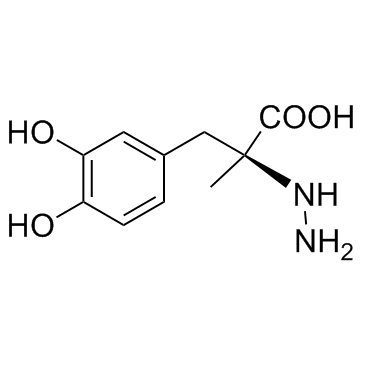
Carbidopa structure
|
Common Name | Carbidopa | ||
|---|---|---|---|---|
| CAS Number | 28860-95-9 | Molecular Weight | 226.23 | |
| Density | 1.4±0.1 g/cm3 | Boiling Point | 528.7±50.0 °C at 760 mmHg | |
| Molecular Formula | C10H14N2O4 | Melting Point | 206 - 208ºC | |
| MSDS | Chinese USA | Flash Point | 273.5±30.1 °C | |
Use of CarbidopaCarbidopa is an inhibitor of DOPA decarboxylase, which is used in parkinson disease.Target: DOPA decarboxylaseCarbidopa (CD), a competitive inhibitor of aromatic l-amino acid decarboxylase that does not cross the blood-brain barrier, is routinely administered with levodopa (LD) to patients with Parkinson disease (PD) to reduce the peripheral decarboxylation of LD to dopamine [1]. CD premedication improves 11C-5-HTP PET image quality and facilitates detection of NET lesions. Because of the similarity of metabolic pathways, this method could probably be applied to improve PET imaging using other tracers like 18F-DOPA and 11C-DOPA [2]. Carbidopa (100 microM) decreased growth of (but did not kill) SK-N-SH neuroblastoma and A204 rhabdomyosarcoma cells and did not affect proliferation of DU 145 prostate, MCF7 breast, or NCI-H460 large cell lung carcinoma lines. sublethal doses of carbidopa produced additive cytotoxic effects in carcinoid cells in combination with etoposide and cytotoxic synergy in SCLC cells when coincubated with topotecan [3]. |
Summary: Carbidopa (anhydrous, CAS号:28860-95-9) is a white crystalline powder with molecular formula C10H14N2O4 and molecular weight 226.23. For research-use only, not for medical or clinical usage.
This table lists Chinese names, IUPAC names and various aliases of this chemical substance.
| Name | carbidopa (anhydrous) |
|---|---|
| Synonym | More Synonyms |
This table contains bioactivity, target information and biological‑assay experimental data of this compound.
| Description | Carbidopa is an inhibitor of DOPA decarboxylase, which is used in parkinson disease.Target: DOPA decarboxylaseCarbidopa (CD), a competitive inhibitor of aromatic l-amino acid decarboxylase that does not cross the blood-brain barrier, is routinely administered with levodopa (LD) to patients with Parkinson disease (PD) to reduce the peripheral decarboxylation of LD to dopamine [1]. CD premedication improves 11C-5-HTP PET image quality and facilitates detection of NET lesions. Because of the similarity of metabolic pathways, this method could probably be applied to improve PET imaging using other tracers like 18F-DOPA and 11C-DOPA [2]. Carbidopa (100 microM) decreased growth of (but did not kill) SK-N-SH neuroblastoma and A204 rhabdomyosarcoma cells and did not affect proliferation of DU 145 prostate, MCF7 breast, or NCI-H460 large cell lung carcinoma lines. sublethal doses of carbidopa produced additive cytotoxic effects in carcinoid cells in combination with etoposide and cytotoxic synergy in SCLC cells when coincubated with topotecan [3]. |
|---|---|
| Related Catalog | |
| References |
This table shows physicochemical parameters including melting point, boiling point, density, solubility and optical rotation. Missing data is marked as N/A.
| Density | 1.4±0.1 g/cm3 |
|---|---|
| Boiling Point | 528.7±50.0 °C at 760 mmHg |
| Melting Point | 206 - 208ºC |
| Molecular Formula | C10H14N2O4 |
| Molecular Weight | 226.23 |
| Flash Point | 273.5±30.1 °C |
| PSA | 115.81000 |
| LogP | -0.19 |
| Vapour Pressure | 0.0±1.5 mmHg at 25°C |
| Index of Refraction | 1.641 |
| InChIKey | TZFNLOMSOLWIDK-JTQLQIEISA-N |
| SMILES | CC(Cc1ccc(O)c(O)c1)(NN)C(=O)O |
This table provides MSDS information including hazard classification, first‑aid, fire‑fighting, spill handling, operation and storage instructions.
This table summarizes toxicological test data, acute & chronic toxicity and ecological hazard parameters for this chemical.
CHEMICAL IDENTIFICATION
HEALTH HAZARD DATAACUTE TOXICITY DATA
MUTATION DATA
|
This table covers safety warnings, protective measures, incompatible substances and disposal guidelines for this compound.
| Personal Protective Equipment | Eyeshields;Gloves;type N95 (US);type P1 (EN143) respirator filter |
|---|---|
| Hazard Codes | Xi |
| RIDADR | NONH for all modes of transport |
| WGK Germany | 3 |
| RTECS | MW5298000 |
| HS Code | 2932999099 |
This table shows customs‑related data including HS‑code, tariff and regulatory conditions for import and export.
| HS Code | 2932999099 |
|---|---|
| Summary | 2932999099. other heterocyclic compounds with oxygen hetero-atom(s) only. VAT:17.0%. Tax rebate rate:13.0%. . MFN tariff:6.5%. General tariff:20.0% |
This table lists relevant public references with title, journal and publication metadata for this compound.
|
A misguided 'pill in the pocket' approach with flecainide leading to cardiac arrest.
BMJ Case Rep. 2012 , doi:10.1136/bcr-2012-006868, (2012)
|
|
|
Beneficial effects of natural phenolics on levodopa methylation and oxidative neurodegeneration.
Brain Res. 1497 , 1-14, (2013) Levodopa (L-DOPA) is widely used for symptomatic management in Parkinson's disease. We recently showed that (-)-epigallocatechin-3-gallate, a tea polyphenol, not only inhibits L-DOPA methylation, but ... |
|
|
Three cases of impulse control disorder in Parkinson's disease patients receiving dopamine replacement therapy.
Ir. Med. J. 106(1) , 24-5, (2013) Impulse control disorders (ICDs) are a known side effect of dopamine replacement therapy in patients with Parkinson's disease (PD). They can have devastating consequences for patients and their famili... |
This table collects all English aliases, systematic names and CAS‑related synonyms of the compound.
| Benzenepropanoic acid, α-hydrazinyl-3,4-dihydroxy-α-methyl-, (αS)-, hydrate (1:1) |
| Carbidopa |
| (S)-Carbidopa |
| 1-a-(3,4-Dihydroxybenzyl)-a-hydrazinopropionic Acid |
| MFCD00069231 |
| L-a-Methyldopahydrazine |
| (aS)-a-Hydrazino-3,4-dihydroxy-a-methylbenzenepropanoic Acid |
| a-Methyldopahydrazine |
| Lodosin |
| EINECS 249-271-9 |
| carbidopa [INN_en] |
| (S)-(-)-Carbidopa |
| HMD |
| (2S)-3-(3,4-Dihydroxyphenyl)-2-hydrazino-2-methylpropanoic acid hydrate (1:1) |
| (2S)-3-(3,4-Dihydroxyphenyl)-2-hydrazino-2-methylpropanoic acid |
| S-(−)-Carbidopa |
| (2S)-3-(3,4-dihydroxyphenyl)-2-hydrazinyl-2-methylpropanoic acid hydrate (1:1) |
| S-(-)-Carbidopa |
| (-)-L-a-Hydrazino-3,4-dihydroxy-a-methylhydrocinnamic Acid |
| (2S)-3-(3,4-dihydroxyphenyl)-2-hydrazinyl-2-methylpropanoic acid |
| Hydrazino-a-methyldopa |
This section contains frequently‑asked‑questions about this compound, including basic parameters, properties, storage conditions and corresponding answers.
| Q: What is the CAS number of carbidopa (anhydrous)? |
| A: CAS number of carbidopa (anhydrous) is 28860-95-9. |
| Q: What is the melting point of carbidopa (anhydrous)? |
| A: Melting point of carbidopa (anhydrous) is 206 - 208ºC. |
| Q: What is the LogP of carbidopa (anhydrous)? |
| A: LogP of carbidopa (anhydrous) is -0.19. |
| Q: What is the molecular weight of carbidopa (anhydrous)? |
| A: Molecular weight of carbidopa (anhydrous) is 226.23. |
| Q: What is the SMILES notation of carbidopa (anhydrous)? |
| A: SMILES notation of carbidopa (anhydrous) is CC(Cc1ccc(O)c(O)c1)(NN)C(=O)O. |
| Q: What is the InChIKey of carbidopa (anhydrous)? |
| A: InChIKey of carbidopa (anhydrous) is TZFNLOMSOLWIDK-JTQLQIEISA-N. |
| Q: What is the boiling point of carbidopa (anhydrous)? |
| A: Boiling point of carbidopa (anhydrous) is 528.7±50.0 °C at 760 mmHg. |
| Q: What is the polar surface area (PSA) of carbidopa (anhydrous)? |
| A: Polar surface area (PSA) of carbidopa (anhydrous) is 115.81000. |
| Q: What is the molecular formula of carbidopa (anhydrous)? |
| A: Molecular formula of carbidopa (anhydrous) is C10H14N2O4. |
| Q: What is the English name of carbidopa (anhydrous)? |
| A: The English name of carbidopa (anhydrous) is carbidopa (anhydrous). |
This table lists manufacturers and suppliers of this compound, including vendor names and product supply reference information.
| Shanghai Nianxing Industrial Co., Ltd |
| Dayang Chem (Hangzhou) Co., Ltd. |