10058-F4
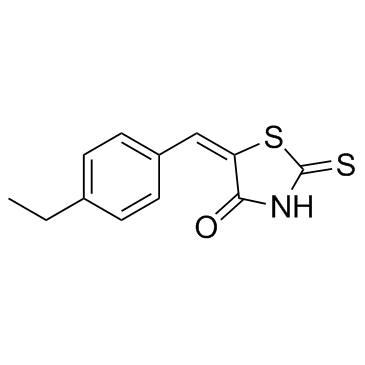
10058-F4 structure
|
Common Name | 10058-F4 | ||
|---|---|---|---|---|
| CAS Number | 403811-55-2 | Molecular Weight | 249.352 | |
| Density | 1.3±0.1 g/cm3 | Boiling Point | 387.1±52.0 °C at 760 mmHg | |
| Molecular Formula | C12H11NOS2 | Melting Point | N/A | |
| MSDS | Chinese USA | Flash Point | 187.9±30.7 °C | |
| Symbol |

GHS07 |
Signal Word | Warning | |
Use of 10058-F410058-F4 is a c-Myc inhibitor that prevents c-Myc-Max dimerization and transactivation of c-Myc target gene expression. |
This table lists Chinese names, IUPAC names and various aliases of this chemical substance.
| Name | (5E)-5-(4-Ethylbenzylidene)-2-mercapto-1,3-thiazol-4(5H)-one |
|---|---|
| Synonym | More Synonyms |
This table contains bioactivity, target information and biological‑assay experimental data of this compound.
| Description | 10058-F4 is a c-Myc inhibitor that prevents c-Myc-Max dimerization and transactivation of c-Myc target gene expression. |
|---|---|
| Related Catalog | |
| In Vitro | 10058-F4 inhibits growth of leukemic cells and dimerization of Myc and Max. 10058-F4 induces cell-cycle arrest and apoptosis of AML cells. 10058-F4 arrests AML cells at G0/G1 phase, downregulates c-Myc expression and upregulated CDK inhibitors, p21 and p27. Meanwhile, 10058-F4 induces apoptosis through activation of mitochondrial pathway shown by downregulation of Bcl-2, upregulation of Bax, release of cytoplasmic cytochrome C, and cleavage of caspase 3, 7, and 9. Furthermore, 10058-F4 also induces myeloid differentiation, possibly through activation of multiple transcription factors. Similarly, 10058-F4-induced apoptosis and differentiation could also be observed in primary AML cells[1]. 10058-F4 decreases c-Myc protein levels, inhibites proliferation of HepG2 cells likely through upregulation of cyclin-dependent kinase (cdk) inhibitor, p21WAF1 and lowers intracellular levels of [alpha]-fetoprotein (AFP). Treatment with 10058-F4 also downregulates human telomerase reverse transcriptase (hTERT) at the transcriptional level. In addition to inhibiting the proliferation of HepG2 cells, 10058-F4 enhances sensitivity to conventional chemotherapeutic agents, doxorubicin, 5-fluorouracil (5-FU) and cisplatin[2]. |
| In Vivo | Peak plasma 10058-F4 concentrations of approximately 300 μM are seen at 5 min and declined to below the detection limit at 360 min following a single iv dose. Plasma concentration versus time data are best approximated by a two-compartment, open, linear model. The highest tissue concentrations of 10058-F4 are found in fat, lung, liver, and kidney. Peak tumor concentrations of 10058-F4 are at least tenfold lower than peak plasma concentrations. Eight metabolites of 10058-F4 are identified in plasma, liver, and kidney. The terminal half-life of 10058-F4 is approximately 1 h, and the volume of distribution is > 200 mL/kg. No significant inhibition of tumor growth is seen after i.v. treatment of mice with either 20 or 30 mg/kg 10058-F4[3]. |
| Cell Assay | Cells, plated in 96-well plates (105/mL for cell lines and 5×10⁵/mL for primary leukemic cells), are treated in triplicate with indicated concentrations of 10058-F4. At various time points, 20 μL 5 mg/mL MTT is added to each well. After incubation at 37°C for 3 hours, the MTT medium is removed and 100 μL DMSO lysis buffer is added. The number of viable cells is assessed by the percentage of absorbance of treated cells relative to that of solvent controls, using 570-nm wavelength on a spectrophotometer. |
| Animal Admin | C B-17 SCID mice bearing PC-3 human prostate tumor xenografts are stratified into the following groups: Control, vehicle control, positive control (docetaxel, 10 mg/kg), and 10058-F4 treatment (20 or 30 mg/kg/dose). Previous studies by us indicates that 30 mg/kg is the maximally tolerated dose of 10058-F4 on this schedule. Mice are treated i.v. daily for 5 days for 2 weeks, and body weights and tumor volumes are recorded twice weekly. In the second study, C B-17 SCID mice bearing DU145 human androgen-independent prostate cancer xenografts are stratified to similar treatment groups. Docetaxel serves as the positive control for both efficacy studies and is administered i.v. every 7 days for two doses of 10 mg/kg. Tumors are measured with calipers, and tumor volumes are calculated using the formula: TV= L×W2/2 where L is the largest diameter of the tumor and W is the smallest diameter perpendicular to L. Mice are followed for at least 1 week following the completion of the dosing so that tumor regrowth could be monitored. |
| References |
This table shows physicochemical parameters including melting point, boiling point, density, solubility and optical rotation. Missing data is marked as N/A.
| Density | 1.3±0.1 g/cm3 |
|---|---|
| Boiling Point | 387.1±52.0 °C at 760 mmHg |
| Molecular Formula | C12H11NOS2 |
| Molecular Weight | 249.352 |
| Flash Point | 187.9±30.7 °C |
| Exact Mass | 249.028198 |
| PSA | 93.53000 |
| LogP | 4.38 |
| Appearance of Characters | yellow |
| Vapour Pressure | 0.0±0.9 mmHg at 25°C |
| Index of Refraction | 1.664 |
| InChIKey | SVXDHPADAXBMFB-JXMROGBWSA-N |
| SMILES | CCc1ccc(C=C2SC(=S)NC2=O)cc1 |
| Storage condition | 2-8°C |
| Water Solubility | DMSO: >10mg/mL | Soluble in DMSO. Soluble in water at concentrations less than 2mg/ml |
This table provides MSDS information including hazard classification, first‑aid, fire‑fighting, spill handling, operation and storage instructions.
This table covers safety warnings, protective measures, incompatible substances and disposal guidelines for this compound.
| Symbol |
GHS07 |
|---|---|
| Signal Word | Warning |
| Hazard Statements | H317-H319 |
| Precautionary Statements | P280-P305 + P351 + P338 |
| Personal Protective Equipment | dust mask type N95 (US);Eyeshields;Faceshields;Gloves |
| Hazard Codes | Xi |
| Risk Phrases | 36-43 |
| Safety Phrases | 26-36/37 |
| RIDADR | NONH for all modes of transport |
| HS Code | 2934100090 |
This table shows customs‑related data including HS‑code, tariff and regulatory conditions for import and export.
| HS Code | 2934100090 |
|---|---|
| Summary | 2934100090 other compounds containing an unfused thiazole ring (whether or not hydrogenated) in the structure VAT:17.0% Tax rebate rate:9.0% Supervision conditions:none MFN tariff:6.5% General tariff:20.0% |
This table lists relevant public references with title, journal and publication metadata for this compound.
|
Epstein-Barr virus nuclear antigen 3A protein regulates CDKN2B transcription via interaction with MIZ-1.
Nucleic Acids Res. 42(15) , 9700-16, (2014) The Epstein-Barr virus (EBV) nuclear antigen 3 family of protein is critical for the EBV-induced primary B-cell growth transformation process. Using a yeast two-hybrid screen we identified 22 novel ce... |
|
|
Loss of the Notch effector RBPJ promotes tumorigenesis.
J. Exp. Med. 212(1) , 37-52, (2015) Aberrant Notch activity is oncogenic in several malignancies, but it is unclear how expression or function of downstream elements in the Notch pathway affects tumor growth. Transcriptional regulation ... |
|
|
Warburg-like Glycolysis and Lactate Shuttle in Mouse Decidua during Early Pregnancy.
J. Biol. Chem. 290 , 21280-91, (2015) Decidualization is an essential process of maternal endometrial stromal cells to support pregnancy. Although it is known that enhanced glucose influx is critical for decidualization, the underlying me... |
This table contains target information, in‑vitro & in‑vivo assay data for this compound.
This table collects all English aliases, systematic names and CAS‑related synonyms of the compound.
| (5E)-5-(4-ethylbenzylidene)-2-mercapto-1,3-thiazol-4(5H)-one(SALTDATA: FREE) |
| 5-[(4-Ethylphenyl)methylene]-2-thioxo-4-thiazolidinone |
| (5E)-5-(4-Ethylbenzylidene)-2-thioxo-1,3-thiazolidin-4-one |
| (Z,E)-5-(4-ETHYLBENZYLIDINE)-2-THIOXOTHIAZOLIDIN-4-ONE |
| 4-Thiazolidinone (5-[(4-ethylphenyl)methylene]-2-thioxo |
| 10058-F4 |
This section contains frequently‑asked‑questions about this compound, including basic parameters, properties, storage conditions and corresponding answers.
| Q: What is the SMILES notation of (5E)-5-(4-Ethylbenzylidene)-2-mercapto-1,3-thiazol-4(5H)-one? |
| A: SMILES notation of (5E)-5-(4-Ethylbenzylidene)-2-mercapto-1,3-thiazol-4(5H)-one is CCc1ccc(C=C2SC(=S)NC2=O)cc1. |
| Q: What is the physical appearance of (5E)-5-(4-Ethylbenzylidene)-2-mercapto-1,3-thiazol-4(5H)-one? |
| A: (5E)-5-(4-Ethylbenzylidene)-2-mercapto-1,3-thiazol-4(5H)-one appears as yellow. |
| Q: What is the boiling point of (5E)-5-(4-Ethylbenzylidene)-2-mercapto-1,3-thiazol-4(5H)-one? |
| A: Boiling point of (5E)-5-(4-Ethylbenzylidene)-2-mercapto-1,3-thiazol-4(5H)-one is 387.1±52.0 °C at 760 mmHg. |
| Q: What English synonyms does (5E)-5-(4-Ethylbenzylidene)-2-mercapto-1,3-thiazol-4(5H)-one have? |
| A: English synonyms of (5E)-5-(4-Ethylbenzylidene)-2-mercapto-1,3-thiazol-4(5H)-one: (5E)-5-(4-ethylbenzylidene)-2-mercapto-1,3-thiazol-4(5H)-one(SALTDATA: FREE), 5-[(4-Ethylphenyl)methylene]-2-thioxo-4-thiazolidinone, (5E)-5-(4-Ethylbenzylidene)-2-thioxo-1,3-thiazolidin-4-one, (Z,E)-5-(4-ETHYLBENZYLIDINE)-2-THIOXOTHIAZOLIDIN-4-ONE, 4-Thiazolidinone (5-[(4-ethylphenyl)methylene]-2-thioxo, 10058-F4. |
| Q: What is the InChIKey of (5E)-5-(4-Ethylbenzylidene)-2-mercapto-1,3-thiazol-4(5H)-one? |
| A: InChIKey of (5E)-5-(4-Ethylbenzylidene)-2-mercapto-1,3-thiazol-4(5H)-one is SVXDHPADAXBMFB-JXMROGBWSA-N. |
| Q: How is the water solubility of (5E)-5-(4-Ethylbenzylidene)-2-mercapto-1,3-thiazol-4(5H)-one? |
| A: Water solubility of (5E)-5-(4-Ethylbenzylidene)-2-mercapto-1,3-thiazol-4(5H)-one: DMSO: >10mg/mL | Soluble in DMSO. Soluble in water at concentrations less than 2mg/ml. |
| Q: What is the CAS number of (5E)-5-(4-Ethylbenzylidene)-2-mercapto-1,3-thiazol-4(5H)-one? |
| A: CAS number of (5E)-5-(4-Ethylbenzylidene)-2-mercapto-1,3-thiazol-4(5H)-one is 403811-55-2. |
| Q: What is the safety information for (5E)-5-(4-Ethylbenzylidene)-2-mercapto-1,3-thiazol-4(5H)-one? |
| A: Safety information for (5E)-5-(4-Ethylbenzylidene)-2-mercapto-1,3-thiazol-4(5H)-one: 26-36/37. |
| Q: What is the polar surface area (PSA) of (5E)-5-(4-Ethylbenzylidene)-2-mercapto-1,3-thiazol-4(5H)-one? |
| A: Polar surface area (PSA) of (5E)-5-(4-Ethylbenzylidene)-2-mercapto-1,3-thiazol-4(5H)-one is 93.53000. |
| Q: What is the LogP of (5E)-5-(4-Ethylbenzylidene)-2-mercapto-1,3-thiazol-4(5H)-one? |
| A: LogP of (5E)-5-(4-Ethylbenzylidene)-2-mercapto-1,3-thiazol-4(5H)-one is 4.38. |
This table lists manufacturers and suppliers of this compound, including vendor names and product supply reference information.
| Shanghai Nianxing Industrial Co., Ltd |