Isoalantolactone
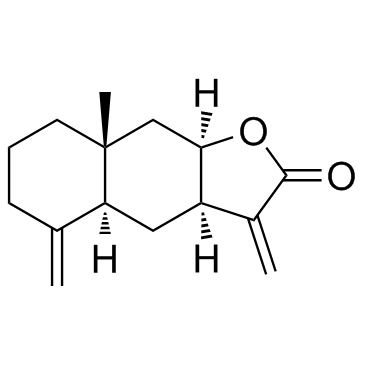
Isoalantolactone structure
|
Common Name | Isoalantolactone | ||
|---|---|---|---|---|
| CAS Number | 470-17-7 | Molecular Weight | 232.318 | |
| Density | 1.1±0.1 g/cm3 | Boiling Point | 364.9±42.0 °C at 760 mmHg | |
| Molecular Formula | C15H20O2 | Melting Point | N/A | |
| MSDS | N/A | Flash Point | 152.7±25.3 °C | |
Use of IsoalantolactoneIsoalantolactone is an apoptosis inducer, which also acts as an alkylating agent. |
This table lists Chinese names, IUPAC names and various aliases of this chemical substance.
| Name | isoalantolactone |
|---|---|
| Synonym | More Synonyms |
This table contains bioactivity, target information and biological‑assay experimental data of this compound.
| Description | Isoalantolactone is an apoptosis inducer, which also acts as an alkylating agent. |
|---|---|
| Related Catalog | |
| Target |
Apoptosis[1] |
| In Vitro | Isoalantolactone exhibits good cytotoxic activity against the K562 human leukaemia cell line (IC50=1.2 μM) [1]. The cytotoxic effect of Isoalantolactone on pancreatic carcinoma is evaluated using PANC-1, BxPC3 and HPAC cell lines. Treatment with Isoalantolactone for 24 h inhibits PANC-1 cell growth in a dose-dependent manner. The inhibition rate is above 90% at 80 µM and the concentration to achieve 50% growth inhibition (IC50) is 40 µM. A similar trend in loss of cell viability is observed in BxPC3 and HPAC cells on Isoalantolactone treatment with IC50 values 43 and 48 µM respectively. Pretreatment with 3 mM N-Acetyl Cysteine (NAC), a specific ROS scavenger, restores the viability of cells indicating that Isoalantolactone exerts cytotoxic effect on cell viability through ROS generation[2]. |
| In Vivo | The acute and chronic toxic effects of Isoalantolactone in CD1 mice are assessed by measuring the changes in body weight, blood biochemistry and histopathology of liver and kidneys in comparison with control groups. Isoalantolactone is well tolerated by mice and no mortality or any sign of pharmacotoxicity are found at a dose of 100 mg/kg during both experimental periods (7 & 30 days). Body weight gains and food consumption are comparable for control and treated mice during both experimental periods and there were no drug-related changes in histopathological and blood biochemistry parameters. The histopathological changes in liver and kidneys are assessed using hematoxylin and eosin staining and correlated with liver and renal function biomarkers. No obvious morphological changes are observed in liver and kidney structures of control and treatment groups. There is a slight increase in serum alanine aminotransferase (ALT) and aspartate aminotransferase (AST) level of treatment group at dose day 7 but this increase is not significantly different (P<0.05) from control group. A significant increase in total bilirubin (TBIL) concentration is found in treatment group (1.43±0.26 vs 0.76±0.12 in control, P<0.05) at dose day 7. Similarly the changes in renal function biomarkers are not significantly different (P<0.05) in the serum of control and treatment groups at dose day 7. The concentration of creatinine (Cr) slightly increases whereas concentration of blood urea nitrogen (BUN) slightly decreases in treatment group. The serum level of AST, ALT, TBIL and BUN slightly decreases when mice are injected with Isoalantolactone at a dose of 100 mg/kg for 30 days[2]. |
| Cell Assay | Cell viability is assessed by MTT assay. Briefly PANC-1, BxPC3, and HPAC cells are treated with DMSO or Isoalantolactone (5, 10, 20, 40, 80 and 100 μM) in the presence or absence of 3 mM NAC for 24 h. Following treatment, the MTT reagent is added (500 µg/mL) and cells are further incubated at 37°C for 4 h. Subsequently 150 μL DMSO is added to dissolve farmazan crystals and absorbance is measured at 570 nm in a microplate reader. The percentage of cell viability is calculated[2]. |
| Animal Admin | Mice[2] In vivo studies for acute and chronic toxicity are conducted on 10-12 week old CD1 mice weighing 27-30 g. The mice are maintained in a specific pathogen-free grade animal facility on a 12-h light/dark cycles at 25±2°C. Mice are randomly divided into four groups. Group A (n=4) administered with 50 µL DMSO intraperitonially for 7 days; Group B (n=4) administered with Isoalantolactone (100 mg/kg body weight) in 50 µL DMSO intraperitonially for 7 days; Group C (n=4) administered with 50 µL DMSO for 30 days and Group D (n=4) administered with Isoalantolactone (100 mg/kg body weight) in 50 µL DMSO intraperitonially for 30 days. At the first and last day of the experiments, the body weight of each mouse is measured. At the end of experiments (at dose day 7 for acute toxicity & dose day 30 for chronic toxicity), mice are anesthetized using Pentobarbital sodium (50 mg/kg ip), blood is collected via cardiac puncture, allowed to clot for 10 min and centrifuge at 1000×g for 10 min at room temperature. Serum is separated and stored at -20°C until analysis. The liver and kidneys are excised and processed for hematoxylin and eosin staining followed established procedures. |
| References |
This table shows physicochemical parameters including melting point, boiling point, density, solubility and optical rotation. Missing data is marked as N/A.
| Density | 1.1±0.1 g/cm3 |
|---|---|
| Boiling Point | 364.9±42.0 °C at 760 mmHg |
| Molecular Formula | C15H20O2 |
| Molecular Weight | 232.318 |
| Flash Point | 152.7±25.3 °C |
| Exact Mass | 232.146332 |
| PSA | 26.30000 |
| LogP | 3.70 |
| Vapour Pressure | 0.0±0.8 mmHg at 25°C |
| Index of Refraction | 1.527 |
| InChIKey | CVUANYCQTOGILD-QVHKTLOISA-N |
| SMILES | C=C1C(=O)OC2CC3(C)CCCC(=C)C3CC12 |
This table summarizes toxicological test data, acute & chronic toxicity and ecological hazard parameters for this chemical.
CHEMICAL IDENTIFICATION
HEALTH HAZARD DATAACUTE TOXICITY DATAMUTATION DATA
|
This table presents publicly reported synthetic routes, reaction conditions, reactants and product information of the compound.
This table lists upstream starting materials and downstream derivative products related to this chemical.
| Precursor 2 | |
|---|---|
| DownStream 1 | |
![(3aR,4aS,8aR,9aR,E)-8a-methyl-5-methylene-3-((phenylthio)methylene)decahydronaphtho[2,3-b]furan-2(3H)-one Structure](https://image.chemsrc.com/caspic/295/69993-39-1.png) CAS#:69993-39-1
CAS#:69993-39-1![(3S,3aR,4aS,8aR,9aR)-3,8a-dimethyl-5-methylidene-3a,4,4a,6,7,8,9,9a-octahydro-3H-benzo[f][1]benzofuran-2-one Structure](https://image.chemsrc.com/caspic/101/1856-58-2.png) CAS#:1856-58-2
CAS#:1856-58-2 CAS#:73069-14-4
This table collects all English aliases, systematic names and CAS‑related synonyms of the compound.
| iso-Alantolactone |
| ISOHELENIN |
| ISOALANTOACTONE |
| (3aR,4aS,8aR,9aR)-8a-Methyl-3,5-bis(methylene)decahydronaphtho[2,3-b]furan-2(3H)-one |
| isolantolactone |
| Isoalantolactone |
| MFCD00056777 |
| (3aR,4aS,8aR,9aR)-8a-methyl-3,5-dimethylidenedecahydronaphtho[2,3-b]furan-2(3H)-one |
This section contains frequently‑asked‑questions about this compound, including basic parameters, properties, storage conditions and corresponding answers.
| Q: What is the polar surface area (PSA) of isoalantolactone? |
| A: Polar surface area (PSA) of isoalantolactone is 26.30000. |
| Q: What is the molecular formula of isoalantolactone? |
| A: Molecular formula of isoalantolactone is C15H20O2. |
| Q: What is the LogP of isoalantolactone? |
| A: LogP of isoalantolactone is 3.70. |
| Q: What is the boiling point of isoalantolactone? |
| A: Boiling point of isoalantolactone is 364.9±42.0 °C at 760 mmHg. |
| Q: What English synonyms does isoalantolactone have? |
| A: English synonyms of isoalantolactone: iso-Alantolactone, ISOHELENIN, ISOALANTOACTONE, (3aR,4aS,8aR,9aR)-8a-Methyl-3,5-bis(methylene)decahydronaphtho[2,3-b]furan-2(3H)-one, isolantolactone, Isoalantolactone, MFCD00056777, (3aR,4aS,8aR,9aR)-8a-methyl-3,5-dimethylidenedecahydronaphtho[2,3-b]furan-2(3H)-one. |
| Q: What is the safety information for isoalantolactone? |
| A: Safety information for isoalantolactone: 22-36. |
| Q: What is the SMILES notation of isoalantolactone? |
| A: SMILES notation of isoalantolactone is C=C1C(=O)OC2CC3(C)CCCC(=C)C3CC12. |
| Q: What is the InChIKey of isoalantolactone? |
| A: InChIKey of isoalantolactone is CVUANYCQTOGILD-QVHKTLOISA-N. |
| Q: What are the downstream products of isoalantolactone? |
| A: Related downstream products(CAS) of isoalantolactone: 73069-14-4. |
| Q: What is the CAS number of isoalantolactone? |
| A: CAS number of isoalantolactone is 470-17-7. |
This table lists manufacturers and suppliers of this compound, including vendor names and product supply reference information.
| Shanghai Nianxing Industrial Co., Ltd |
| BioBioPha |
| Dayang Chem (Hangzhou) Co., Ltd. |
| naturewill |