Pinocembrin
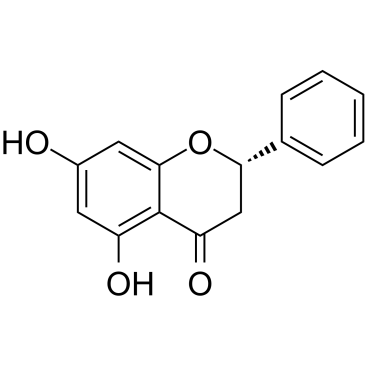
Pinocembrin structure
|
Common Name | Pinocembrin | ||
|---|---|---|---|---|
| CAS Number | 480-39-7 | Molecular Weight | 256.25 | |
| Density | 1.4±0.1 g/cm3 | Boiling Point | 511.1±50.0 °C at 760 mmHg | |
| Molecular Formula | C15H12O4 | Melting Point | N/A | |
| MSDS | USA | Flash Point | 199.3±23.6 °C | |
Use of PinocembrinPinocembrin ((+)-Pinocoembrin) is a flavonoid found in propolis, acts as a competitive inhibitor of histidine decarboxylase, and is an effective anti-allergic agent, with antioxidant, antimicrobial and anti-inflammatory properties[1]. |
This table lists Chinese names, IUPAC names and various aliases of this chemical substance.
| Name | pinocembrin |
|---|---|
| Synonym | More Synonyms |
This table contains bioactivity, target information and biological‑assay experimental data of this compound.
| Description | Pinocembrin ((+)-Pinocoembrin) is a flavonoid found in propolis, acts as a competitive inhibitor of histidine decarboxylase, and is an effective anti-allergic agent, with antioxidant, antimicrobial and anti-inflammatory properties[1]. |
|---|---|
| Related Catalog | |
| In Vitro | Pinocembrin (5, 10, 25, 50, 100 or 200 µM, 24 hours) significantly reduces cell viability of RBL-2H3 cells[1]. Pinocembrin (25 or 50 µM) suppresses iNOS, PGE-2 and COX-2 levels, increases p38-Mapk and IкB-α, and inhibits phosphorylation of IкB-α[1]. Cell Viability Assay[1] Cell Line: RBL-2H3 cells Concentration: 5, 10, 25, 50, 100 or 200 µM Incubation Time: 24 hours Result: Decreased cell viability by ∼50% at ≥ 100 µM. Showed 75% cell viability at lower concentrations. |
| References |
This table shows physicochemical parameters including melting point, boiling point, density, solubility and optical rotation. Missing data is marked as N/A.
| Density | 1.4±0.1 g/cm3 |
|---|---|
| Boiling Point | 511.1±50.0 °C at 760 mmHg |
| Molecular Formula | C15H12O4 |
| Molecular Weight | 256.25 |
| Flash Point | 199.3±23.6 °C |
| Exact Mass | 256.073547 |
| PSA | 66.76000 |
| LogP | 3.93 |
| Vapour Pressure | 0.0±1.4 mmHg at 25°C |
| Index of Refraction | 1.662 |
| InChIKey | URFCJEUYXNAHFI-ZDUSSCGKSA-N |
| SMILES | O=C1CC(c2ccccc2)Oc2cc(O)cc(O)c21 |
This table summarizes toxicological test data, acute & chronic toxicity and ecological hazard parameters for this chemical.
CHEMICAL IDENTIFICATION
HEALTH HAZARD DATAACUTE TOXICITY DATA
|
This table covers safety warnings, protective measures, incompatible substances and disposal guidelines for this compound.
| Safety Phrases | 24/25 |
|---|
This table lists upstream starting materials and downstream derivative products related to this chemical.
| Precursor 3 | |
|---|---|
| DownStream 4 | |
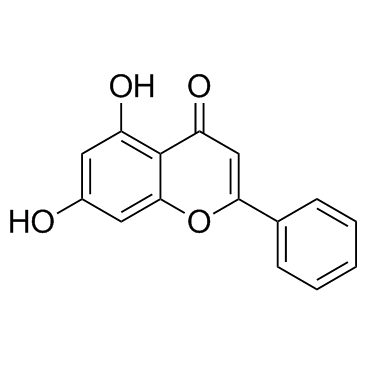 CAS#:480-40-0
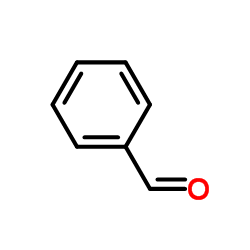 CAS#:100-52-7
![1-[2-hydroxy-4,6-bis-(tetra-O-acetyl-β-D-glucopyranosyloxy)-phenyl]-ethanone Structure](https://image.chemsrc.com/caspic/108/6157-13-7.png) CAS#:6157-13-7
CAS#:6157-13-7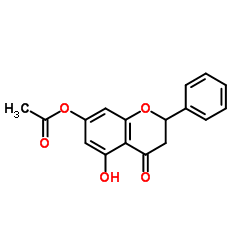 CAS#:109592-60-1
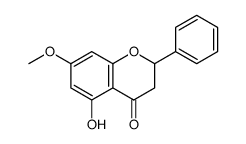 CAS#:75291-74-6
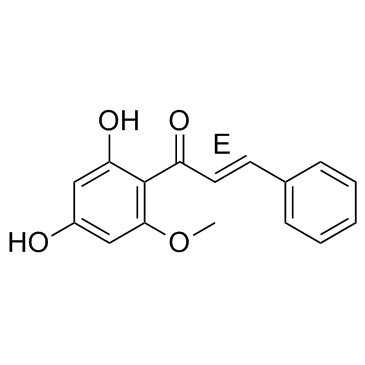 CAS#:19309-14-9
This table contains target information, in‑vitro & in‑vivo assay data for this compound.
This table collects all English aliases, systematic names and CAS‑related synonyms of the compound.
| Galangin flavanone |
| (2S)-5,7-Dihydroxy-2-phenyl-2,3-dihydro-4H-chromen-4-one |
| Pinocembrin |
| (2S)-pinocembrin |
| Dihydrochrysin |
| (2S)-5,7-dihydroxy-2-phenyl-2,3-dihydrochromen-4-one |
| 5,7-Dihydroxyflavanone |
| (2S)-5,7-dihydroxy-2-phenylchroman-4-one |
This section contains frequently‑asked‑questions about this compound, including basic parameters, properties, storage conditions and corresponding answers.
| Q: What English synonyms does pinocembrin have? |
| A: English synonyms of pinocembrin: Galangin flavanone, (2S)-5,7-Dihydroxy-2-phenyl-2,3-dihydro-4H-chromen-4-one, Pinocembrin, (2S)-pinocembrin, Dihydrochrysin, (2S)-5,7-dihydroxy-2-phenyl-2,3-dihydrochromen-4-one, 5,7-Dihydroxyflavanone, (2S)-5,7-dihydroxy-2-phenylchroman-4-one. |
| Q: What are the upstream materials of pinocembrin? |
| A: Related upstream materials(CAS) of pinocembrin: 480-40-0;100-52-7;6157-13-7. |
| Q: What is the LogP of pinocembrin? |
| A: LogP of pinocembrin is 3.93. |
| Q: What is the CAS number of pinocembrin? |
| A: CAS number of pinocembrin is 480-39-7. |
| Q: What is the molecular formula of pinocembrin? |
| A: Molecular formula of pinocembrin is C15H12O4. |
| Q: What is the safety information for pinocembrin? |
| A: Safety information for pinocembrin: 24/25. |
| Q: What is the molecular weight of pinocembrin? |
| A: Molecular weight of pinocembrin is 256.25. |
| Q: What is the polar surface area (PSA) of pinocembrin? |
| A: Polar surface area (PSA) of pinocembrin is 66.76000. |
| Q: What are the uses of pinocembrin? |
| A: Main uses of pinocembrin: Pinocembrin ((+)-Pinocoembrin) is a flavonoid found in propolis, acts as a competitive inhibitor of histidine decarboxylase, and is an effective anti-allergic agent, with antioxidant, antimicrobial and anti-inflammatory properties[1]. |
| Q: What is the SMILES notation of pinocembrin? |
| A: SMILES notation of pinocembrin is O=C1CC(c2ccccc2)Oc2cc(O)cc(O)c21. |
This table lists manufacturers and suppliers of this compound, including vendor names and product supply reference information.
| Shanghai Nianxing Industrial Co., Ltd |
| BioBioPha |
| Dayang Chem (Hangzhou) Co., Ltd. |
| naturewill |