2',3'-Dideoxyinosine
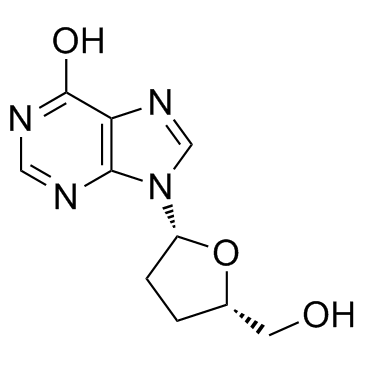
2',3'-Dideoxyinosine structure
|
Common Name | 2',3'-Dideoxyinosine | ||
|---|---|---|---|---|
| CAS Number | 69655-05-6 | Molecular Weight | 236.227 | |
| Density | 1.8±0.1 g/cm3 | Boiling Point | 531.2±60.0 °C at 760 mmHg | |
| Molecular Formula | C10H12N4O3 | Melting Point | 193-195 °C | |
| MSDS | Chinese USA | Flash Point | 275.0±32.9 °C | |
Use of 2',3'-DideoxyinosineDidanosine(Videx) is a reverse transcriptase inhibitor with an IC50 of 0.49 μM.Target: NRTIs; HIVDidanosine is a dideoxynucleoside compound in which the 3'-hydroxy group on the sugar moiety has been replaced by a hydrogen. This modification prevents the formation of phosphodiester linkages which are needed for the completion of nucleic acid chains. Didanosine is a potent inhibitor of HIV replication, acting as a chain-terminator of viral DNA by binding to reverse transcriptase. Didanosine demonstrated linear pharmacokinetic behavior over the dose ranges of 0.4 to 16.5 mg/kg intravenously and 0.8 to 10.2 mg/kg orally. Bioavailability of didanosine when administered as a solution with an antacid was approximately 43% for doses from 0.8 to 10.2 mg/kg in patients with AIDS and advanced AIDS-related complex. Bioavailability of didanosine from the citrate-phosphate-buffered solution, the formulation currently used in phase II and expanded access studies, was comparable to the formulation used in the phase I trials [1]. ddI might be responsible for fulminant hepatitis in all three AIDS patients. This toxic effect may be added to the list of potential adverse events occurring during ddI therapy [2]. |
This table lists Chinese names, IUPAC names and various aliases of this chemical substance.
| Name | didanosine |
|---|---|
| Synonym | More Synonyms |
This table contains bioactivity, target information and biological‑assay experimental data of this compound.
| Description | Didanosine(Videx) is a reverse transcriptase inhibitor with an IC50 of 0.49 μM.Target: NRTIs; HIVDidanosine is a dideoxynucleoside compound in which the 3'-hydroxy group on the sugar moiety has been replaced by a hydrogen. This modification prevents the formation of phosphodiester linkages which are needed for the completion of nucleic acid chains. Didanosine is a potent inhibitor of HIV replication, acting as a chain-terminator of viral DNA by binding to reverse transcriptase. Didanosine demonstrated linear pharmacokinetic behavior over the dose ranges of 0.4 to 16.5 mg/kg intravenously and 0.8 to 10.2 mg/kg orally. Bioavailability of didanosine when administered as a solution with an antacid was approximately 43% for doses from 0.8 to 10.2 mg/kg in patients with AIDS and advanced AIDS-related complex. Bioavailability of didanosine from the citrate-phosphate-buffered solution, the formulation currently used in phase II and expanded access studies, was comparable to the formulation used in the phase I trials [1]. ddI might be responsible for fulminant hepatitis in all three AIDS patients. This toxic effect may be added to the list of potential adverse events occurring during ddI therapy [2]. |
|---|---|
| Related Catalog | |
| References |
This table shows physicochemical parameters including melting point, boiling point, density, solubility and optical rotation. Missing data is marked as N/A.
| Density | 1.8±0.1 g/cm3 |
|---|---|
| Boiling Point | 531.2±60.0 °C at 760 mmHg |
| Melting Point | 193-195 °C |
| Molecular Formula | C10H12N4O3 |
| Molecular Weight | 236.227 |
| Flash Point | 275.0±32.9 °C |
| Exact Mass | 236.090942 |
| PSA | 93.03000 |
| LogP | -1.31 |
| Vapour Pressure | 0.0±1.5 mmHg at 25°C |
| Index of Refraction | 1.798 |
| InChIKey | BXZVVICBKDXVGW-NKWVEPMBSA-N |
| SMILES | O=c1[nH]cnc2c1ncn2C1CCC(CO)O1 |
| Storage condition | 2-8°C |
| Stability | Stable. Combustible. Incompatible with strong oxidizing agents. |
| Water Solubility | 1-5 g/100 mL at 21 ºC |
This table provides MSDS information including hazard classification, first‑aid, fire‑fighting, spill handling, operation and storage instructions.
This table summarizes toxicological test data, acute & chronic toxicity and ecological hazard parameters for this chemical.
CHEMICAL IDENTIFICATION
HEALTH HAZARD DATAACUTE TOXICITY DATA
MUTATION DATA
|
This table covers safety warnings, protective measures, incompatible substances and disposal guidelines for this compound.
| Personal Protective Equipment | Eyeshields;Gloves;type N95 (US);type P1 (EN143) respirator filter |
|---|---|
| Hazard Codes | C |
| Risk Phrases | R34 |
| Safety Phrases | S26-S27-S36/37/39-S45 |
| RIDADR | NONH for all modes of transport |
| WGK Germany | 2 |
| RTECS | NM7460700 |
| HS Code | 2942000000 |
This table presents publicly reported synthetic routes, reaction conditions, reactants and product information of the compound.
This table lists upstream starting materials and downstream derivative products related to this chemical.
| Precursor 8 | |
|---|---|
| DownStream 2 | |
![N[SP]1[/SP],5'-O-dibenzyl-2',3'-dideoxyinosine Structure](https://image.chemsrc.com/caspic/410/810694-79-2.png) CAS#:810694-79-2
CAS#:810694-79-2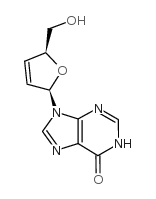 CAS#:42867-68-5
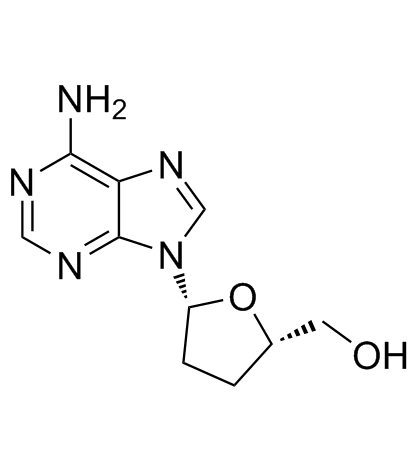 CAS#:4097-22-7
![9-[(2R,5S)-5-[[tert-butyl(dimethyl)silyl]oxymethyl]oxolan-2-yl]-3H-purin-6-one Structure](https://image.chemsrc.com/caspic/418/177779-56-5.png) CAS#:177779-56-5
CAS#:177779-56-5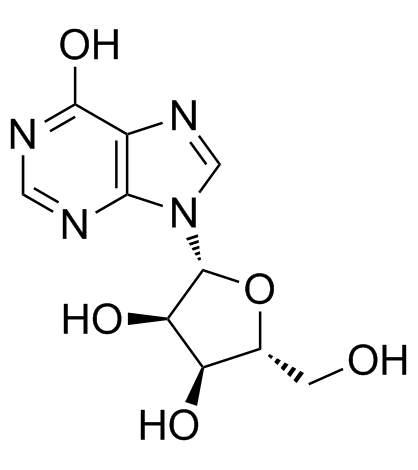 CAS#:58-63-9
 CAS#:389128-06-7
 CAS#:119794-34-2
 CAS#:119818-51-8
 CAS#:5983-09-5
This table shows customs‑related data including HS‑code, tariff and regulatory conditions for import and export.
| HS Code | 2942000000 |
|---|
This table lists relevant public references with title, journal and publication metadata for this compound.
|
Absence of a universal mechanism of mitochondrial toxicity by nucleoside analogs.
Antimicrob. Agents Chemother. 51 , 2531-9, (2007) Nucleoside analogs are associated with various mitochondrial toxicities, and it is becoming increasingly difficult to accommodate these differences solely in the context of DNA polymerase gamma inhibi... |
|
|
Cheminformatics analysis of assertions mined from literature that describe drug-induced liver injury in different species.
Chem. Res. Toxicol. 23 , 171-83, (2010) Drug-induced liver injury is one of the main causes of drug attrition. The ability to predict the liver effects of drug candidates from their chemical structures is critical to help guide experimental... |
|
|
Translating clinical findings into knowledge in drug safety evaluation--drug induced liver injury prediction system (DILIps).
J. Sci. Ind. Res. 65(10) , 808, (2006) Drug-induced liver injury (DILI) is a significant concern in drug development due to the poor concordance between preclinical and clinical findings of liver toxicity. We hypothesized that the DILI typ... |
This table contains target information, in‑vitro & in‑vivo assay data for this compound.
This table collects all English aliases, systematic names and CAS‑related synonyms of the compound.
| 9-[(2R,5S)-5-(hydroxyméthyl)tétrahydrofuran-2-yl]-1,9-dihydro-6H-purin-6-one |
| DDI |
| Videx |
| 9-[(2R,5S)-5-(Hydroxymethyl)tetrahydro-2-furanyl]-1,9-dihydro-6H-purin-6-one |
| 9-[(2R,5S)-5-(Hydroxymethyl)tetrahydrofuran-2-yl]-9H-purin-6-ol |
| MFCD00077728 |
| VIDEX EC |
| 2',3'-Dideoxyinosine |
| 9-[(2R,5S)-5-(Hydroxymethyl)tetrahydrofuran-2-yl]-1,9-dihydro-6H-purin-6-one |
| Dideoxyinosine |
| Didanosine |
| 9-[(2R,5S)-5-(Hydroxymethyl)tetrahydrofuran-2-yl]-1,9-dihydro-6H-purin-6-on |
| didanosinum [INN_la] |
This section contains frequently‑asked‑questions about this compound, including basic parameters, properties, storage conditions and corresponding answers.
| Q: How is the water solubility of didanosine? |
| A: Water solubility of didanosine: 1-5 g/100 mL at 21 ºC. |
| Q: What is the English name of didanosine? |
| A: The English name of didanosine is didanosine. |
| Q: What are the upstream materials of didanosine? |
| A: Related upstream materials(CAS) of didanosine: 810694-79-2;42867-68-5;4097-22-7;177779-56-5;58-63-9;389128-06-7;119794-34-2;119818-51-8. |
| Q: What is the boiling point of didanosine? |
| A: Boiling point of didanosine is 531.2±60.0 °C at 760 mmHg. |
| Q: What is the molecular weight of didanosine? |
| A: Molecular weight of didanosine is 236.227. |
| Q: What is the InChIKey of didanosine? |
| A: InChIKey of didanosine is BXZVVICBKDXVGW-NKWVEPMBSA-N. |
| Q: What are the storage conditions for didanosine? |
| A: Storage conditions for didanosine: 2-8°C. |
| Q: What is the melting point of didanosine? |
| A: Melting point of didanosine is 193-195 °C. |
| Q: What is the LogP of didanosine? |
| A: LogP of didanosine is -1.31. |
| Q: What are the downstream products of didanosine? |
| A: Related downstream products(CAS) of didanosine: 5983-09-5;177779-56-5. |
This table lists manufacturers and suppliers of this compound, including vendor names and product supply reference information.
| Shanghai Nianxing Industrial Co., Ltd |
| Dayang Chem (Hangzhou) Co., Ltd. |