Aprotinin acetate salt
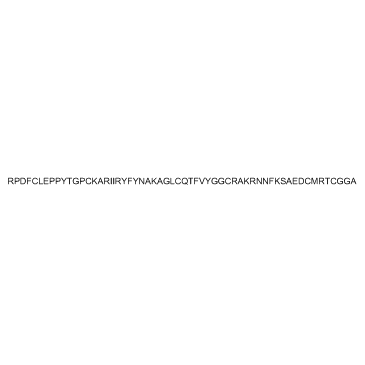
Aprotinin acetate salt structure
|
Common Name | Aprotinin acetate salt | ||
|---|---|---|---|---|
| CAS Number | 9087-70-1 | Molecular Weight | 6511.83000 | |
| Density | N/A | Boiling Point | N/A | |
| Molecular Formula | C284H432N84O79S7 | Melting Point | N/A | |
| MSDS | USA | Flash Point | N/A | |
Use of Aprotinin acetate saltAprotinin is a bovine pancreatic trypsin inhibitor (BPTI) inhibitor which inhibits trypsin and chymotrypsin with Kis of 0.06 pM and 9 nM, respectively. |
This table lists Chinese names, IUPAC names and various aliases of this chemical substance.
| Name | Aprotinin |
|---|---|
| Synonym | More Synonyms |
This table contains bioactivity, target information and biological‑assay experimental data of this compound.
| Description | Aprotinin is a bovine pancreatic trypsin inhibitor (BPTI) inhibitor which inhibits trypsin and chymotrypsin with Kis of 0.06 pM and 9 nM, respectively. |
|---|---|
| Related Catalog | |
| Target |
Ki: 0.06 pM (Trypsin), 9 nM (Chymotrypsin)[1] |
| In Vitro | Aprotinin, a serine protease inhibitor isolated from bovine lung, is a complex protease inhibitor that is an antifibrinolytic, inhibits contact activation, and decreases the inflammatory response to cardiopulmonary bypass[2]. Aprotinin inhibits trypsin (bovine, Ki= 0.06 pM), chymotrypsin (bovine, Ki= 9 nM), plasmin (human, 0.23 nM)[1]. Aprotinin is also a competitive protein inhibitor of NOS activity. It inhibits NOS-I and NOS-II with Ki values of 50 μM and 78 μM, respectively[3]. Aprotinin significantly inhibits fibrinolysis with an IC50 of 0.16±0.05 μM[4]. |
| In Vivo | High dose aprotinin can reduce blood loss and transfusion requirements associated with primary cardiac procedures such as coronary artery bypass graft (CABG) or heart valve replacement surgery[5]. Aprotinin inhibits thrombus formation in a dose-dependent manner. Aprotinin at a dose of 1.5 mg kg-1 (bolus) and 3 mg kg-1 h-1 infusion (maintenance infusion) causes a tendency towards a reduction in bleeding time. Aprotinin significantly reduces the bleeding time starting at a dose of 3 mg kg-1 bolus plus 6 mg kg-1 h-1 showing a reduction of approximately 84%±2.9%. At the highest dose of 5 mg kg-1 and 10 mg kg-1 h-1, the strongest effects are observed[4]. Aprotinin may affect tumor necrosis factor-alpha (TNF) levels. Soluble TNFRI levels are significantly increased following I/R in the aprotinin treated wild type mice and not detected in all TNFRInull mice[6]. |
| Animal Admin | Rats: Male Wistar rats (180-220 g) are used in the study. Aprotinin is dissolved in physiological saline. Aprotinin is administered by bolus injection followed by a maintenance infusion. The doses given are 1.5 mg kg-1 and 3 mg kg-1 h-1, 3mg kg-1 and 6 mg kg-1 h-1 up to 5 mg kg-1 and 10 mg kg-1 h-1. Plasma concentrations for the two agents are assessed by pharmacokinetic studies in rats[4]. Mice: An intact mouse model of ischemia/reperfusion (30 min-I/60 min-R) is used and left ventricular peak + dP/dt is measured in wild type mice (WT, C57BL/6; n=10), WT mice with aprotinin (4mL/kg; n=10), transgenic mice devoid of the TNFRI (TNFRInull; n=10), and TNFRInull with aprotinin (n=10)[6]. |
| References |
This table shows physicochemical parameters including melting point, boiling point, density, solubility and optical rotation. Missing data is marked as N/A.
| Molecular Formula | C284H432N84O79S7 |
|---|---|
| Molecular Weight | 6511.83000 |
| Exact Mass | 6507.00000 |
| Appearance of Characters | lyophilized powder | white |
| InChIKey | ZPNFWUPYTFPOJU-YSFZTAPISA-N |
| SMILES | CCC(C)C1NC(=O)C(CCCNC(=N)N)NC(=O)C(C)NC(=O)C(CCCCN)NC(=O)C2CSSCC3NC(=O)CNC(=O)CNC(=O)C(Cc4ccc(O)cc4)NC(=O)C(C(C)C)NC(=O)C(Cc4ccccc4)NC(=O)C(C(C)O)NC(=O)C(CCC(N)=O)NC(=O)C(CSSCC(NC(=O)C(CC(=O)O)NC(=O)C(CCC(=O)O)NC(=O)C(C)NC(=O)C(CO)NC(=O)C(CCCCN)NC(=O)C(Cc4ccccc4)NC(=O)C(CC(N)=O)NC(=O)C(CC(N)=O)NC(=O)C(CCCNC(=N)N)NC(=O)C(CCCCN)NC(=O)C(C)NC(=O)C(CCCNC(=N)N)NC3=O)C(=O)NC(CCSC)C(=O)NC(CCCNC(=N)N)C(=O)NC(C(C)O)C(=O)NC(C(=O)NCC(=O)NCC(=O)NC(C)C(=O)O)CSSCC(NC(=O)C(Cc3ccccc3)NC(=O)C(CC(=O)O)NC(=O)C3CCCN3C(=O)C(N)CCCNC(=N)N)C(=O)NC(CC(C)C)C(=O)NC(CCC(=O)O)C(=O)N3CCCC3C(=O)N3CCCC3C(=O)NC(Cc3ccc(O)cc3)C(=O)NC(C(C)O)C(=O)NCC(=O)N3CCCC3C(=O)N2)NC(=O)C(CC(C)C)NC(=O)CNC(=O)C(C)NC(=O)C(CCCCN)NC(=O)C(C)NC(=O)C(CC(N)=O)NC(=O)C(Cc2ccc(O)cc2)NC(=O)C(Cc2ccccc2)NC(=O)C(Cc2ccc(O)cc2)NC(=O)C(CCCNC(=N)N)NC(=O)C(C(C)CC)NC1=O |
| Storage condition | 2-8°C |
| Stability | Stable. Incompatible with strong oxidizing agents. |
| Water Solubility | glycerol: soluble3mg/mL, clear, colorless (equilibration buffer containing 5% glycerol) | Freely soluble in water and in aqueous buffers of low ionic strength. |
This table covers safety warnings, protective measures, incompatible substances and disposal guidelines for this compound.
| Personal Protective Equipment | Eyeshields;Gloves;type N95 (US);type P1 (EN143) respirator filter |
|---|---|
| Hazard Codes | Xn,Xi |
| Risk Phrases | 42/43-36/37/38-20/21/22 |
| Safety Phrases | 22-45-36/37-36-26 |
| RIDADR | NONH for all modes of transport |
| WGK Germany | 1 |
| RTECS | YN5080000 |
| HS Code | 35040000 |
This table lists relevant public references with title, journal and publication metadata for this compound.
|
Engineering of a Biomimetic Pericyte-Covered 3D Microvascular Network.
PLoS ONE 10 , e0133880, (2015) Pericytes enveloping the endothelium play an important role in the physiology and pathology of microvessels, especially in vessel maturation and stabilization. However, our understanding of fundamenta... |
|
|
SH2-PLA: a sensitive in-solution approach for quantification of modular domain binding by proximity ligation and real-time PCR.
BMC Biotechnol. 15 , 60, (2015) There is a great interest in studying phosphotyrosine dependent protein-protein interactions in tyrosine kinase pathways that play a critical role in many aspects of cellular function. We previously e... |
|
|
Functional microRNA library screening identifies the hypoxamir miR-24 as a potent regulator of smooth muscle cell proliferation and vascularization.
Antioxid. Redox Signal. 21(8) , 1167-76, (2014) Smooth muscle cells (SMCs) are key components within the vasculature. Dependent on the stimulus, SMC can either be in a proliferative (synthetic) or differentiated state. Alterations of SMC phenotype ... |
This table contains target information, in‑vitro & in‑vivo assay data for this compound.
|
Name: Human plasminogen (S1: Chymotrypsin)
Source: IUPHAR-DB
Target: plasminogen (S1: Chymotrypsin) [Homo sapiens]
External Id: 2394_Human
|
This table collects all English aliases, systematic names and CAS‑related synonyms of the compound.
| cas9004-04-0 |
| Trypsin Inhibitor |
| MFCD00130541 |
This section contains frequently‑asked‑questions about this compound, including basic parameters, properties, storage conditions and corresponding answers.
| Q: What is the molecular formula of Aprotinin? |
| A: Molecular formula of Aprotinin is C284H432N84O79S7. |
| Q: What is the InChIKey of Aprotinin? |
| A: InChIKey of Aprotinin is ZPNFWUPYTFPOJU-YSFZTAPISA-N. |
| Q: What are the storage conditions for Aprotinin? |
| A: Storage conditions for Aprotinin: 2-8°C. |
| Q: What is the molecular weight of Aprotinin? |
| A: Molecular weight of Aprotinin is 6511.83000. |
| Q: What English synonyms does Aprotinin have? |
| A: English synonyms of Aprotinin: cas9004-04-0, Trypsin Inhibitor, MFCD00130541. |
| Q: What is the physical appearance of Aprotinin? |
| A: Aprotinin appears as lyophilized powder | white. |
| Q: What are the uses of Aprotinin? |
| A: Main uses of Aprotinin: Aprotinin is a bovine pancreatic trypsin inhibitor (BPTI) inhibitor which inhibits trypsin and chymotrypsin with Kis of 0.06 pM and 9 nM, respectively. |
| Q: How is the water solubility of Aprotinin? |
| A: Water solubility of Aprotinin: glycerol: soluble3mg/mL, clear, colorless (equilibration buffer containing 5% glycerol) | Freely soluble in water and in aqueous buffers of low ionic strength. |
| Q: What is the safety information for Aprotinin? |
| A: Safety information for Aprotinin: 22-45-36/37-36-26. |
| Q: What is the CAS number of Aprotinin? |
| A: CAS number of Aprotinin is 9087-70-1. |
This table lists manufacturers and suppliers of this compound, including vendor names and product supply reference information.
| Shanghai Nianxing Industrial Co., Ltd |
| Henan Tianfu Chemical Co., Ltd. |