GLYCEROL STEARATE
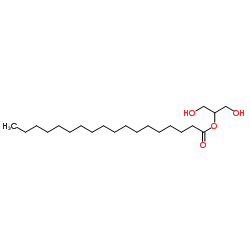
GLYCEROL STEARATE structure
|
Common Name | GLYCEROL STEARATE | ||
|---|---|---|---|---|
| CAS Number | 31566-31-1 | Molecular Weight | 358.556 | |
| Density | 1.0±0.1 g/cm3 | Boiling Point | 485.7±25.0 °C at 760 mmHg | |
| Molecular Formula | C21H42O4 | Melting Point | 78-81 °C | |
| MSDS | N/A | Flash Point | 155.6±16.7 °C | |
This table lists Chinese names, IUPAC names and various aliases of this chemical substance.
| Name | Glyceryl monostearate |
|---|---|
| Synonym | More Synonyms |
This table shows physicochemical parameters including melting point, boiling point, density, solubility and optical rotation. Missing data is marked as N/A.
| Density | 1.0±0.1 g/cm3 |
|---|---|
| Boiling Point | 485.7±25.0 °C at 760 mmHg |
| Melting Point | 78-81 °C |
| Molecular Formula | C21H42O4 |
| Molecular Weight | 358.556 |
| Flash Point | 155.6±16.7 °C |
| Exact Mass | 358.308319 |
| PSA | 66.76000 |
| LogP | 7.46 |
| Vapour Pressure | 0.0±2.8 mmHg at 25°C |
| Index of Refraction | 1.469 |
| Storage condition | −20°C |
This table provides MSDS information including hazard classification, first‑aid, fire‑fighting, spill handling, operation and storage instructions.
|
Section 1. Chemical Product and Company Identification Glyceryl MonostearateCatalog GL153, GL155, GL141, Common Name/ Number(s). GL149 Trade Name
Glyceryl Monostearate Section 4. First Aid Measures Eye ContactCheck for and remove any contact lenses. In case of contact, immediately flush eyes with plenty of water for at least 15 minutes. Get medical attention if irritation occurs. Skin ContactWash with soap and water. Cover the irritated skin with an emollient. Get medical attention if irritation develops. Serious Skin ContactNot available. InhalationIf inhaled, remove to fresh air. If not breathing, give artificial respiration. If breathing is difficult, give oxygen. Get medical attention. Serious InhalationNot available. IngestionDo NOT induce vomiting unless directed to do so by medical personnel. Never give anything by mouth to an unconscious person. If large quantities of this material are swallowed, call a physician immediately. Loosen tight clothing such as a collar, tie, belt or waistband. Serious IngestionNot available. Section 5. Fire and Explosion Data Flammability of the Product May be combustible at high temperature. Auto-Ignition Temperature Not available. Flash PointsOPEN CUP: >260°C (500°F) (Cleveland.). Flammable LimitsNot available. Products of CombustionThese products are carbon oxides (CO, CO2). Fire Hazards in Presence of Slightly flammable to flammable in presence of heat. Various SubstancesNon-flammable in presence of shocks. Explosion Hazards in Presence Risks of explosion of the product in presence of mechanical impact: Not available. Risks of explosion of the product in presence of static discharge: Not available. of Various Substances SMALL FIRE: Use DRY chemical powder. Fire Fighting Media and InstructionsLARGE FIRE: Use water spray, fog or foam. Do not use water jet. Not available. Special Remarks on Fire Hazards Special Remarks on Explosion Not available. Hazards Section 6. Accidental Release Measures Small SpillUse appropriate tools to put the spilled solid in a convenient waste disposal container. Finish cleaning by spreading water on the contaminated surface and dispose of according to local and regional authority requirements. Large SpillUse a shovel to put the material into a convenient waste disposal container. Finish cleaning by spreading water on the contaminated surface and allow to evacuate through the sanitary system. Glyceryl Monostearate Section 7. Handling and Storage PrecautionsKeep away from heat. Keep away from sources of ignition. Ground all equipment containing material. Do not breathe dust. StorageKeep container tightly closed. Keep container in a cool, well-ventilated area. Sensitive to light. Store in light-resistant containers. Section 8. Exposure Controls/Personal Protection Engineering ControlsUse process enclosures, local exhaust ventilation, or other engineering controls to keep airborne levels below recommended exposure limits. If user operations generate dust, fume or mist, use ventilation to keep exposure to airborne contaminants below the exposure limit. Personal Protection Safety glasses. Lab coat. Dust respirator. Be sure to use an approved/certified respirator or equivalent. Gloves. Personal Protection in Case of Splash goggles. Full suit. Dust respirator. Boots. Gloves. A self contained breathing apparatus should be used a Large Spillto avoid inhalation of the product. Suggested protective clothing might not be sufficient; consult a specialist BEFORE handling this product. Exposure LimitsNot available. Section 9. Physical and Chemical Properties Physical state and appearance Solid. (Flakes solid. Waxy solid.)OdorNot available. TasteNot available. Molecular Weight358.63 g/mole ColorWhite. Off-white. pH (1% soln/water)Not available. Boiling Point>260°C (500°F) Melting Point58°C (136.4°F) Critical TemperatureNot available. Not available. Specific Gravity Vapor PressureNot applicable. Vapor DensityNot available. VolatilityNot available. Odor ThresholdNot available. Not available. Water/Oil Dist. Coeff. Ionicity (in Water)Not available. Not available. Dispersion Properties SolubilityInsoluble in cold water, hot water. Section 10. Stability and Reactivity Data StabilityThe product is stable. Not available. Instability Temperature Conditions of InstabilityExcess heat, incompatible materials, light Incompatibility with variousNot available. substances CorrosivityNot available. Glyceryl Monostearate Special Remarks onLight sensitive. Reactivity Special Remarks onNot available. Corrosivity PolymerizationWill not occur. Section 11. Toxicological Information Routes of EntryInhalation. Ingestion. Toxicity to AnimalsAcute oral toxicity (LD50): >12800 mg/kg [Rat]. Chronic Effects on Humans Not available. Other Toxic Effects onSlightly hazardous in case of skin contact (irritant), of ingestion, of inhalation. Humans Special Remarks onNot available. Toxicity to Animals Special Remarks onNot available. Chronic Effects on Humans Special Remarks on otherAcute Potential Health Effects: Toxic Effects on HumansMay cause skin, eye, respiratory tract, and gastrointestinal tract irritation Section 12. Ecological Information EcotoxicityNot available. BOD5 and CODNot available. Products of BiodegradationPossibly hazardous short term degradation products are not likely. However, long term degradation products may arise. The product itself and its products of degradation are not toxic. Toxicity of the Products of Biodegradation Special Remarks on theNot available. Products of Biodegradation Section 13. Disposal Considerations Waste DisposalWaste must be disposed of in accordance with federal, state and local environmental control regulations. Section 14. Transport Information DOT ClassificationNot a DOT controlled material (United States). IdentificationNot applicable. Special Provisions forNot applicable. Transport DOT (Pictograms) Glyceryl Monostearate Section 15. Other Regulatory Information and Pictograms TSCA 8(b) inventory: Glyceryl Monostearate Federal and State FDA: Direct Food Additives GRAS list (21CFR 184.1324): Listed as Glyceryl Monostearate Regulations FDA: Everything Added to Food in the United States (EAFUS) list: Listed as Glyceryl Monostearate FEMA: Generally Recognized as Safe List: Listed as Glyceryl Monostearate California prop. 65: This product contains the following ingredients for which the State of California has found California to cause cancer which would require a warning under the statute: No products were found. Proposition 65 Warnings California prop. 65: This product contains the following ingredients for which the State of California has found to cause birth defects which would require a warning under the statute: No products were found. Other RegulationsEINECS: This product is on the European Inventory of Existing Commercial Chemical Substances (EINECS No. 250-705-4). Canada: Listed on Canadian Domestic Substance List (DSL). China: Listed on National Inventory. Japan: Not listed on National Inventory (ENCS). Korea: Listed on National Inventory (KECI). Philippines: Listed on National Inventory (PICCS). Australia: Listed on AICS. Other ClassificationsWHMIS (Canada) Not controlled under WHMIS (Canada). DSCL (EEC)This product is not classified according Not applicable. to the EU regulations. Health Hazard HMIS (U.S.A.)1 National Fire Protection 1 Flammability 1 Association (U.S.A.) Fire Hazard 1 0 Reactivity Health Reactivity 0 Specific hazard Personal Protection E WHMIS (Canada) (Pictograms) DSCL (Europe) (Pictograms) TDG (Canada) (Pictograms) ADR (Europe) (Pictograms) Protective Equipment Gloves. Lab coat. Glyceryl Monostearate Dust respirator. Be sure to use an approved/certified respirator or equivalent. SECTION 16 - ADDITIONAL INFORMATION N/A |
This table summarizes toxicological test data, acute & chronic toxicity and ecological hazard parameters for this chemical.
CHEMICAL IDENTIFICATION
HEALTH HAZARD DATAACUTE TOXICITY DATA
|
This table covers safety warnings, protective measures, incompatible substances and disposal guidelines for this compound.
| Hazard Codes | Xi |
|---|---|
| WGK Germany | 1 |
| HS Code | 2915709000 |
This table shows customs‑related data including HS‑code, tariff and regulatory conditions for import and export.
| HS Code | 2915709000 |
|---|---|
| Summary | 2915709000. palmitic acid and its salts and esters. VAT:17.0%. Tax rebate rate:13.0%. . MFN tariff:5.5%. General tariff:30.0% |
This table collects all English aliases, systematic names and CAS‑related synonyms of the compound.
| EINECS 204-664-4 |
| Octadecanoic acid, monoester with 1,2,3-propanetriol |
| 2-stearoylglycerol |
| MFCD00036186 |
| 1,3-Dihydroxy-2-propanyl stearate |
| Glycerin monostearate |
| GLYCEROL STEARATE |
| Octadecanoic acid, 2-hydroxy-1-(hydroxymethyl)ethyl ester |
| 2-hydroxy-1-(hydroxymethyl)ethyl stearate |
| 1,3-Dihydroxypropan-2-yl stearate |
| glycerol monostearate |
| 1,3-dihydroxypropan-2-yl octadecanoate |
| 2-hydroxy-1-(hydroxymethyl)ethyl octadecanoate |
This section contains frequently‑asked‑questions about this compound, including basic parameters, properties, storage conditions and corresponding answers.
| Q: What English synonyms does Glyceryl monostearate have? |
| A: English synonyms of Glyceryl monostearate: EINECS 204-664-4, Octadecanoic acid, monoester with 1,2,3-propanetriol, 2-stearoylglycerol, MFCD00036186, 1,3-Dihydroxy-2-propanyl stearate, Glycerin monostearate, GLYCEROL STEARATE, Octadecanoic acid, 2-hydroxy-1-(hydroxymethyl)ethyl ester, 2-hydroxy-1-(hydroxymethyl)ethyl stearate, 1,3-Dihydroxypropan-2-yl stearate, glycerol monostearate, 1,3-dihydroxypropan-2-yl octadecanoate, 2-hydroxy-1-(hydroxymethyl)ethyl octadecanoate. |
| Q: What is the molecular weight of Glyceryl monostearate? |
| A: Molecular weight of Glyceryl monostearate is 358.556. |
| Q: What is the English name of Glyceryl monostearate? |
| A: The English name of Glyceryl monostearate is Glyceryl monostearate. |
| Q: What is the melting point of Glyceryl monostearate? |
| A: Melting point of Glyceryl monostearate is 78-81 °C. |
| Q: What are the storage conditions for Glyceryl monostearate? |
| A: Storage conditions for Glyceryl monostearate: −20°C. |
| Q: What is the polar surface area (PSA) of Glyceryl monostearate? |
| A: Polar surface area (PSA) of Glyceryl monostearate is 66.76000. |
| Q: What is the CAS number of Glyceryl monostearate? |
| A: CAS number of Glyceryl monostearate is 31566-31-1. |
| Q: What is the boiling point of Glyceryl monostearate? |
| A: Boiling point of Glyceryl monostearate is 485.7±25.0 °C at 760 mmHg. |
| Q: What is the LogP of Glyceryl monostearate? |
| A: LogP of Glyceryl monostearate is 7.46. |
| Q: What is the molecular formula of Glyceryl monostearate? |
| A: Molecular formula of Glyceryl monostearate is C21H42O4. |
This table lists manufacturers and suppliers of this compound, including vendor names and product supply reference information.
| Shanghai Nianxing Industrial Co., Ltd |
| Dayang Chem (Hangzhou) Co., Ltd. |
| Henan Tianfu Chemical Co., Ltd. |