Ampicillin sodium
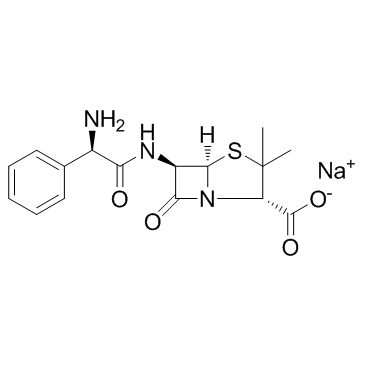
Ampicillin sodium structure
|
Common Name | Ampicillin sodium | ||
|---|---|---|---|---|
| CAS Number | 69-52-3 | Molecular Weight | 371.387 | |
| Density | N/A | Boiling Point | 683.9ºC at 760 mmHg | |
| Molecular Formula | C16H18N3NaO4S | Melting Point | 215 °C (dec.)(lit.) | |
| MSDS | Chinese USA | Flash Point | N/A | |
| Symbol |

GHS08 |
Signal Word | Danger | |
Use of Ampicillin sodiumAmpicillin sodium is a broad-spectrum beta-lactam antibiotic against a variety of gram-positive and gram-negative bacteria. |
| Name | ampicillin sodium |
|---|---|
| Synonym | More Synonyms |
| Description | Ampicillin sodium is a broad-spectrum beta-lactam antibiotic against a variety of gram-positive and gram-negative bacteria. |
|---|---|
| Related Catalog | |
| Target |
Bacterial[1] |
| In Vitro | Ampicillin inhibits the growth of E. coli of swine origin in a dose-dependent manner. The effective inhibitory concentration of Ampicillin was 2.5 uG/mL[1]. |
| In Vivo | Ampicillin is very effective in alleviating the symptoms of hemorrhagic enteritis in a 11-week old pig[1]. Ampicillin produces maximum concentrations in bile twice as high as in serum. The peak concentration of ampicillin after an oral dose is as twice as high in portal blood as in peripheral blood[2]. Ampicillin provides neuroprotection against ischemia-reperfusion brain injury. Ampicillin reduces the activities of MMPs and increases the expression level of GLT-1. Pretreatment with ampicillin significantly reduces medial hippocampal cell death following global forebrain ischemia[3]. |
| Animal Admin | Mice: Ampicillin is dissolved in normal saline. Male C57BL/6 mice were anesthetized with halothane and subjected to bilateral common carotid artery occlusion for 40 min. Before transient forebrain ischemia, ampicillin (200 mg/kg, intraperitoneally [i.p.]) or penicillin G (6,000 U/kg or 20,000 U/kg, i.p.) was administered daily for 5 days. In the control animals, saline was administered at the same volume and time schedule[3]. |
| References |
| Boiling Point | 683.9ºC at 760 mmHg |
|---|---|
| Melting Point | 215 °C (dec.)(lit.) |
| Molecular Formula | C16H18N3NaO4S |
| Molecular Weight | 371.387 |
| Exact Mass | 371.091583 |
| PSA | 140.86000 |
| LogP | 0.01250 |
| InChIKey | KLOHDWPABZXLGI-YWUHCJSESA-M |
| SMILES | CC1(C)SC2C(NC(=O)C(N)c3ccccc3)C(=O)N2C1C(=O)[O-].[Na+] |
| Water Solubility | H2O: 50 mg/mL, clear, very faintly yellow |
Synonym:Alpen-N; Amcill-S; D-Alpha-aminobenxylpenicillin sodium salt; Ampicillin sodium sal Section 2 - COMPOSITION, INFORMATION ON INGREDIENTS
Risk Phrases: 36/37/38 42/43 Section 3 - HAZARDS IDENTIFICATION EMERGENCY OVERVIEW
Irritating to eyes, respiratory system and skin. May cause sensitization by inhalation and skin contact. Potential Health Effects Eye: Causes eye irritation. Skin: Causes skin irritation. May cause skin sensitization, an allergic reaction, which becomes evident upon re-exposure to this material. May be harmful if absorbed through the skin. Ingestion: May cause gastrointestinal irritation with nausea, vomiting and diarrhea. May be harmful if swallowed. Inhalation: Causes respiratory tract irritation. May cause allergic respiratory reaction. May be harmful if inhaled. Chronic: No information found. Section 4 - FIRST AID MEASURES Eyes: Immediately flush eyes with plenty of water for at least 15 minutes, occasionally lifting the upper and lower eyelids. Get medical aid. Skin: Immediately flush skin with plenty of water for at least 15 minutes while removing contaminated clothing and shoes. Get medical aid if irritation develops or persists. Wash clothing before reuse. Ingestion: Do not induce vomiting. If victim is conscious and alert, give 2-4 cupfuls of milk or water. Get medical aid. Inhalation: Remove from exposure and move to fresh air immediately. If not breathing, give artificial respiration. If breathing is difficult, give oxygen. Get medical aid. Notes to Physician: Section 5 - FIRE FIGHTING MEASURES General Information: As in any fire, wear a self-contained breathing apparatus in pressure-demand, MSHA/NIOSH (approved or equivalent), and full protective gear. During a fire, irritating and highly toxic gases may be generated by thermal decomposition or combustion. Extinguishing Media: Use water spray, dry chemical, carbon dioxide, or appropriate foam. Section 6 - ACCIDENTAL RELEASE MEASURES General Information: Use proper personal protective equipment as indicated in Section 8. Spills/Leaks: Vacuum or sweep up material and place into a suitable disposal container. Clean up spills immediately, observing precautions in the Protective Equipment section. Avoid generating dusty conditions. Provide ventilation. Section 7 - HANDLING and STORAGE Handling: Wash thoroughly after handling. Remove contaminated clothing and wash before reuse. Use with adequate ventilation. Minimize dust generation and accumulation. Avoid contact with skin and eyes. Keep container tightly closed. Avoid ingestion and inhalation. Storage: Store in a cool, dry, well-ventilated area away from incompatible substances. Section 8 - EXPOSURE CONTROLS, PERSONAL PROTECTION Engineering Controls: Facilities storing or utilizing this material should be equipped with an eyewash facility and a safety shower. Use adequate ventilation to keep airborne concentrations low. Exposure Limits CAS# 69-52-3: Personal Protective Equipment Eyes: Wear appropriate protective eyeglasses or chemical safety goggles as described by OSHA's eye and face protection regulations in 29 CFR 1910.133 or European Standard EN166. Skin: Wear appropriate protective gloves to prevent skin exposure. Clothing: Wear appropriate protective clothing to prevent skin exposure. Respirators: Follow the OSHA respirator regulations found in 29 CFR 1910.134 or European Standard EN 149. Use a NIOSH/MSHA or European Standard EN 149 approved respirator if exposure limits are exceeded or if irritation or other symptoms are experienced. Section 9 - PHYSICAL AND CHEMICAL PROPERTIES Physical State: Solid Color: white to off-white Odor: none reported pH: 8.0-10.0 @ 1% solu. Vapor Pressure: Not applicable. Viscosity: Not applicable. Boiling Point: Not available. Freezing/Melting Point: 419 deg F Autoignition Temperature: Not applicable. Flash Point: Not applicable. Explosion Limits, lower: Not available. Explosion Limits, upper: Not available. Decomposition Temperature: Not available. Solubility in water: Very soluble in water. Specific Gravity/Density: Not available. Molecular Formula: C16H18N3O4SNa Molecular Weight: 371.1935 Section 10 - STABILITY AND REACTIVITY Chemical Stability: Stable under normal temperatures and pressures. Conditions to Avoid: High temperatures, incompatible materials, dust generation, moisture. Incompatibilities with Other Materials: Strong oxidizers. Hazardous Decomposition Products: Carbon monoxide, oxides of nitrogen, oxides of sulfur, carbon dioxide. Hazardous Polymerization: Has not been reported. Section 11 - TOXICOLOGICAL INFORMATION RTECS#: CAS# 69-52-3: XH8400000 LD50/LC50: CAS# 69-52-3: Oral, mouse: LD50 = >5314 mg/kg; Oral, rat: LD50 = >5314 mg/kg. Carcinogenicity: Ampicillin Sodium - Not listed by ACGIH, IARC, or NTP. Other: See actual entry in RTECS for complete information. Section 12 - ECOLOGICAL INFORMATION Other No information available. Section 13 - DISPOSAL CONSIDERATIONS Dispose of in a manner consistent with federal, state, and local regulations. Section 14 - TRANSPORT INFORMATION IATA Shipping Name: Not regulated. Hazard Class: UN Number: Packing Group: IMO Shipping Name: Not regulated. Hazard Class: UN Number: Packing Group: RID/ADR Shipping Name: Not regulated. Hazard Class: UN Number: Packing group: Section 15 - REGULATORY INFORMATION European/International Regulations European Labeling in Accordance with EC Directives Hazard Symbols: XN Risk Phrases: R 36/37/38 Irritating to eyes, respiratory system and skin. R 42/43 May cause sensitization by inhalation and skin contact. Safety Phrases: S 26 In case of contact with eyes, rinse immediately with plenty of water and seek medical advice. S 36/37/39 Wear suitable protective clothing, gloves and eye/face protection. WGK (Water Danger/Protection) CAS# 69-52-3: No information available. Canada None of the chemicals in this product are listed on the DSL/NDSL list. CAS# 69-52-3 is not listed on Canada's Ingredient Disclosure List. US FEDERAL TSCA CAS# 69-52-3 is not listed on the TSCA inventory. It is for research and development use only. SECTION 16 - ADDITIONAL INFORMATION N/A |
CHEMICAL IDENTIFICATION
HEALTH HAZARD DATAACUTE TOXICITY DATA
|
| Symbol |
GHS08 |
|---|---|
| Signal Word | Danger |
| Hazard Statements | H317-H334 |
| Precautionary Statements | P261-P280-P342 + P311 |
| Personal Protective Equipment | dust mask type N95 (US);Eyeshields;Faceshields;Gloves |
| Hazard Codes | Xi:Irritant |
| Risk Phrases | R42/43 |
| Safety Phrases | S22-S36/37-S45-S36-S26 |
| RIDADR | NONH for all modes of transport |
| WGK Germany | 2 |
| RTECS | XH8400000 |
| HS Code | 2941101900 |
| Precursor 0 | |
|---|---|
| DownStream 1 | |
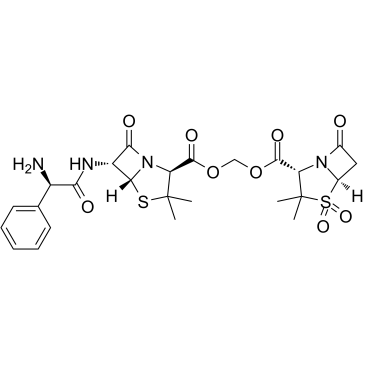 CAS#:76497-13-7
| HS Code | 2941101900 |
|---|
|
Glucose recognition proteins for glucose sensing at physiological concentrations and temperatures.
ACS Chem. Biol. 9(7) , 1595-602, (2014) Advancements in biotechnology have allowed for the preparation of designer proteins with a wide spectrum of unprecedented chemical and physical properties. A variety of chemical and genetic methods ca... |
|
|
Phenotypic heterogeneity enables uropathogenic Escherichia coli to evade killing by antibiotics and serum complement.
Infect. Immun. 83(3) , 1056-67, (2015) Uropathogenic strains of Escherichia coli (UPEC) are the major cause of bacteremic urinary tract infections. Survival in the bloodstream is associated with different mechanisms that help to resist ser... |
|
|
Anti-tumor effects of flavonoids from the ethnic medicine Docynia delavayi (Franch.) Schneid. and its possible mechanism.
J. Med. Food 17(7) , 787-94, (2014) This study investigated the active components and the anti-tumor efficacy and mechanisms of the flavonoids from Docynia delavayi (Franch.) Schneid. (DDS). MTT assay was used to examine the growth inhi... |
|
Name: Primary cell-based high-throughput screening assay for identification of compounds th...
Source: Johns Hopkins Ion Channel Center
Target: regulator of G-protein signaling 4 isoform 2 [Homo sapiens]
External Id: JHICC_RGS_Act_HTS
|
|
Name: Luminescence-based cell-based primary high throughput screening assay to identify ago...
Source: The Scripps Research Institute Molecular Screening Center
Target: mu-type opioid receptor isoform MOR-1 [Homo sapiens]
External Id: OPRM1-OPRD1_AG_LUMI_1536_1X%ACT PRUN
|
|
Name: QFRET-based biochemical primary high throughput screening assay to identify exosite i...
Source: The Scripps Research Institute Molecular Screening Center
Target: disintegrin and metalloproteinase domain-containing protein 17 preproprotein [Homo sapiens]
External Id: ADAM17_INH_QFRET_1536_1X%INH PRUN
|
|
Name: ERK5 transcriptional activity HTS
Source: 24565
Target: N/A
External Id: ERK5 transcriptional activity-HTS
|
|
Name: Fluorescence-based cell-based primary high throughput screening assay to identify ago...
Source: The Scripps Research Institute Molecular Screening Center
Target: muscarinic acetylcholine receptor M1 [Homo sapiens]
External Id: CHRM1_AG_FLUO8_1536_1X%ACT PRUN
|
|
Name: Antimicrobial activity against Escherichia coli N43 expressing AcrAB efflux pump muta...
Source: ChEMBL
Target: Escherichia coli
External Id: CHEMBL2183433
|
|
Name: A screen for compounds that inhibit the activity of LtaS in Staphylococcus aureus
Source: ICCB-Longwood/NSRB Screening Facility, Harvard Medical School
External Id: HMS979
|
|
Name: High throughput fluorescence intensity-based biochemical assay to screen for small mo...
Source: University of Pittsburgh Molecular Library Screening Center
Target: furin (paired basic amino acid cleaving enzyme), isoform CRA_a [Homo sapiens]
External Id: MH080376 Biochemical HTS for Inhibitors of the Proprotein Convertase Furin.
|
|
Name: Fluorescence polarization to screen for inhibitor that competite the binding of FadD2...
Source: Broad Institute
Target: FATTY-ACID-CoA LIGASE FADD28 (FATTY-ACID-CoA SYNTHETASE)
External Id: 2147-01_Inhibitor_SinglePoint_HTS_Activity
|
|
Name: Flow Cytometric HTS Screen for inhibitors of the ABC transporter ABCB6 for Validation...
Source: NMMLSC
Target: ATP-binding cassette sub-family B member 6, mitochondrial [Homo sapiens]
External Id: UNMCMD_ABCB6_1o_ValidationSet
|
| omnipen-n |
| Amcill-s |
| pena/n |
| Anhypen |
| XLD AGAR |
| penialmen |
| Alppen-N |
| EINECS 200-708-1 |
| Alpen-n |
| Cilleral |
| sodium ampicillin salt |
| MFCD00064313 |
| Ampicillin sodium |
| sodium ampicillin |
| Citteral |
| AmpicillinSodium |
| Ampicillin (sodium) |