A 10 year surveillance for antimicrobial susceptibility of Escherichia coli and Klebsiella pneumoniae in community- and hospital-associated intra-abdominal infections in China.
Qiwen Yang, Hui Zhang, Yao Wang, Yingchun Xu, Minjun Chen, Robert E Badal, Hui Wang, Yuxing Ni, Yunsong Yu, Bijie Hu, Ziyong Sun, Wenxiang Huang, Yong Wang, Anhua Wu, Xianju Feng, Kang Liao, Dingxia Shen, Zhidong Hu, Yunzhuo Chu, Juan Lu, Bin Cao, Jianrong Su, Bingdong Gui, Qiong Duan, Shufang Zhang, Haifeng Shao, Haishen Kong, Yunjian Hu, Huifen Ye
Index: J. Med. Microbiol. 62(Pt 9) , 1343-9, (2013)
Full Text: HTML
Abstract
The objective of this study was to investigate the susceptibility of hospital-associated (HA) and community-associated (CA) Escherichia coli and Klebsiella pneumoniae isolated from patients with intra-abdominal infections (IAIs) in China. From 2002 to 2011, the minimum inhibitory concentrations (MICs) of 12 antibiotics against 3074 E. coli and 1025 K. pneumoniae from 23 centres located in 16 cities were determined by the broth microdilution method. During the 10 year study period, ertapenem, imipenem, amikacin and piperacillin-tazobactam retained high and stable activity against E. coli and K. pneumoniae isolates regardless of whether their source was HA or CA and regardless of their extended-spectrum beta-lactamase (ESBL) production. However, the susceptibility of E. coli to cephalosporins and ampicillin-sulbactam decreased dramatically during the 10 years, especially for the CA isolates. Fluoroquinolones showed low activity against E. coli. During the whole study period, the ESBL rates for E. coli isolates from IAIs increased from 36.1 % in 2002-2003 to 68.1 % in 2010-2011 (P<0.001). Correspondingly, the ESBL rates in HA isolates increased from 52.2 % in 2002-2003 to 70.0 % in 2010-2011 (P = 0.001), and in CA isolates from 19.1 % in 2002-2003 to 61.6 % in 2010-2011 (P<0.001). The ESBL-positive rate in K. pneumoniae remained between 30.1 and 39.3 % of the total isolates with no significant change during the 10 years. In conclusion, carbapenems retained the highest susceptibility rates against HA and CA E. coli and K. pneumoniae. High prevalence of ESBL in HA E. coli and fast-growing resistance in CA E. coli severely limit the empirical use of the third- and fourth-generation cephalosporins in the therapy of IAIs.
Related Compounds
| Structure | Name/CAS No. | Molecular Formula | Articles |
|---|---|---|---|
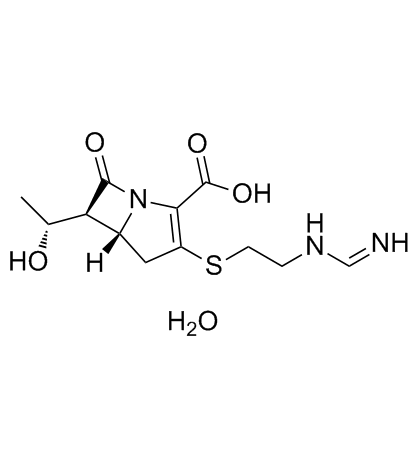 |
Imipenem
CAS:74431-23-5 |
C12H19N3O5S |
|
Combined disc methods for the detection of KPC- and/or VIM-p...
2013-09-01 [Clin. Microbiol. Infect. 19(9) , E412-5, (2013)] |
|
Inhibitory Potential of Twenty Five Anti-tuberculosis Drugs ...
2015-01-01 [Biol. Pharm. Bull. 38 , 1425-9, (2015)] |
|
Colistin and doripenem combinations against Pseudomonas aeru...
2015-05-01 [J. Antimicrob. Chemother. 70 , 1434-42, (2015)] |
|
Identification of capsular types in carbapenem-resistant Kle...
2015-02-01 [Antimicrob. Agents Chemother. 59(2) , 1038-47, (2015)] |
|
Activity of MK-7655 combined with imipenem against Enterobac...
2013-10-01 [J. Antimicrob. Chemother. 68(10) , 2286-90, (2013)] |