盐酸左旋多巴甲酯

盐酸左旋多巴甲酯结构式

|
常用名 | 盐酸左旋多巴甲酯 | 英文名 | L-3,4-Dihydroxyphenylalanine Methyl ester hydrochloride |
|---|---|---|---|---|
| CAS号 | 1421-65-4 | 分子量 | 247.676 | |
| 密度 | 1.322g/cm3 | 沸点 | 384.4ºC at 760mmHg | |
| 分子式 | C10H14ClNO4 | 熔点 | N/A | |
| MSDS | 美版 | 闪点 | 186.3ºC |
盐酸左旋多巴甲酯用途Melevodopa hydrochloride is a biochemical. |

| 中文名 | L-3,4-二羟基苯基丙氨酸甲酯盐酸 |
|---|---|
| 英文名 | L-DOPA Methyl Ester Hydrochloride |
| 中文别名 | 盐酸左旋多巴甲酯 |
| 英文别名 | 更多 |
| 密度 | 1.322g/cm3 |
|---|---|
| 沸点 | 384.4ºC at 760mmHg |
| 分子式 | C10H14ClNO4 |
| 分子量 | 247.676 |
| 闪点 | 186.3ºC |
| 精确质量 | 247.061142 |
| PSA | 92.78000 |
| LogP | 1.64290 |
| 外观性状 | 白色固体 |
| 蒸汽压 | 1.86E-06mmHg at 25°C |
| 储存条件 | -20°C |
| 计算化学 | 1.疏水参数计算参考值(XlogP):无 2.氢键供体数量:4 3.氢键受体数量:5 4.可旋转化学键数量:4 5.互变异构体数量:18 6.拓扑分子极性表面积92.8 7.重原子数量:16 8.表面电荷:0 9.复杂度:222 10.同位素原子数量:0 11.确定原子立构中心数量:1 12.不确定原子立构中心数量:0 13.确定化学键立构中心数量:0 14.不确定化学键立构中心数量:0 15.共价键单元数量:2 |
| 危害码 (欧洲) | Xi |
|---|---|
| 危险品运输编码 | NONH for all modes of transport |
| 海关编码 | 2923900090 |
|
~99%
盐酸左旋多巴甲酯 1421-65-4 |
| 文献:Journal of Medicinal Chemistry, , vol. 44, # 21 p. 3488 - 3503 |
|
~%
盐酸左旋多巴甲酯 1421-65-4 |
| 文献:US5952328 A1, ; US 5952328 A |
|
~%
盐酸左旋多巴甲酯 1421-65-4 |
| 文献:US5387610 A1, ; |

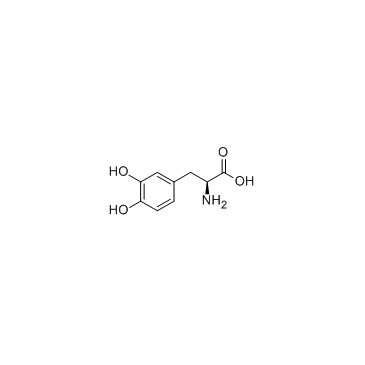
| 盐酸左旋多巴甲酯上游产品 3 | |
|---|---|
| 盐酸左旋多巴甲酯下游产品 0 | |
| 海关编码 | 2923900090 |
|---|---|
| 中文概述 | 2923900090 其他季铵盐及季铵碱。监管条件:无。增值税率:17.0%。退税率:9.0%。最惠国关税:6.5%。普通关税:30.0% |
| 申报要素 | 品名, 成分含量, 用途 |
| Summary | 2923900090 other quaternary ammonium salts and hydroxides。Supervision conditions:None。VAT:17.0%。Tax rebate rate:9.0%。MFN tariff:6.5%。General tariff:30.0% |
|
Striatal astrocytes act as a reservoir for L-DOPA.
PLoS ONE 9(9) , e106362, (2014) L-DOPA is therapeutically efficacious in patients with Parkinson's disease (PD), although dopamine (DA) neurons are severely degenerated. Since cortical astrocytes express neutral amino acid transport... |
|
|
L-DOPA-induced dyskinesia in a rat model of Parkinson's disease is associated with the fluctuational release of norepinephrine in the sensorimotor striatum.
J. Neurosci. Res. 92(12) , 1733-45, (2014) L-3,4-dihydroxyphenylalanine (L-DOPA)-induced dyskinesia (LID) is the most common complication of standard L-DOPA therapy for Parkinson's disease experienced by most parkinsonian patients. LID is asso... |
|
|
Genome-wide microarray analysis identifies a potential role for striatal retrograde endocannabinoid signaling in the pathogenesis of experimental L-DOPA-induced dyskinesia.
Synapse 68(8) , 332-43, (2014) l-3,4-Dihydroxyphenylalanine (L-DOPA) is the most widely used drug for the treatment of Parkinson's disease. Unfortunately, chronic administration of this dopamine precursor causes L-DOPA-induced dysk... |
| L-Tyrosine, 3-hydroxy-, methyl ester, hydrochloride |
| MFCD00038958 |
| L-Tyrosine, 3-hydroxy-, methyl ester, hydrochloride (1:1) |
| L-3,4-Dihydroxyphenylalanine methyl ester hydrochloride |
| methyl (2S)-2-amino-3-(3,4-dihydroxyphenyl)propanoate,hydrochloride |
| Methyl 3-hydroxy-L-tyrosinate hydrochloride (1:1) |
| (S)-Methyl 2-amino-3-(3,4-dihydroxyphenyl)propanoate hydrochloride |
| Methyl L-DOPA hydrochloride |
| methyldopa hydrochloride |
本网页内容来自不同专业数据源,如对内容有疑义,欢迎联系service1@chemsrc.com。

- 上海化源生化科技有限公司
- 上海市 上海市 普陀区
- 产品名:(S)-2-氨基-3-(3,4-二羟苯基)丙酸甲酯盐酸盐
- 纯度:98.0%
- 价格:
- 联系人:徐经理

- 联系电话:133 1186 9306
- 上海阿拉丁生化科技股份有限公司
- 上海市 上海市 浦东新区
- 产品名:盐酸左旋多巴甲酯
- 产品网址:http://www.aladdin-e.com/zh_cn/S133010.html
- 纯度:98.0%
- 价格: ¥49.9/1g ¥29.9/250mg ¥89.9/5g ¥需询单/1g
- 联系人:阿拉丁
- 联系电话:400-620-6333
查看所有供应商和价格请点击: