
- 成都普康生物科技有限公司
- 四川省 成都市 温江区
- 产品名:(R)-N-FOMC-氮杂环丁烷-2-羧酸 (D)
- 纯度:98.0%
- 规格:10g
- 联系人:杨丽华

- 联系电话:+8628-82550498
- 上海阿拉丁生化科技股份有限公司
- 上海市 上海市 浦东新区
- 产品名:(R)-1-(((9H-芴-9-基)甲氧基)羰基)氮杂环丁烷-2-羧酸
- 纯度:96.0%
- 规格:50mg/250mg/1g/1g
- 联系人:阿拉丁
- 联系电话:400-620-6333
查看所有供应商和价格请点击:
374791-02-3
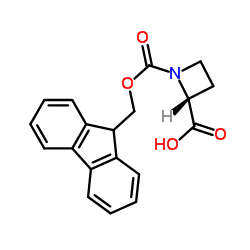
- 常用中文名:(R)-1-(((9H-芴-9-基)甲氧基)羰基)氮杂环丁烷-2-羧酸
- 常用英文名:(R)-N-Fmoc-Azetidine-2-Carboxylic Acid
- CAS号:374791-02-3
- 分子式:C19H17NO4
- 分子量:323.343
- 发布时间:2018-12-20 19:31:26
- 更新时间:2025-08-24 14:58:17
| 中文名 | (R)-N-FMOC-吖啶-2-羧酸 |
|---|---|
| 英文名 | (2R)-1-(9H-fluoren-9-ylmethoxycarbonyl)azetidine-2-carboxylic acid |
| 中文别名 |
(R)-N-芴甲氧羰基-吖丁啶-2-羧酸
(R)-1-Fmoc-2-吖丁啶甲酸 |
| 英文别名 |
fmoc-d-azetidine-2-carboxylic acid
(2R)-1-[(9H-Fluoren-9-ylmethoxy)carbonyl]-2-azetidinecarboxylic acid (R)-N-Fmoc-Azetidine-2-Carboxylic Acid |
| 密度 | 1.4±0.1 g/cm3 |
|---|---|
| 沸点 | 543.3±43.0 °C at 760 mmHg |
| 熔点 | 139.4ºC |
| 分子式 | C19H17NO4 |
| 分子量 | 323.343 |
| 闪点 | 282.3±28.2 °C |
| 精确质量 | 323.115753 |
| PSA | 66.84000 |
| LogP | 2.74 |
| 蒸汽压 | 0.0±1.5 mmHg at 25°C |
| 折射率 | 1.651 |
| 储存条件 | 密闭于阴凉干燥环境中 |
| 稳定性 | 遵照规定使用和储存则不会分解。 |
| 分子结构 | 1、摩尔折射率:无可用 2、 摩尔体积(cm3/mol):无可用 3、 等张比容(90.2K):无可用 4、 表面张力(dyne/cm):无可用 5、 极化率:无可用 |
| 计算化学 | 1、 疏水参数计算参考值(XlogP):2.7 2、 氢键供体数量:3 3、 氢键受体数量:4 4、 可旋转化学键数量:2 5、 拓扑分子极性表面积(TPSA):89.9 6、 重原子数量:23 7、 表面电荷:0 8、 复杂度:475 9、 同位素原子数量:0 10、 确定原子立构中心数量:0 11、 不确定原子立构中心数量:2 12、 确定化学键立构中心数量:0 13、 不确定化学键立构中心数量:0 14、 共价键单元数量:1 |
| 更多 | 1. 性状:无可用 2. 密度(g/mL,25/4℃):无可用 3. 相对蒸汽密度(g/mL,空气=1):无可用 4. 熔点(ºC):无可用 5. 沸点(ºC,常压):无可用 6. 沸点(ºC,5.2kPa):无可用 7. 折射率:无可用 8. 闪点(ºC):无可用 9. 比旋光度(º):无可用 10. 自燃点或引燃温度(ºC):无可用 11. 蒸气压(kPa,25ºC):无可用 12. 饱和蒸气压(kPa,60ºC):无可用 13. 燃烧热(KJ/mol):无可用 14. 临界温度(ºC):无可用 15. 临界压力(KPa):无可用 16. 油水(辛醇/水)分配系数的对数值:无可用 17. 爆炸上限(%,V/V):无可用 18. 爆炸下限(%,V/V):无可用 19. 溶解性:无可用 |
Synonym:(R)-N-(9-Fluorenylmethoxycarbonyl)azetidine-2-carboxylic acid; 1,2-Azetidinedicarboxylic acid, 1-(9H-fluoren-9-ylmethyl) ester, (2R)- Section 2 - COMPOSITION, INFORMATION ON INGREDIENTS
Risk Phrases: None Listed. Section 3 - HAZARDS IDENTIFICATION EMERGENCY OVERVIEW
The toxicological properties of this material have not been fully investigated. Potential Health Effects Eye: May cause eye irritation. Skin: May cause skin irritation. May be harmful if absorbed through the skin. Ingestion: May cause irritation of the digestive tract. The toxicological properties of this substance have not been fully investigated. May be harmful if swallowed. Inhalation: May cause respiratory tract irritation. The toxicological properties of this substance have not been fully investigated. May be harmful if inhaled. Chronic: No information found. Section 4 - FIRST AID MEASURES Eyes: In case of contact, immediately flush eyes with plenty of water for at least 15 minutes. Get medical aid. Skin: In case of contact, flush skin with plenty of water. Remove contaminated clothing and shoes. Get medical aid if irritation develops and persists. Wash clothing before reuse. Ingestion: If swallowed, do not induce vomiting unless directed to do so by medical personnel. Never give anything by mouth to an unconscious person. Get medical aid. Inhalation: If inhaled, remove to fresh air. If not breathing, give artificial respiration. If breathing is difficult, give oxygen. Get medical aid. Notes to Physician: Treat symptomatically and supportively. Section 5 - FIRE FIGHTING MEASURES General Information: As in any fire, wear a self-contained breathing apparatus in pressure-demand, MSHA/NIOSH (approved or equivalent), and full protective gear. During a fire, irritating and highly toxic gases may be generated by thermal decomposition or combustion. Extinguishing Media: Use water spray, dry chemical, carbon dioxide, or chemical foam. Section 6 - ACCIDENTAL RELEASE MEASURES General Information: Use proper personal protective equipment as indicated in Section 8. Spills/Leaks: Vacuum or sweep up material and place into a suitable disposal container. Clean up spills immediately, observing precautions in the Protective Equipment section. Avoid generating dusty conditions. Provide ventilation. Section 7 - HANDLING and STORAGE Handling: Wash thoroughly after handling. Use with adequate ventilation. Minimize dust generation and accumulation. Avoid contact with eyes, skin, and clothing. Keep container tightly closed. Avoid breathing dust. Storage: Store in a tightly closed container. Store in a cool, dry, well-ventilated area away from incompatible substances. Section 8 - EXPOSURE CONTROLS, PERSONAL PROTECTION Engineering Controls: Facilities storing or utilizing this material should be equipped with an eyewash facility and a safety shower. Use adequate ventilation to keep airborne concentrations low. Exposure Limits CAS# 374791-02-3: Personal Protective Equipment Eyes: Wear appropriate protective eyeglasses or chemical safety goggles as described by OSHA's eye and face protection regulations in 29 CFR 1910.133 or European Standard EN166. Skin: Wear appropriate protective gloves to prevent skin exposure. Clothing: Wear appropriate protective clothing to prevent skin exposure. Respirators: Follow the OSHA respirator regulations found in 29 CFR 1910.134 or European Standard EN 149. Use a NIOSH/MSHA or European Standard EN 149 approved respirator if exposure limits are exceeded or if irritation or other symptoms are experienced. Section 9 - PHYSICAL AND CHEMICAL PROPERTIES Physical State: Powder Color: white Odor: Not available. pH: Not available. Vapor Pressure: Not available. Viscosity: Not available. Boiling Point: Not available. Freezing/Melting Point: 139.4 deg C Autoignition Temperature: Not available. Flash Point: Not applicable. Explosion Limits, lower: Not available. Explosion Limits, upper: Not available. Decomposition Temperature: Solubility in water: Specific Gravity/Density: Molecular Formula: C19H17NO4 Molecular Weight: 323.34 Section 10 - STABILITY AND REACTIVITY Chemical Stability: Stable at room temperature in closed containers under normal storage and handling conditions. Conditions to Avoid: Dust generation. Incompatibilities with Other Materials: Strong oxidizing agents. Hazardous Decomposition Products: Nitrogen oxides, carbon monoxide, carbon dioxide. Hazardous Polymerization: Has not been reported Section 11 - TOXICOLOGICAL INFORMATION RTECS#: CAS# 374791-02-3 unlisted. LD50/LC50: Not available. Carcinogenicity: (R)-N-FMOC-Azetidine-2-carboxylic acid - Not listed by ACGIH, IARC, or NTP. Section 12 - ECOLOGICAL INFORMATION Section 13 - DISPOSAL CONSIDERATIONS Dispose of in a manner consistent with federal, state, and local regulations. Section 14 - TRANSPORT INFORMATION IATA Not regulated as a hazardous material. IMO Not regulated as a hazardous material. RID/ADR Not regulated as a hazardous material. Section 15 - REGULATORY INFORMATION European/International Regulations European Labeling in Accordance with EC Directives Hazard Symbols: Not available. Risk Phrases: Safety Phrases: S 24/25 Avoid contact with skin and eyes. WGK (Water Danger/Protection) CAS# 374791-02-3: No information available. Canada None of the chemicals in this product are listed on the DSL/NDSL list. CAS# 374791-02-3 is not listed on Canada's Ingredient Disclosure List. US FEDERAL TSCA CAS# 374791-02-3 is not listed on the TSCA inventory. It is for research and development use only. SECTION 16 - ADDITIONAL INFORMATION N/A |
|
生态学数据: 该物质对环境可能有危害,对水体应给予特别注意。
|