Application of TOOS reagent in enzymatic spectrophotometric determination of hydrogen peroxide
更新时间:2025-08-21 23:50:45
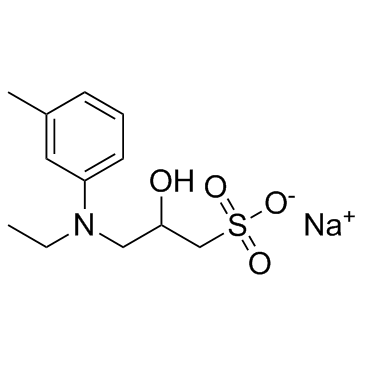
| 常用名 | N-乙基-N-(2-羟基-3-磺丙基)-3-甲基苯胺钠盐(TOOS) | CAS号 | 82692-93-1 |
|---|---|---|---|
| 价格 | $1.7/10g $1.4/50g $1.13/100mg | 纯度 | 99.0% |
| 备货期 | 需询单 | 库存 | 现货 |
| 产品网页 | https://www.hbdsbio.com/products/toos-cas-no-82692-93-1.html | ||
| 产品详情(用途,包装等)
In the fields of biochemistry and medical diagnosis, hydrogen peroxide (H ₂ O ₂) is an important reactive oxygen species molecule, and accurate determination of its concentration is of great significance for monitoring various biochemical reactions, disease diagnosis, and evaluating treatment effectiveness. With the advancement of technology, enzymatic photometry has gradually become the preferred method for detecting hydrogen peroxide due to its high sensitivity and easy operation. In this method, N-ethyl-N - (2-hydroxy-3-sulfopropyl) -3-methylaniline sodium salt (TOOS), as a novel Trinder's reagent, has brought new breakthroughs to the determination of hydrogen peroxide with its unique advantages and wide applicability. Innovations in TOOS reagents Although traditional Trinder's reagents have been widely used in hydrogen peroxide determination, they have problems such as poor water solubility, insufficient stability, and susceptibility to environmental interference, which limit their application in certain complex samples or special conditions. In contrast, TOOS reagents have innovated in their chemical structure by introducing specific functional groups, significantly improving their water solubility and enabling more uniform dispersion in solution, reducing errors caused by precipitation. In addition, TOOS also exhibits a wider pH adaptability range, which means that it can maintain stable reaction performance under different biological samples and experimental conditions, which is crucial for improving the accuracy and repeatability of detection. The mechanism of enzymatic photometric determination of hydrogen peroxide Enzymatic photometry is a method for determining the concentration of target molecules based on the color changes produced by enzymatic reactions. In the determination of hydrogen peroxide, peroxidase (such as horseradish peroxidase) is usually used as a catalyst, which can promote the oxidative coupling reaction between hydrogen peroxide and TOOS and another auxiliary substrate (such as 4-aminoantipyrine or 3-methylbenzothiazole sulfone). This reaction produces a dye with a strong color (usually purple or blue), whose color depth is proportional to the concentration of hydrogen peroxide. By measuring the absorbance of this dye, the concentration of hydrogen peroxide can be indirectly calculated. |
- 上海阿拉丁生化科技股份有限公司
- 上海市 上海市 浦东新区
- 产品名:N-乙基-N-(2-羟基-3-磺丙基)-3-甲基苯胺钠盐(TOOS)
- 价格: ¥49.9/1g ¥514.9/25g ¥118.9/5g ¥需询单/1g
- 纯度:99.0%
- 备货期:1天
- 联系人:阿拉丁

 2881459338
复制
2881459338
复制
- 中山市迪欣化工有限公司
- 广东省 中山市 三角镇
- 产品名:N-乙基-N-(2-羟基-3-磺丙基)-3-甲基苯胺钠盐
- 价格: ¥80.0/1g
- 纯度:99.0%
- 备货期:3天
- 联系人:董生
2470479589
复制
- 上海化源世纪贸易有限公司
- 上海市 上海市 普陀区
- 产品名:3-(<I>N</I>-乙基-3-甲基苯胺基)-2-羟基丙磺酸 钠盐
- 价格:
- 纯度:98.0%
- 备货期:10天
- 联系人:徐经理
351666998
复制


 133 1186 9306
复制
133 1186 9306
复制

查看所有供应商和价格请点击:
N-乙基-N-(2-羟基-3-磺丙基)-3-甲基苯胺钠盐(TOOS)生产厂家
参考价格:$66/10mM*1mLinDMSO