In vitro system to estimate renal brush border enzyme-mediated cleavage of Peptide linkages for designing radiolabeled antibody fragments of low renal radioactivity levels.
Yasushi Fujioka, Satoshi Satake, Tomoya Uehara, Takahiro Mukai, Hiromichi Akizawa, Kazuma Ogawa, Hideo Saji, Keigo Endo, Yasushi Arano
文献索引:Bioconjug. Chem. 16(6) , 1610-6, (2005)
全文:HTML全文
摘要
Renal localization of radiolabeled antibody fragments presents a problem in targeted imaging and radiotherapy. We recently reported that Fab fragments labeled with 3'-[(131)I]iodohippuryl N(epsilon)-maleoyl-l-lysine (HML) demonstrated markedly low renal radioactivity levels from early postinjection in mice. Previous studies suggested that low renal radioactivity levels were attributable to cleavage of the glycyl-lysine sequence in HML by the action of renal brush border enzymes, followed by urinary excretion of the resulting m-iodohippuric acid. In this study, an in vitro system using brush border membrane vesicles (BBMVs) isolated from the rat kidney cortex was developed to estimate renal brush border enzyme(s)-mediated cleavage of the peptide linkage. Low molecular weight HML derivatives, 3'-[(125)I]iodohippuryl l-lysine (HL), 3'-[(125)I]iodohippuryl N(epsilon)-tert-butoxycarbonyl-l-lysine (HBL), and their d-amino acid counterparts, were synthesized and incubated in BBMVs. Both [(125)I]HL and [(125)I]HBL generated m-[(125)I]iodohippuric acid after incubation in BBMVs at 37 degrees C while the latter liberated significantly higher amounts of the metabolite. [(125)I]d-HL and [(125)I]d-HBL failed to release the metabolite under similar conditions. The liberation of m-[(125)I]iodohippric acid from [(125)I]HL was significantly facilitated or completely inhibited by the addition of an activator or an inhibitor for carboxypeptidase M. The release of m-[(125)I]iodohippuric acid from [(125)I]HBL increased by the addition of the activator, whereas the inhibitor partially inhibited the release of the metabolite from [(125)I]HBL. The BBMV-mediated release of m-[(125)I]iodohippuric acid from [(125)I]HBL was not impaired by the addition of inhibitors for neutral endopeptidase or renal dipeptidase. These findings showed that the glycyl-l-lysine sequence in HML would be recognized and cleaved by metalloenzymes and nonmetalloenzymes on the renal brush border even when iodine was incorporated into a benzene ring and the N(epsilon)-amine residue of lysine was chemically modified, which supported the hypothesis that low renal radioactivity levels of HML-conjugated Fab fragments would be attributed to the release of m-iodohippuric acid by renal brush border enzymes. This study suggested that this in vitro system using BBMVs would be useful to estimate radiolabeling reagents of antibody fragments or peptides designed to reduce renal radioactivity with a variety of radionuclides.
相关化合物
| 结构式 | 名称/CAS号 | 分子式 | 全部文献 |
|---|---|---|---|
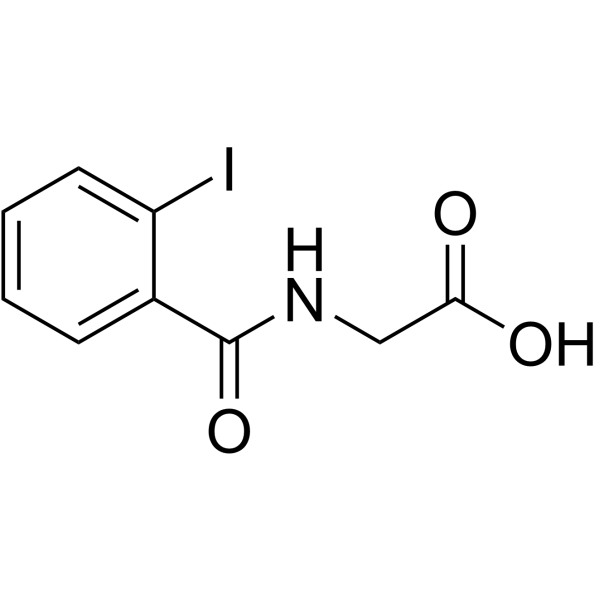 |
2'-碘马尿酸
CAS:147-58-0 |
C9H8INO3 |
|
Renal brush border enzyme-cleavable linkages for low renal r...
2013-02-20 [Bioconjug. Chem. 24(2) , 291-9, (2013)] |
|
Renal function and cardiopulmonary bypass in pediatric cardi...
2006-10-01 [Pediatr. Nephrol. 21(10) , 1446-51, (2006)] |
|
123I-hippuran renal scintigraphy with evaluation of single-k...
2003-11-01 [J. Nucl. Med. 44(11) , 1755-60, (2003)] |
|
Preclinical evaluation of 99mTc(CO)3-aspartic-N-monoacetic a...
2012-08-01 [J. Nucl. Med. 53(8) , 1277-83, (2012)] |
|
Evaluation of (123)I-orthoiodohippurate single kidney cleara...
2006-12-01 [Eur. J. Nucl. Med. Mol. Imaging 33(12) , 1483-90, (2006)] |