Aromatase destabilizer: novel action of exemestane, a food and drug administration-approved aromatase inhibitor.
Xin Wang, Shiuan Chen
文献索引:Cancer Res. 66(21) , 10281-6, (2006)
全文:HTML全文
摘要
Using Western blot as the major technique, we studied the effects of the three Food and Drug Administration (FDA)-approved aromatase inhibitors (AI) on aromatase protein stability in the aromatase-overexpressing breast cancer cell line MCF-7aro. We have found that exemestane treatment significantly reduces aromatase protein level. Exemestane induces aromatase degradation in a dose-responsive manner (25-200 nmol/L), and the effect can be seen in as early as 2 hours. Metabolic labeling with S(35)-methionine was used to determine the half-life (t(1/2)) of aromatase protein. In the presence of 200 nmol/L exemestane, the t(1/2) of aromatase was reduced to 12.5 hours from 28.2 hours in the untreated cells. Furthermore, exemestane-induced aromatase degradation can be completely blocked by 10 micromol/L MG132, indicating that the degradation is mediated by proteasome. We also examined the effect of exemestane on aromatase mRNA level using real-time reverse transcription-PCR. No significant changes in mRNA level were detected after 8 hours of treatment with exemestane (200 nmol/L). This is the first report on the evaluation of three FDA-approved AIs on the stability of the aromatase protein. We have found that exemestane, different from letrozole and anastrozole, can destabilize the aromatase protein.
相关化合物
| 结构式 | 名称/CAS号 | 分子式 | 全部文献 |
|---|---|---|---|
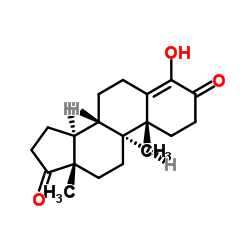 |
4-雄烯-4-醇-3,17-二酮
CAS:566-48-3 |
C19H26O3 |
|
Screening estrogenic activities of chemicals or mixtures in ...
2012-01-01 [PLoS ONE 7 , e36069, (2012)] |
|
Combined inhibitory effect of formestane and herceptin on a ...
2010-07-01 [Cancer Sci. 101 , 1661-9, (2010)] |
|
The effects of aromatase inhibitors and selective estrogen r...
2007-10-01 [Curr. Eye Res. 32(10) , 819-27, (2007)] |
|
Coadministration of the aromatase inhibitor formestane and a...
2007-04-01 [Planta Med. 73(4) , 318-22, (2007)] |
|
The role of estrogen in the developmental appearance of sens...
2008-01-01 [Brain Res. 1222 , 118-28, (2008)] |