Novel carbazolyl-substituted spiro[acridine-9,9′-fluorene] derivatives as deep-blue emitting materials for OLED applications
Wei Sun, Nonglin Zhou, Yin Xiao, Shirong Wang, Xianggao Li
文献索引:10.1016/j.dyepig.2018.02.041
全文:HTML全文
摘要
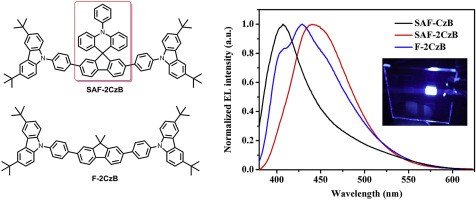
Blue organic light-emitting diodes (OLEDs) are of great significance in the fields of flat-panel display and solid-state lighting. Herein, three carbazolyl-substituted blue emitters, namely SAF-CzB, SAF-2CzB, and F-2CzB, were designed and synthesized. Two compounds SAF-CzB and SAF-2CzB possess a rigid spiro[acridine-9,9′-fluorene] (SAF) central core. The counterpart F-2CzB, which contains 9,9-dimethylfluorene as core was, also researched for comparative purpose. The introduction of SAF into fluorene-based materials could simultaneously improve their thermal stability, hole injection and transport ability, as well as prevent the fluorenone defect. The compound SAF-2CzB shows a higher decomposition temperature (Td) of 534 °C compared to that of F-2CzB (488 °C). The hole-transporting property of SAF-2CzB is also better than that of F-2CzB demonstrated by single-carrier devices. The presence of a bulky spiro-annulated triphenylamine moiety at the C9 position of the fluorene might suppress the fluorenone defect. Non-doped OLED based on SAF-2CzB as the emitting layer shows the best performance with maximum current efficiency (CE) of 4.07 cd A−1 and power efficiency (PE) of 1.83 l m W−1, compared with 3.03 cd A−1 and 1.08 l m W−1 for SAF-CzB, 3.14 cd A−1 and 1.23 l m W−1 for F-2CzB. In particular, both SAF-2CzB- and F-2CzB-based device exhibit good color stability with CIE coordinate of (0.16, 0.11) at the voltage of 7–12 V.