Zatebradine hydrochloride
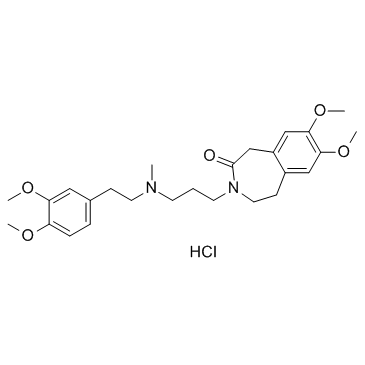
Zatebradine hydrochloride structure
|
Common Name | Zatebradine hydrochloride | ||
|---|---|---|---|---|
| CAS Number | 91940-87-3 | Molecular Weight | 493.03500 | |
| Density | 1.115g/cm3 | Boiling Point | 612.5ºC at 760mmHg | |
| Molecular Formula | C26H37ClN2O5 | Melting Point | N/A | |
| MSDS | Chinese USA | Flash Point | 324.3ºC | |
Use of Zatebradine hydrochlorideZatebradine(UL-FS49) Hcl is a potent HCN channels antagonist, which decreased the heartbeat in a reversible manner; 92% inhibition of the hHCN1-mediated current at 10 uM.IC50 value: 10 uM(92% 92% inhibition of the hHCN1) [1]Target: hHCN channel antagonistThe pharmacological properties of hHCN1-mediated currents resembled those of native hyperpolarization-activated currents (I(h)), that is, blockade by Cs(+) (99% at 5 mm), ZD 7288 (98% at 100 microm) and zatebradine (92% at 10 microm) [1]. When voltage-clamp pulse trains were applied, cilobradine induced a use-dependent blockade of If that was stronger and faster than that with zatebradine. Recovery from blockade during prolonged hyperpolarization was significantly faster with zatebradine [2]. The selective HCN blocker zatebradine reduced the activity of oriens-lacunosum moleculare interneurons in wild-type but not HCN2(-/-) mice and decreased the frequency of spontaneous inhibitory currents in postsynaptic CA1 pyramidal cells [3]. |
| Name | 3-[3-[2-(3,4-dimethoxyphenyl)ethyl-methylamino]propyl]-7,8-dimethoxy-2,5-dihydro-1H-3-benzazepin-4-one,hydrochloride |
|---|---|
| Synonym | More Synonyms |
| Description | Zatebradine(UL-FS49) Hcl is a potent HCN channels antagonist, which decreased the heartbeat in a reversible manner; 92% inhibition of the hHCN1-mediated current at 10 uM.IC50 value: 10 uM(92% 92% inhibition of the hHCN1) [1]Target: hHCN channel antagonistThe pharmacological properties of hHCN1-mediated currents resembled those of native hyperpolarization-activated currents (I(h)), that is, blockade by Cs(+) (99% at 5 mm), ZD 7288 (98% at 100 microm) and zatebradine (92% at 10 microm) [1]. When voltage-clamp pulse trains were applied, cilobradine induced a use-dependent blockade of If that was stronger and faster than that with zatebradine. Recovery from blockade during prolonged hyperpolarization was significantly faster with zatebradine [2]. The selective HCN blocker zatebradine reduced the activity of oriens-lacunosum moleculare interneurons in wild-type but not HCN2(-/-) mice and decreased the frequency of spontaneous inhibitory currents in postsynaptic CA1 pyramidal cells [3]. |
|---|---|
| Related Catalog | |
| References |
| Density | 1.115g/cm3 |
|---|---|
| Boiling Point | 612.5ºC at 760mmHg |
| Molecular Formula | C26H37ClN2O5 |
| Molecular Weight | 493.03500 |
| Flash Point | 324.3ºC |
| Exact Mass | 492.23900 |
| PSA | 60.47000 |
| LogP | 3.95270 |
| InChIKey | ZRNKXJHEQKMWCH-UHFFFAOYSA-N |
| SMILES | COc1ccc(CCN(C)CCCN2CCc3cc(OC)c(OC)cc3CC2=O)cc1OC.Cl |
| Personal Protective Equipment | Eyeshields;Gloves;type N95 (US);type P1 (EN143) respirator filter |
|---|---|
| Safety Phrases | 22-24/25 |
| RIDADR | NONH for all modes of transport |
| WGK Germany | 3 |
|
Abnormal diastolic currents in ventricular myocytes from spontaneous hypertensive heart failure rats.
Am. J. Physiol. Heart Circ. Physiol. 291(5) , H2192-8, (2006) Hypertension is a common cause of heart failure, and ventricular arrhythmias are a major cause of death in heart failure. The spontaneous hypertension heart failure (SHHF) rat model was used to study ... |
|
|
Effects of tachycardia on regional wall motion in acute ischemic canine heart.
Tohoku J. Exp. Med. 203(2) , 111-21, (2004) Tachycardia accompanies the preload reduction. Our aim is to assess the effect of the heart rate change on wall motion in ischemic heart. In 8 dogs with occlusion of left anterior descending artery, w... |
|
|
Validation of a high-sensitivity assay for zatebradine in dried blood spots of human blood at pg/ml concentrations using HILIC-MS/MS.
Bioanalysis 2(11) , 1863-71, (2010) One of the main reasons for the increased popularity of dried blood spots (DBS) is related to the 3Rs principles (replacement, refinement and reduction) for animal use in drug development. The small b... |
| Zatebradine dihydrochloride |
| Zatebradine hydrochloride |
| UL-FS49 |
| Zatebradine (hydrochloride) |