Glepaglutide
Modify Date: 2024-04-12 17:31:26
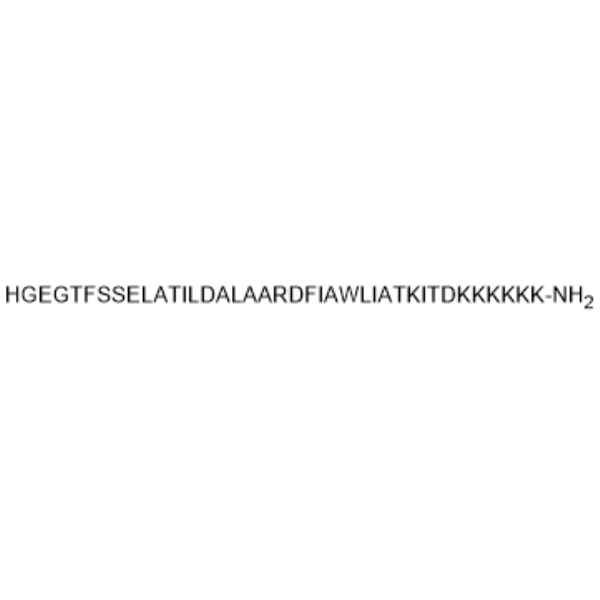
Glepaglutide structure
|
Common Name | Glepaglutide | ||
|---|---|---|---|---|
| CAS Number | 914009-86-2 | Molecular Weight | 4316.08 | |
| Density | N/A | Boiling Point | N/A | |
| Molecular Formula | C197H325N53O55 | Melting Point | N/A | |
| MSDS | N/A | Flash Point | N/A | |
Use of GlepaglutideGlepaglutide (ZP1848), a long-acting GLP-2 analogue, is a potent GLP-2R agonist. Glepaglutide reduces faecal output and increases intestinal absorption. Glepaglutide alleviates small intestinal inflammation. Glepaglutide can be used in the research of inflammatory bowel disease (IBD) and Crohn’s disease[1][2][3]. |
| Name | Glepaglutide |
|---|
| Description | Glepaglutide (ZP1848), a long-acting GLP-2 analogue, is a potent GLP-2R agonist. Glepaglutide reduces faecal output and increases intestinal absorption. Glepaglutide alleviates small intestinal inflammation. Glepaglutide can be used in the research of inflammatory bowel disease (IBD) and Crohn’s disease[1][2][3]. |
|---|---|
| Related Catalog | |
| Target |
GLP-2R[3] |
| In Vivo | Glepaglutide (200 and 400 nmol/kg, s.c., twice a day for 14 days) shows intestinotrophic effect in rats with small intestinal inflammation[3]. Animal Model: Rats with Indomethacin (HY-14397)-induced small intestinal inflammation[3] Dosage: 200 and 400 nmol/kg Administration: Subcutaneousinjection (s.c.), twice a day for 14 days. Result: Increased plasma citrulline concentration. Increased small intestinal mass. Decreased small intestinal concentrations of the inflammatory marker (AGP and MPO). |
| Molecular Formula | C197H325N53O55 |
|---|---|
| Molecular Weight | 4316.08 |
| InChIKey | DOAUQKRTILFGHV-IFMWCMAISA-N |
| SMILES | CCC(C)C(NC(=O)C(CC(C)C)NC(=O)C(Cc1c[nH]c2ccccc12)NC(=O)C(C)NC(=O)C(NC(=O)C(Cc1ccccc1)NC(=O)C(CC(=O)O)NC(=O)C(CCCN=C(N)N)NC(=O)C(C)NC(=O)C(C)NC(=O)C(CC(C)C)NC(=O)C(C)NC(=O)C(CC(=O)O)NC(=O)C(CC(C)C)NC(=O)C(NC(=O)C(NC(=O)C(C)NC(=O)C(CC(C)C)NC(=O)C(CCC(=O)O)NC(=O)C(CO)NC(=O)C(CO)NC(=O)C(Cc1ccccc1)NC(=O)C(NC(=O)CNC(=O)C(CCC(=O)O)NC(=O)CNC(=O)C(N)Cc1c[nH]cn1)C(C)O)C(C)O)C(C)CC)C(C)CC)C(=O)NC(C)C(=O)NC(C(=O)NC(CCCCN)C(=O)NC(C(=O)NC(C(=O)NC(CC(=O)O)C(=O)NC(CCCCN)C(=O)NC(CCCCN)C(=O)NC(CCCCN)C(=O)NC(CCCCN)C(=O)NC(CCCCN)C(=O)NC(CCCCN)C(N)=O)C(C)O)C(C)CC)C(C)O |