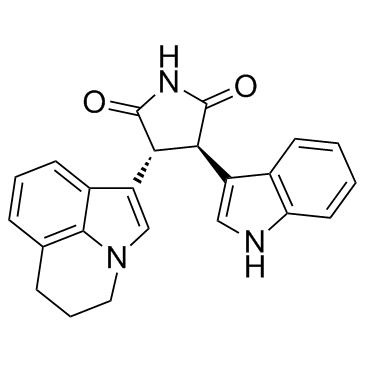
(3S,4S)-3-(5,6-Dihydro-4H-Pyrrolo[3,2,1-Ij]Quinolin-1-Yl)-4-(1H-Indol-3-Yl)Pyrrolidine-2,5-Dione
Modify Date: 2025-09-12 19:06:02
![(3S,4S)-3-(5,6-Dihydro-4H-Pyrrolo[3,2,1-Ij]Quinolin-1-Yl)-4-(1H-Indol-3-Yl)Pyrrolidine-2,5-Dione Structure](https://image.chemsrc.com/caspic/481/905854-03-7.png)
(3S,4S)-3-(5,6-Dihydro-4H-Pyrrolo[3,2,1-Ij]Quinolin-1-Yl)-4-(1H-Indol-3-Yl)Pyrrolidine-2,5-Dione structure
|
Common Name | (3S,4S)-3-(5,6-Dihydro-4H-Pyrrolo[3,2,1-Ij]Quinolin-1-Yl)-4-(1H-Indol-3-Yl)Pyrrolidine-2,5-Dione | ||
|---|---|---|---|---|
| CAS Number | 905854-03-7 | Molecular Weight | 369.41600 | |
| Density | N/A | Boiling Point | N/A | |
| Molecular Formula | C23H19N3O2 | Melting Point | N/A | |
| MSDS | N/A | Flash Point | N/A | |
Use of (3S,4S)-3-(5,6-Dihydro-4H-Pyrrolo[3,2,1-Ij]Quinolin-1-Yl)-4-(1H-Indol-3-Yl)Pyrrolidine-2,5-Dione(3S,4S)-Tivantinib is a potent and highly selective inhibitor of the receptor tyrosine kinase c-MET. (3S,4S)-Tivantinib has two novel targets, GSK3α and GSK3β, which play an important role in the cellular mechanism of non-small cell lung cancer (NSCLC)[1]. |
| Name | 2,5-Pyrrolidinedione, 3-(5,6-dihydro-4H-pyrrolo[3,2,1-ij]quinolin-1-yl)-4-(1H-indol-3-yl)-, (3S,4S) |
|---|---|
| Synonym | More Synonyms |
| Description | (3S,4S)-Tivantinib is a potent and highly selective inhibitor of the receptor tyrosine kinase c-MET. (3S,4S)-Tivantinib has two novel targets, GSK3α and GSK3β, which play an important role in the cellular mechanism of non-small cell lung cancer (NSCLC)[1]. |
|---|---|
| Related Catalog | |
| References |
| Molecular Formula | C23H19N3O2 |
|---|---|
| Molecular Weight | 369.41600 |
| Exact Mass | 369.14800 |
| PSA | 66.89000 |
| LogP | 3.92140 |
| InChIKey | UCEQXRCJXIVODC-WOJBJXKFSA-N |
| SMILES | O=C1NC(=O)C(c2cn3c4c(cccc24)CCC3)C1c1c[nH]c2ccccc12 |
| Storage condition | 2-8°C |
| Precursor 0 | |
|---|---|
| DownStream 1 | |
 CAS#:905854-02-6
| (+-)-trans-2-Propylamino-cyclohexanol-(1) |
| (+)-3(S),4(S)-3-(5,6-dihydro-4H-pyrrolo[3,2,1-ij]quinolin-1-yl)-4(1H-indol-3-yl)pyrrolidine-2,5-dione |
| 2-(propylamino)cyclohexanol |
| (-)-trans-3-(5,6-dihydro-4H-pyrrolo[3,2,1-ij]quinolin-1-yl)-4-(1H-indol-3-yl)pyrrolidine-2,5-dione |
| (1R,2R)-2-(PROPYLAMINO)CYCLOHEXANOL |