1,8-Dihydroxy-4,5-dinitroanthraquinone
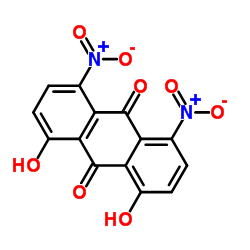
1,8-Dihydroxy-4,5-dinitroanthraquinone structure
|
Common Name | 1,8-Dihydroxy-4,5-dinitroanthraquinone | ||
|---|---|---|---|---|
| CAS Number | 81-55-0 | Molecular Weight | 330.206 | |
| Density | 1.8±0.1 g/cm3 | Boiling Point | 669.4±55.0 °C at 760 mmHg | |
| Molecular Formula | C14H6N2O8 | Melting Point | 225 °C (dec.)(lit.) | |
| MSDS | Chinese USA | Flash Point | 280.8±20.0 °C | |
| Symbol |

GHS07 |
Signal Word | Warning | |
Use of 1,8-Dihydroxy-4,5-dinitroanthraquinone1,8-Dihydroxy-4,5-dinitroanthraquinone (ARDP0006; DHDNE) is a potent inhibitor of serine proteinase NS2B/3, the dengue viral protein. 1,8-Dihydroxy-4,5-dinitroanthraquinone has intermolecular proteinase activity and viral inhibition ability with IC50s of 432 μM and 4.2 μM, respectively. Meanwhile 1,8-Dihydroxy-4,5-dinitroanthraquinone inhibits NS2B/3 cleavage in BHK-21 cells at a dose ranging from 4.2 μM to 432 μM[1]. |
| Name | 1,8-Dihydroxy-4,5-dinitroanthraquinone |
|---|---|
| Synonym | More Synonyms |
| Description | 1,8-Dihydroxy-4,5-dinitroanthraquinone (ARDP0006; DHDNE) is a potent inhibitor of serine proteinase NS2B/3, the dengue viral protein. 1,8-Dihydroxy-4,5-dinitroanthraquinone has intermolecular proteinase activity and viral inhibition ability with IC50s of 432 μM and 4.2 μM, respectively. Meanwhile 1,8-Dihydroxy-4,5-dinitroanthraquinone inhibits NS2B/3 cleavage in BHK-21 cells at a dose ranging from 4.2 μM to 432 μM[1]. |
|---|---|
| Related Catalog | |
| In Vitro | 1,8-Dihydroxy-4,5-dinitroanthraquinone (50 μM-2 mM;90 分钟) 抑制 NS2B/3 裂解,并在 100 μM 时显着且显着地作用于 BHK-21 细胞[1]。 |
| References |
| Density | 1.8±0.1 g/cm3 |
|---|---|
| Boiling Point | 669.4±55.0 °C at 760 mmHg |
| Melting Point | 225 °C (dec.)(lit.) |
| Molecular Formula | C14H6N2O8 |
| Molecular Weight | 330.206 |
| Flash Point | 280.8±20.0 °C |
| Exact Mass | 330.012421 |
| PSA | 166.24000 |
| LogP | 4.94 |
| Vapour Pressure | 0.0±2.1 mmHg at 25°C |
| Index of Refraction | 1.782 |
| Stability | Stable. Incompatible with strong oxidizing agents. |
CHEMICAL IDENTIFICATION
HEALTH HAZARD DATAACUTE TOXICITY DATA
MUTATION DATA
|
| Symbol |
GHS07 |
|---|---|
| Signal Word | Warning |
| Hazard Statements | H315-H319-H335 |
| Precautionary Statements | P261-P305 + P351 + P338 |
| Personal Protective Equipment | dust mask type N95 (US);Eyeshields;Gloves |
| Hazard Codes | Xi:Irritant; |
| Risk Phrases | R36/37/38 |
| Safety Phrases | S26-S36 |
| RIDADR | NONH for all modes of transport |
| WGK Germany | 3 |
| RTECS | CB6700000 |
| HS Code | 2914700090 |
|
~73%
1,8-Dihydroxy-4... CAS#:81-55-0 |
| Literature: Chang; Cheng Synthetic Communications, 1995 , vol. 25, # 13 p. 1893 - 1900 |
|
~76%
1,8-Dihydroxy-4... CAS#:81-55-0 |
| Literature: Chang Synthetic Communications, 1994 , vol. 24, # 7 p. 931 - 937 |
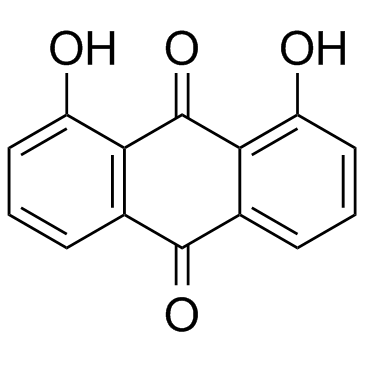
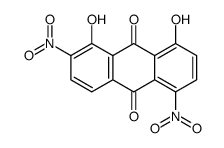
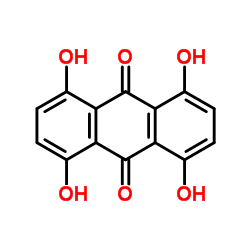 CAS#:81-60-7
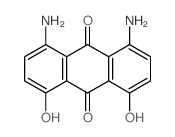 CAS#:128-94-9
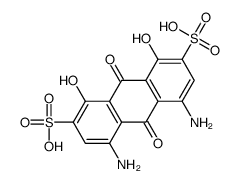 CAS#:17418-72-3
| HS Code | 2914700090 |
|---|---|
| Summary | HS: 2914700090 halogenated, sulphonated, nitrated or nitrosated derivatives of ketones and quinones, whether or not with other oxygen function Tax rebate rate:9.0% Supervision conditions:none VAT:17.0% MFN tariff:5.5% General tariff:30.0% |
|
Catalysed hydrogenation of hydroxynitroanthraquinones in strong acid. Morley JO and Hutcheson R.
J. Chem. Technol. Biotechnol. 30(1) , 409-414, (1980)
|
|
|
Measurement and Correlation of Derivatized Anthraquinone Solubility in Supercritical Carbon Dioxide. Alwi RS and Tamura K.
J. Chem. Eng. Data 60(10) , 3046-3052, (2015)
|
| 4,5-Dinitrochrysazin |
| 1,8 DIHYDROXY 4,5 DINITRO AQ |
| 4,5-Dinitrodanthron |
| 1,8-dihydroxy-4,5-dinitroanthra-9,10-quinone |
| 1,8-dihydroxy-4,5-dinitro-anthraquinon |
| Dihydroxy-4,5-dinitroanthraquinone |
| MFCD00019149 |
| 1,8-Dihydroxy-4,5-dinitroanthracene-9,10-dione |
| 1,8-Dihydroxy-4,5-dinitro-anthrachinon |
| 1,8-dihydroxy-4,5-dinitro-anthraquinone |
| 1,8-dihydroxy-4,5-dinitro-9,10-anthracenedione |
| EINECS 201-360-3 |
| 1,8-Dihydroxy-4,5-dinitro-9,10-anthraquinone |
| 1,8-Dihydroxy-4,5-di |
| 9,10-Anthracenedione, 1,8-dihydroxy-4,5-dinitro- |
| 4,5 DINITROCHRYSAZINE |
| 4,5-dinitro-1,8-dihydroxyanthraquinone |
The content on this webpage is sourced from various professional data sources. If you have any questions or concerns regarding the content, please feel free to contact service1@chemsrc.com.
- Shanghai Nianxing Industrial Co., Ltd
- China
- Product Name: 1,8-Dihydroxy-4,5-dinitroanthraquinone
- Price: Check
- Purity: 98.0%
- Delivery: 10 Day
- Contact: Yang
- Email: sales@echemcloud.com
- Shanghai Jizhi Biochemical Technology Co., Ltd
- China
- Product Name: 1,8-Dihydroxy-4,5-dinitroanthraquinone
- Price: ¥388.0/5g ¥108.0/1g
- Purity: 97.0%
- Delivery: 3 Day
- Contact: Liu jia


- Email: 2130147988@qq.com
- DC Chemicals Limited
- China
- Product Name: ARDP0006
- Price: $Inquiry/100mg $Inquiry/250mg $Inquiry/500mg
- Purity: 98.0%
- Delivery: 3 Day
- Contact: Tony Cao
- Email: sales@dcchemicals.com
- Dayang Chem (Hangzhou) Co., Ltd.
- China
- Product Name: 1,8-Dihydroxy-4,5-dinitroanthraquinone
- Price: $Inquiry/100g $Inquiry/1kg $Inquiry/100kg $Inquiry/1000kg
- Purity: 98.0%
- Delivery: Inquiry
- Contact: Ms Wang
- Email: enquiry@dycnchem.com
Get all suppliers and price by the below link:
1,8-Dihydroxy-4,5-dinitroanthraquinone suppliers
Reference only. check more 1,8-Dihydroxy-4,5-dinitroanthraquinone price