ADENOSINE 5'-TRIPHOSPHATE,PERIODATE OXIDIZED SODIUM SALT
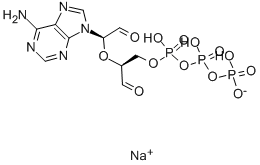
ADENOSINE 5'-TRIPHOSPHATE,PERIODATE OXIDIZED SODIUM SALT structure
|
Common Name | ADENOSINE 5'-TRIPHOSPHATE,PERIODATE OXIDIZED SODIUM SALT | ||
|---|---|---|---|---|
| CAS Number | 71997-40-5 | Molecular Weight | 571.11 | |
| Density | N/A | Boiling Point | N/A | |
| Molecular Formula | C10H11N5Na3O13P3 | Melting Point | N/A | |
| MSDS | USA | Flash Point | N/A | |
Use of ADENOSINE 5'-TRIPHOSPHATE,PERIODATE OXIDIZED SODIUM SALTOxidized ATP (oATP) trisodium salt is a broad-spectrum P2 receptor inhibitor. Oxidized ATP trisodium salt irreversibly antagonizes P2X7R activation. Oxidized ATP trisodium salt inhibits c-reactive protein (CRP)-induced NLRP3 inflammasome activation. Oxidized ATP trisodium salt can be used for research of atherosclerosis[1][2]. |
| Name | ADENOSINE 5'-TRIPHOSPHATE, PERIODATE OXIDIZED SODIUM SALT |
|---|---|
| Synonym | More Synonyms |
| Description | Oxidized ATP (oATP) trisodium salt is a broad-spectrum P2 receptor inhibitor. Oxidized ATP trisodium salt irreversibly antagonizes P2X7R activation. Oxidized ATP trisodium salt inhibits c-reactive protein (CRP)-induced NLRP3 inflammasome activation. Oxidized ATP trisodium salt can be used for research of atherosclerosis[1][2]. |
|---|---|
| Related Catalog | |
| Target |
NLRP3 inflammasome P2X7 Receptor |
| In Vivo | Oxidized ATP (300 μg/mouse, i.p., twice a week) trisodium salt ameliorates the induced mouse experimental autoimmune uveitis (EAU) in B6 mice[2]. Animal Model: Induced mouse experimental autoimmune uveitis (EAU)[2] Dosage: 300 μg/mouse Administration: i.p. Result: Showed almost undetected EAU, as shown by fundoscopic and pathologic examination. Decreased serum IL-17 level. Mitigated the autoreactive T cell response. |
| References |
| Molecular Formula | C10H11N5Na3O13P3 |
|---|---|
| Molecular Weight | 571.11 |
| Storage condition | −20°C |
| Personal Protective Equipment | Eyeshields;Gloves;type N95 (US);type P1 (EN143) respirator filter |
|---|---|
| RIDADR | NONH for all modes of transport |
| WGK Germany | 3 |
|
Involvement of a P2X7 Receptor in the Acrosome Reaction Induced by ATP in Rat Spermatozoa.
J. Cell Physiol. 230 , 3068-75, (2015) The acrosome reaction (AR) is the exocytosis of the acrosomal vesicle in response to different physiological and non-physiological stimuli. Particularly in mammals, the AR is needed for sperm to fuse ... |
|
|
P2X1 Receptor Antagonists Inhibit HIV-1 Fusion by Blocking Virus-Coreceptor Interactions.
J. Virol. 89 , 9368-82, (2015) HIV-1 Env glycoprotein-mediated fusion is initiated upon sequential binding of Env to CD4 and the coreceptor CXCR4 or CCR5. Whereas these interactions are thought to be necessary and sufficient to pro... |
|
|
Cell stress increases ATP release in NLRP3 inflammasome-mediated autoinflammatory diseases, resulting in cytokine imbalance.
Proc. Natl. Acad. Sci. U. S. A. 112(9) , 2835-40, (2015) Cell stress is implicated in triggering bouts of systemic inflammation in patients with autoinflammatory disorders. Blood monocytes from patients affected by NLRP3-mediated cryopyrin-associated period... |
| MFCD00056956 |