Bestatin hydrochloride
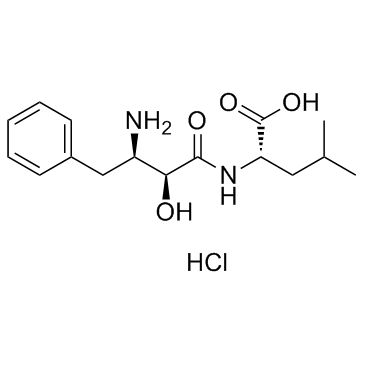
Bestatin hydrochloride structure
|
Common Name | Bestatin hydrochloride | ||
|---|---|---|---|---|
| CAS Number | 65391-42-6 | Molecular Weight | 344.834 | |
| Density | N/A | Boiling Point | 604.7ºC at 760 mmHg | |
| Molecular Formula | C16H25ClN2O4 | Melting Point | 216-218 °C | |
| MSDS | Chinese USA | Flash Point | 319.5ºC | |
Use of Bestatin hydrochlorideBestatin hydrochloride is an inhibitor of CD13 (Aminopeptidase N)/APN and leukotriene A4 hydrolase, used for cancer treatment. |
Summary: Bestatin hydrochloride (Chinese name: 苯丁抑制素盐酸盐, CAS number: 65391-42-6) is a metalloproteinase inhibitor with molecular formula C16H25ClN2O4 and molecular weight 344.834. It appears as a white to almost white powder or crystal with a melting point of 216-218°C. For research-use only, not for medical or clinical usage.
This table lists Chinese names, IUPAC names and various aliases of this chemical substance.
| Name | Bestatin hydrochloride |
|---|---|
| Synonym | More Synonyms |
This table contains bioactivity, target information and biological‑assay experimental data of this compound.
| Description | Bestatin hydrochloride is an inhibitor of CD13 (Aminopeptidase N)/APN and leukotriene A4 hydrolase, used for cancer treatment. |
|---|---|
| Related Catalog | |
| In Vitro | Bestatin enhances ATRA-induced differentiation and inhibits ATRA-driven phosphorylation of p38 MAPK in ATRA-sensitive APL NB4 cells. Bestatin can not reverse the differentiation block in ATRA-resistant APL MR2 cells. CD13 ligation with anti-CD13 antibody WM-15 results in phosphorylation of p38 MAPK, reduces the inhibition of Bestatin on the phosphorylation of p38 MAPK, and completely abolishes the enhancement of Bestatin on ATRA-inducing differentiation in NB4 cells[2]. Bestatin (600 μM)-treated cells progress slower through the cell cycle due to decreased rate of cell growth and the frequency of cell division. Bestatin inhibits the frequency of mitosis and the inherent multinuclearity in D. discoideum, and is not cytotoxic to D. discoideum cells at 0-600 μM. Bestatin inhibits aminopeptidase activity in lysates of PsaA-GFP- and GFP-expressing cells by 69.39% ± 10.5% and 39.93% ± 18.7% of control, respectively[4]. |
| In Vivo | Bestatin (20 μM) significantly reduces CD13 expression in diabetic mice and results a significant inhibition of MMP-9 specific gelationolytic band densities compared to diabetic vehicle-treated mice. Bestatin treatment significantly inhibits the expression of VEGF and heparanase in diabetic mice. Intravitreal bestatin treatment significantly downregulates the expression of both HIF-1α and VEGF in diabetic mice retinas. Furthermore, the upregulated expression of heparanase in diabetic mice retinas is significantly inhibited by intravitreal bestatin treatment[1]. Bestatin (10, 1, and 0.1mg/kg, i.p.) treatment before the antigen-potentiated humoral response to SRBC results in an increased number of splenocytes producing hemolytic anti-SRBC antibodies (PFC) and the 2-ME-resistant serum hemagglutinin titer (at a dose of 0.1 mg/kg). Bestatin (1 and 0.1 mg/kg) administered to mice five times on alternate days after cyclophosphamide injection does not change the suppressive effect of the drug regarding the number of PFC, and even causes the further decrease of the total anti-SRBC hemagglutinins at dose of 1 mg/kg on day 7 after antigen stimulation[3]. |
| Kinase Assay | Cells are harvested, washed, and lysed in NP-40 lysis buffer (50 mM Tris-HCl [pH 7.5], 150 mM NaCl, 0.5% NP-40). Total cell protein is quantified using the Bradford assay and 1-mg/mL protein aliquots are made. Ten microliters of total cell protein is mixed with 290 μL of substrate solution (0.1 mg/mL dithiothreitol [DTT], 0.1 mg/mL albumin, and 1 mM alanine-β-naphthylamide). Fluorometric measurements (340 nm excitation, 400 nm emission) are made after 15 and 30 min. The slope of the line between the 15- and 30-min measurements is used to represent aminopeptidase activity. Total cell protein is preincubated with bestatin, amastatin, puromycin, EDTA, and/or ZnCl2 for 20 min before the fluorometric aminopeptidase assay. |
| Cell Assay | Growing cells (1×10⁶ to 2×10⁶ cells/mL) are diluted to 1.0×10³ cells/mL and transferred (3 mL) into a well in a 12-well multiwell plate (2.5-cm diameter/well). Cells are treated with 0, 10, 50, 100, 300, or 600 μM Bestatin and allowed to grow at 21°C shaking at 180 rpm for 48 h. A hemocytometer is used to measure cell density after 0, 24, and 48 h. |
| Animal Admin | Bestatin is dissolved in PBS. The agent (doses of 10, 1, and 0.1 mg/kg) is injected i.p. to non-cyclophosphamide-treated mice, 5 or 10 times at 24-h intervals before SRBC immunization. The mice are immunized 24 h after the last dose of bestatin. Pharmacological immunosuppression is induced by a single intraperitoneal injection of cyclophosphamide administered at a dose of 350 mg/kg, 12 days before SRBC immunization. Bestatin at the doses of 1 and 0.1 mg/kg is injected to cyclophosphamide-immunosuppressed mice i.p. five times at 48-h intervals or 10 times at 24-h intervals before SRBC immunization. The first dose of bestatin is administered 24 h after cyclophosphamide, while the last dose of the drug is injected 24h before SRBC immunization. |
| References |
This table shows physicochemical parameters including melting point, boiling point, density, solubility and optical rotation. Missing data is marked as N/A.
| Boiling Point | 604.7ºC at 760 mmHg |
|---|---|
| Melting Point | 216-218 °C |
| Molecular Formula | C16H25ClN2O4 |
| Molecular Weight | 344.834 |
| Flash Point | 319.5ºC |
| Exact Mass | 344.150299 |
| PSA | 112.65000 |
| LogP | 2.42600 |
| InChIKey | XGDFITZJGKUSDK-UDYGKFQRSA-N |
| SMILES | CC(C)CC(NC(=O)C(O)C(N)Cc1ccccc1)C(=O)O.Cl |
| Storage condition | −20°C |
| Water Solubility | H2O: 25 mg/mL, clear, colorless |
This table provides MSDS information including hazard classification, first‑aid, fire‑fighting, spill handling, operation and storage instructions.
This table covers safety warnings, protective measures, incompatible substances and disposal guidelines for this compound.
| Personal Protective Equipment | Eyeshields;Gloves;type N95 (US);type P1 (EN143) respirator filter |
|---|---|
| Hazard Codes | Xn |
| Risk Phrases | R20/21/22 |
| Safety Phrases | S22-S24/25 |
| RIDADR | NONH for all modes of transport |
| WGK Germany | 3 |
| HS Code | 29242995 |
This table presents publicly reported synthetic routes, reaction conditions, reactants and product information of the compound.
This table lists upstream starting materials and downstream derivative products related to this chemical.
| Precursor 8 | |
|---|---|
| DownStream 0 | |
 CAS#:60016-66-2
 CAS#:246506-78-5
 CAS#:65322-89-6
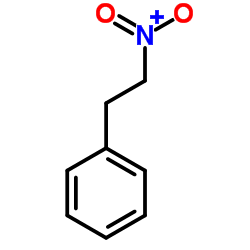 CAS#:6125-24-2
 CAS#:640279-63-6
 CAS#:2666-93-5
 CAS#:139397-07-2
 CAS#:685508-11-6
This table shows customs‑related data including HS‑code, tariff and regulatory conditions for import and export.
| HS Code | 29242995 |
|---|
This table lists relevant public references with title, journal and publication metadata for this compound.
|
Nerve growth factor-induced synapse-like structures in contralateral sensory ganglia contribute to chronic mirror-image pain.
Pain 156 , 2295-309, (2015) Elevated nerve growth factor (NGF) in the contralateral dorsal root ganglion (DRG) mediates mirror-image pain after peripheral nerve injury, but the underlying mechanism remains unclear. Using intrath... |
|
|
Chemical genetics reveals a complex functional ground state of neural stem cells.
Nat. Chem. Biol. 3(5) , 268-273, (2007) The identification of self-renewing and multipotent neural stem cells (NSCs) in the mammalian brain holds promise for the treatment of neurological diseases and has yielded new insight into brain canc... |
|
|
Genetic mapping of targets mediating differential chemical phenotypes in Plasmodium falciparum.
Nat. Chem. Biol. 5 , 765-71, (2009) Studies of gene function and molecular mechanisms in Plasmodium falciparum are hampered by difficulties in characterizing and measuring phenotypic differences between individual parasites. We screened... |
This table contains target information, in‑vitro & in‑vivo assay data for this compound.
|
Name: qHTS to identify inhibitors of the New Delhi Metallo-beta-lactamase (NDM): assay vali...
Source: NCGC
External Id: adst_MBL_Abs_LOPAC_o1
|
|
Name: Inhibition of neurosphere proliferation of mouse neural precursor cells by MTT assay
Source: ChEMBL
Target: N/A
External Id: CHEMBL1266185
|
|
Name: qHTS assay for measurement of the activity of small molecule inhibitors on Zika virus...
Source: NCGC
Target: N/A
External Id: ZIK097
|
|
Name: Dicer-mediated maturation of pre-microRNA
Source: Center for Chemical Genomics, University of Michigan
Target: N/A
External Id: TargetID_659_CEMA
|
|
Name: S16 Schwann cell viability assay (CellTiter-Glo assay)
Source: NCGC
Target: N/A
External Id: cmt-p4-fda-celltiter_regid
|
|
Name: Biochemical firefly luciferase enzyme assay for NPC
Source: NCGC
Target: Luciferase [Photinus pyralis]
External Id: adst-fluc-km-fda-o1_regid
|
|
Name: Validation qHTS for Identification of Calcium Integrin Binding protein 1 (CIB1) Compe...
Source: NCGC
External Id: cib1-v1-fp-lopac
|
|
Name: qHTS for Inhibitors of Polymerase Iota
Source: NCGC
Target: DNA polymerase iota [Homo sapiens]
External Id: PolI100
|
|
Name: qHTS for Inhibitors of Polymerase Eta
Source: NCGC
Target: DNA polymerase eta [Homo sapiens]
External Id: PolE100
|
|
Name: Primary Screen for Target Class Profiling of Small Molecule Inhibitors of Methyltrans...
Source: NCGC
External Id: MTASE-p
|
This table collects all English aliases, systematic names and CAS‑related synonyms of the compound.
| Ubenimex HCl,Bestatin hydrochloride |
| (4S,5R)-5-amino-4-hydroxy-2-(2-methylpropyl)-3-oxo-6-phenyl-D-norleucine hydrochloride |
| Bestatin hydrochloride, 10 mM in DMSO |
| N-(3-Amino-2-hydroxy-1-oxo-4-phenylbutyl)-L-leucine monohydrochloride |
| Ubenimex HCl |
| N-[(2S,3R)-3-Amino-2-hydroxy-4-phenylbutanoyl]-L-leucine hydrochloride (1:1) |
| N-[(2S,3R)-3-AMINO-2-HYDROXY-4-PHENYLBUTYRYL]-L-LEUCINE HYDROCHLORIDE |
| Ubenimex-d7 HClQ: What is Ubenimex-d7 HCl Q: What is the CAS Number of Ubenimex-d7 HCl |
| BESTATIN HCL |
| BESTATIN HYDROCHLORIDE //BP |
| MFCD00058004 |
| N-(3R-AMINO-2S-HYDROXY-1-OXO-4-PHENYLBUTYL)-L-LEUCINE, MONOHYDROCHLORIDE |
| (S)-2-((2S,3R)-3-amino-2-hydroxy-4-phenylbutanaMido)-4-Methylpentanoic acid hydrochloride |
| N-[(2S,3R)-3-Amino-2-hydroxy-4-phenylbutanoyl]-L-leucine hydrochloride |
| Bestatin hydrochloride, (HPLC) |
| L-Leucine, N-[(2S,3R)-3-amino-2-hydroxy-1-oxo-4-phenylbutyl]-, hydrochloride (1:1) |
| [(2S,3R)-3-AMINO-2-HYDROXY-4-PHENYLBUTANOYL]-L-LEUCINE HCL |
| N-(2S,3R-3-AMINO-2-HYDROXY-4-PHENYLBUTY- RYL)-L-LEUCINE HCL |
| Bestatin.HCI |
| Wufenmei Hydrochloride |
| Bestatin ade |
| BESTATIN HYDROCHLORIDE |
| D7-Bestatin HCl (D7-Ubenimex HCl) |
| N-[(2S,3R)-3-Amino-2-hydroxy-4-phenylbutyryl]-L-leucine Hydrochloride > |
| Ubenimex hydrochloride |
| Bestatin hydrochloride, aminoptidase inhibitor |
| (AMINO-2-HYDROXY-4-PHENYLBUTYRYL)-L-LEUCINE HYDROCHLORIDE |
| HYDROCHLORIDE,Ubenimex |
| Bestatin (hydrochloride) |
| (S)-2-((2S,3R)-3-Amino-2-hydroxy-4-phenylbutanamido)-4-methylpentanoic acid hydrochloride[Ubenimex Hydrochloride |
| L-Leucine,N-[(2S,3R)-3-amino-2-hydroxy-1-oxo-4-phenylbutyl]-, hydrochloride (1:1) |
| Ubenimex Hydrochloride [for Biochemical ] |
| Bestatin HCl - Bio-X |
| [(2S,3R)-3-AMINO-2-HYDROXY-4-PHENYLBUTANOYL]-L-LEUCINE HYDROCHLORIDE |
| Bestatin-d7 HCl (Ubenimex-d7 HCl) |
| Ubenimex-d7 HCl |
This section contains frequently‑asked‑questions about this compound, including basic parameters, properties, storage conditions and corresponding answers.
| Q: What is the InChIKey of Bestatin hydrochloride? |
| A: InChIKey of Bestatin hydrochloride is XGDFITZJGKUSDK-UDYGKFQRSA-N. |
| Q: What is the English name of Bestatin hydrochloride? |
| A: The English name of Bestatin hydrochloride is Bestatin hydrochloride. |
| Q: What is the melting point of Bestatin hydrochloride? |
| A: Melting point of Bestatin hydrochloride is 216-218 °C. |
| Q: What is the boiling point of Bestatin hydrochloride? |
| A: Boiling point of Bestatin hydrochloride is 604.7ºC at 760 mmHg. |
| Q: What is the CAS number of Bestatin hydrochloride? |
| A: CAS number of Bestatin hydrochloride is 65391-42-6. |
| Q: How is the water solubility of Bestatin hydrochloride? |
| A: Water solubility of Bestatin hydrochloride: H2O: 25 mg/mL, clear, colorless. |
| Q: What are the uses of Bestatin hydrochloride? |
| A: Main uses of Bestatin hydrochloride: Bestatin hydrochloride is an inhibitor of CD13 (Aminopeptidase N)/APN and leukotriene A4 hydrolase, used for cancer treatment. |
| Q: What are the upstream materials of Bestatin hydrochloride? |
| A: Related upstream materials(CAS) of Bestatin hydrochloride: 60016-66-2;246506-78-5;65322-89-6;6125-24-2;640279-63-6;2666-93-5;139397-07-2;685508-11-6. |
| Q: What are the storage conditions for Bestatin hydrochloride? |
| A: Storage conditions for Bestatin hydrochloride: −20°C. |
| Q: What is the safety information for Bestatin hydrochloride? |
| A: Safety information for Bestatin hydrochloride: S22-S24/25. |
This table lists manufacturers and suppliers of this compound, including vendor names and product supply reference information.
| Dayang Chem (Hangzhou) Co., Ltd. |