Oleandrin
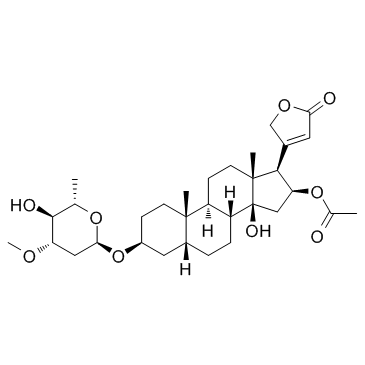
Oleandrin structure
|
Common Name | Oleandrin | ||
|---|---|---|---|---|
| CAS Number | 465-16-7 | Molecular Weight | 576.718 | |
| Density | 1.26 | Boiling Point | 693.7±55.0 °C at 760 mmHg | |
| Molecular Formula | C32H48O9 | Melting Point | 250ºC | |
| MSDS | Chinese USA | Flash Point | 217.2±25.0 °C | |
| Symbol |


GHS06, GHS08 |
Signal Word | Danger | |
Use of OleandrinOleandrin inhibits the Na+, K+-ATPase activity with an IC50 of 620 nM. |
Summary: Oleandrin, also known as oleandrin, has a molecular formula of C32H48O9 and a molecular weight of 576.718. For research-use only, not for medical or clinical usage.
This table lists Chinese names, IUPAC names and various aliases of this chemical substance.
| Name | oleandrin |
|---|---|
| Synonym | More Synonyms |
This table contains bioactivity, target information and biological‑assay experimental data of this compound.
| Description | Oleandrin inhibits the Na+, K+-ATPase activity with an IC50 of 620 nM. |
|---|---|
| Related Catalog | |
| Target |
IC50: 620 nM (Na+, K+-ATPase)[1]. |
| In Vitro | Study of Na,K-ATPase inhibition shows an IC50 (nM) of 620 for Oleandrin. The inhibition of Na,K-ATPase by Oleandrin confirms that it likely exert its toxic effect through inhibition of sodium pump activity[1]. When treated with a series of concentrations of Oleandrin (0.2-25 nM), the undifferentiated CaCO-2 cells are sensitive as evidenced by an IC50 of 8.25 nM. In contrast, a maximum growth inhibition of only 20% is reached in differentiated CaCO-2 cells even though they are treated with Oleandrin concentrations as high as 25 nM[2]. |
| In Vivo | The effect of Oleandrin is investigated on glioma growth in vivo. To this aim, SCID or C57BL/6 mice are transplanted, respectively, with human U87MG (5×10⁴), U251, GBM19 (5×10⁵), or murine (syngeneic) GL261 (7.5×10⁴) cells into the right striatum and, after 10 d, treated daily with intraperitoneal Oleandrin for an additional 7 d. Oleandrin significantly reduces tumor sizes in human and murine glioma cell models in vivo in a dose-dependent way. High concentrations of Oleandrin (3 mg/kg) are fatal in both models, as expected from the known lethal dose for rodents. Doses of Oleandrin below the lethal dose (0.3 mg/kg) significantly increase the survival time from 32.6±1.4 d to 53.8±9.6 d in mice injected with U87MG cells (n=5-11; p<0.01, log-rank test) and from 23.37±1.2 d to 34.38±3.3 d (n=5-11; p<0.01, log rank test) in mice injected with GL261 cells[3]. |
| Cell Assay | Undifferentiated wild-type and well-differentiated CaCO-2 cells are treated with a range of concentrations of Oleandrin (0.2-25 nM). After 48 h, cells are labeled with BrdU and relative cell proliferation is determined with a BrdU Cell Proliferation Kit[2]. |
| Animal Admin | Mice[3] After tumor cell injection, SCID or C57BL/6 mice are monitored daily. The end point is determined by lack of physical activity or death. The mean survival time is calculated using the Kaplan-Meier method and statistical analysis is performed using a log-rank test. For cotreatment with Temozolomide (TMZ), 10 d after tumor injection, mice are treated with Oleandrin (0.03, 0.3, or 3 mg/kg/daily, i.p.), TMZ (50 mg/kg, i.p., every 2 d for a total of 4 times with a stop of 2 weeks) or both. The dosing scheme is chosen starting from these data to be reasonably sure that a constant concentration of drug is maintained along the experiment. Animals used in Kaplan-Meier survival studies receive up to four TMZ cycles. |
| References |
This table shows physicochemical parameters including melting point, boiling point, density, solubility and optical rotation. Missing data is marked as N/A.
| Density | 1.26 |
|---|---|
| Boiling Point | 693.7±55.0 °C at 760 mmHg |
| Melting Point | 250ºC |
| Molecular Formula | C32H48O9 |
| Molecular Weight | 576.718 |
| Flash Point | 217.2±25.0 °C |
| Exact Mass | 576.329834 |
| PSA | 120.75000 |
| LogP | 2.30 |
| Vapour Pressure | 0.0±4.9 mmHg at 25°C |
| Index of Refraction | 1.567 |
| InChIKey | JLPDBLFIVFSOCC-XYXFTTADSA-N |
| SMILES | COC1CC(OC2CCC3(C)C(CCC4C3CCC3(C)C(C5=CC(=O)OC5)C(OC(C)=O)CC43O)C2)OC(C)C1O |
This table provides MSDS information including hazard classification, first‑aid, fire‑fighting, spill handling, operation and storage instructions.
This table covers safety warnings, protective measures, incompatible substances and disposal guidelines for this compound.
| Symbol |
GHS06, GHS08 |
|---|---|
| Signal Word | Danger |
| Hazard Statements | H300 + H330-H373 |
| Precautionary Statements | P260-P264-P284-P301 + P310-P310 |
| Hazard Codes | T |
| Risk Phrases | 23/24/25 |
| Safety Phrases | 22-36/37/39-45 |
| RIDADR | UN 2811 |
| RTECS | FH4585000 |
This table lists relevant public references with title, journal and publication metadata for this compound.
|
Rapid detection of convallatoxin using five digoxin immunoassays.
Clin. Toxicol. (Phila.) 52(7) , 659-63, (2014) Cardiac glycosides of plant origin are implicated in toxic ingestions that may result in hospitalization and are potentially lethal. The utility of commonly available digoxin serum assays for detectin... |
|
|
PBI-05204, a supercritical CO₂ extract of Nerium oleander, inhibits growth of human pancreatic cancer via targeting the PI3K/mTOR pathway.
Invest. New Drugs 33(2) , 271-9, (2015) Introduction Oleandrin, a cardiac glycoside, exerts strong anti-proliferative activity against various human malignancies in in vitro cells. Here, we report the antitumor efficacy of PBI-05204, a supe... |
|
|
BDNF mediates neuroprotection against oxygen-glucose deprivation by the cardiac glycoside oleandrin.
J. Neurosci. 34(3) , 963-8, (2014) We have previously shown that the botanical drug candidate PBI-05204, a supercritical CO2 extract of Nerium oleander, provides neuroprotection in both in vitro and in vivo brain slice-based models for... |
This table collects all English aliases, systematic names and CAS‑related synonyms of the compound.
| (3β,5β,16β)-16-(acetyloxy)-3-[(2,6-dideoxy-3-O-methyl-α-L-arabino-hexopyranosyl)oxy]-14-hydroxycard-20(22)-enolide |
| Corrigen |
| OLEANDRIN |
| Neriolin |
| (3β,5β,16β)-16-Acetoxy-3-[(2,6-dideoxy-3-O-methyl-α-L-arabino-hexopyranosyl)oxy]-14-hydroxycard-20(22)-enolide |
| Cholesteryl-methyl-ether |
| Cholesterin-methylether |
| (3b,5b,16b)-16-(Acetyloxy)-3-[(2,6-dideoxy-3-O-methyl-a-L-arabino-hexopyranosyl)oxy]-14-hydroxycard-20(22)-enolide |
| Folinerin |
| Cholesterin-monomethylether |
| EINECS 207-361-5 |
This section contains frequently‑asked‑questions about this compound, including basic parameters, properties, storage conditions and corresponding answers.
| Q: What is the molecular weight of oleandrin? |
| A: Molecular weight of oleandrin is 576.718. |
| Q: What are the uses of oleandrin? |
| A: Main uses of oleandrin: Oleandrin inhibits the Na+, K+-ATPase activity with an IC50 of 620 nM. |
| Q: What is the CAS number of oleandrin? |
| A: CAS number of oleandrin is 465-16-7. |
| Q: What is the LogP of oleandrin? |
| A: LogP of oleandrin is 2.30. |
| Q: What is the molecular formula of oleandrin? |
| A: Molecular formula of oleandrin is C32H48O9. |
| Q: What is the SMILES notation of oleandrin? |
| A: SMILES notation of oleandrin is COC1CC(OC2CCC3(C)C(CCC4C3CCC3(C)C(C5=CC(=O)OC5)C(OC(C)=O)CC43O)C2)OC(C)C1O. |
| Q: What is the boiling point of oleandrin? |
| A: Boiling point of oleandrin is 693.7±55.0 °C at 760 mmHg. |
| Q: What is the polar surface area (PSA) of oleandrin? |
| A: Polar surface area (PSA) of oleandrin is 120.75000. |
| Q: What is the melting point of oleandrin? |
| A: Melting point of oleandrin is 250ºC. |
| Q: What is the safety information for oleandrin? |
| A: Safety information for oleandrin: 22-36/37/39-45. |
This table lists manufacturers and suppliers of this compound, including vendor names and product supply reference information.
| Shanghai Nianxing Industrial Co., Ltd |
| BioBioPha |
| naturewill |