Sitafloxacin hydrochloride
Modify Date: 2025-08-22 10:22:32
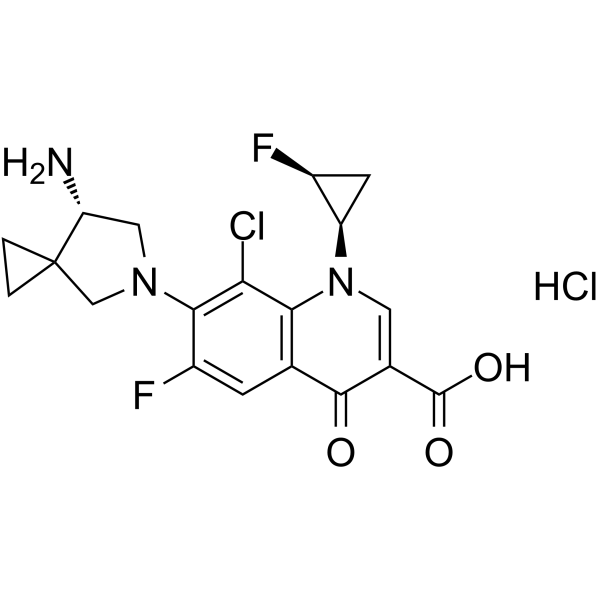
Sitafloxacin hydrochloride structure
|
Common Name | Sitafloxacin hydrochloride | ||
|---|---|---|---|---|
| CAS Number | 346607-37-2 | Molecular Weight | 446.28 | |
| Density | N/A | Boiling Point | N/A | |
| Molecular Formula | C19H19Cl2F2N3O3 | Melting Point | N/A | |
| MSDS | N/A | Flash Point | N/A | |
Use of Sitafloxacin hydrochlorideSitafloxacin (DU6859a) hydrochloride is a potent, orally active fluoroquinolone antibiotic. Sitafloxacin hydrochloride shows antichlamydial activity and antibacterial activities against a broad range of gram-positive and gram-negative bacteria, including anaerobic bacteria, as well as against atypical pathogens. Sitafloxacin hydrochloride can be used for the research of respiratory tract infection and urinary tract infection[1][2]. |
| Name | Sitafloxacin hydrochloride |
|---|
| Description | Sitafloxacin (DU6859a) hydrochloride is a potent, orally active fluoroquinolone antibiotic. Sitafloxacin hydrochloride shows antichlamydial activity and antibacterial activities against a broad range of gram-positive and gram-negative bacteria, including anaerobic bacteria, as well as against atypical pathogens. Sitafloxacin hydrochloride can be used for the research of respiratory tract infection and urinary tract infection[1][2]. |
|---|---|
| Related Catalog | |
| In Vitro | Sitafloxacin (DU6859a) hydrochloride shows antibacterial activities with MIC of 0.03, 0.12, 0.06 mg/L for wild-type ATCC 49619, gyrA mutant SP39, parC mutant 1026523 streptococcus pneumoniae stran, respectively[1]. Sitafloxacin (DU6859a) hydrochloride shows antibacterial activities for quinolone-susceptible strains of streptococcus pneumoniae with MIC of 0.03, 0.03 mg/L for EG 00093 and EG 00218 strain, respectively[1]. Sitafloxacin (DU6859a) hydrochloride shows inhibition for DNA gyrase and topoisomerase IV (TopoIV) with >IC50s of 4.38, 3.12 mg/L, respectively[1]. |
| In Vivo | Sitafloxacin (DU6859a; 12.5-100 mg/kg; i.g.; daily for 4 weeks; BALB/c female mice) hydrochloride has antibacterial activity. M. ulcerans cells could be isolated from the inoculated footpads and there was no evidence of footpad swelling[2]. Animal Model: BALB/c female mice[2] Dosage: 12.5, 25, 50 and 100 mg/kg Administration: Oral gavage; daily, for 4 weeks Result: Inhibits the growth of Mycobacterium ulcerans and the M. ulcerans cells |
| References |
| Molecular Formula | C19H19Cl2F2N3O3 |
|---|---|
| Molecular Weight | 446.28 |
| InChIKey | RAVWIGVZRVPBHN-JJZGMWGRSA-N |
| SMILES | Cl.NC1CN(c2c(F)cc3c(=O)c(C(=O)O)cn(C4CC4F)c3c2Cl)CC12CC2 |