Diphenylterazine
Modify Date: 2025-08-25 12:50:24
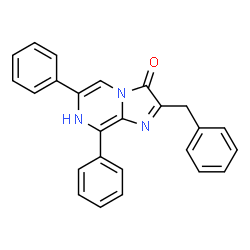
Diphenylterazine structure
|
Common Name | Diphenylterazine | ||
|---|---|---|---|---|
| CAS Number | 344940-63-2 | Molecular Weight | 377.44 | |
| Density | N/A | Boiling Point | N/A | |
| Molecular Formula | C25H19N3O | Melting Point | N/A | |
| MSDS | N/A | Flash Point | N/A | |
Use of DiphenylterazineDiphenylterazine is a bioluminescence agent. |
| Name | Diphenylterazine |
|---|
| Description | Diphenylterazine is a bioluminescence agent. |
|---|---|
| Related Catalog | |
| In Vitro | Diphenylterazine is a bioluminescence agent. Diphenylterazine alone yields very little background, leading to excellent signal-to-background ratios. Furthermore, Diphenylterazine elicits minimal cell toxicity at millimolar concentrations. Diphenylterazine injections into untransfected BALB/c mice do not yield any background emission. The bioluminescence resulting from intraperitoneally injected Diphenylterazine displays extended kinetics[1]. |
| Cell Assay | BALB/c mice are used and transfected with cells expressing teLuc, Antares, Antares2 and FLuc by injecting cells into the tail vein of BALB/c mice. After the diminishing of the FLuc bioluminescence, 0.3 µmol Diphenylterazine or furimazine is intraperitoneally injected. Mice are imaged with a 1-min exposure per frame over a course of 20 min. The images are processed using the Fiji image analysis software and the frames with highest signals in individual experiments are used for comparison[1]. |
| References |
| Molecular Formula | C25H19N3O |
|---|---|
| Molecular Weight | 377.44 |
| InChIKey | ZMJMWAVOTYOMRN-UHFFFAOYSA-N |
| SMILES | Oc1c(Cc2ccccc2)nc2c(-c3ccccc3)nc(-c3ccccc3)cn12 |
| Storage condition | 2-8℃ |