13-Oxo-9E,11E-octadecadienoic acid
Modify Date: 2025-09-14 12:14:27
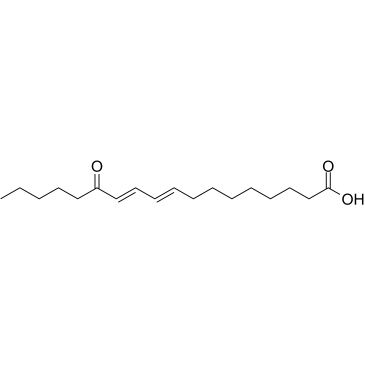
13-Oxo-9E,11E-octadecadienoic acid structure
|
Common Name | 13-Oxo-9E,11E-octadecadienoic acid | ||
|---|---|---|---|---|
| CAS Number | 29623-29-8 | Molecular Weight | 294.42900 | |
| Density | 0.966±0.06 g/cm3(Predicted) | Boiling Point | 425.5±18.0 °C(Predicted) | |
| Molecular Formula | C18H30O3 | Melting Point | N/A | |
| MSDS | N/A | Flash Point | N/A | |
Use of 13-Oxo-9E,11E-octadecadienoic acid13-Oxo-9E,11E-octadecadienoic acid, an isomer of 9-oxo-ODA, is a potent PPARα activator derived from tomato juice. 13-Oxo-9E,11E-octadecadienoic acid decreases plasma and hepatic triglyceride in obese diabetic mice[1]. |
| Name | (9Z,11E/Z)-13-oxooctadecatrienoic acid |
|---|---|
| Synonym | More Synonyms |
| Description | 13-Oxo-9E,11E-octadecadienoic acid, an isomer of 9-oxo-ODA, is a potent PPARα activator derived from tomato juice. 13-Oxo-9E,11E-octadecadienoic acid decreases plasma and hepatic triglyceride in obese diabetic mice[1]. |
|---|---|
| Related Catalog | |
| Target |
PPARα |
| In Vivo | 13-Oxo-9E,11E-octadecadienoic acid (feed; 0.02% and 0.05%; for 4 weeks) improves dyslipidemia and lowering TG content in the liver and skeletal muscle of HFD-fed KK-Ay mice[1]. Animal Model: Male KK-Ay mice with 4-week-old[1] Dosage: 0.02% and 0.05% Administration: Feed; for 4 weeks Result: Improved dyslipidemia and lowering TG content in the liver and skeletal muscle of HFD-fed KK-Ay mice. |
| References |
| Density | 0.966±0.06 g/cm3(Predicted) |
|---|---|
| Boiling Point | 425.5±18.0 °C(Predicted) |
| Molecular Formula | C18H30O3 |
| Molecular Weight | 294.42900 |
| Exact Mass | 294.21900 |
| PSA | 54.37000 |
| LogP | 5.06350 |
| InChIKey | JHXAZBBVQSRKJR-KDFHGORWSA-N |
| SMILES | CCCCCC(=O)C=CC=CCCCCCCCC(=O)O |
| 13-oxo-9Z,11E/Z-octadecadienoic acid |
| 13-Oxo-9,11-octadecadiensaeure |
| 13-Oxo-9E,11E-octadecadienoicacid |
| 13-Oxo-9E,11E-octadecadienoic acid |