CUCURBIT(8)URIL
Modify Date: 2025-08-20 22:52:07
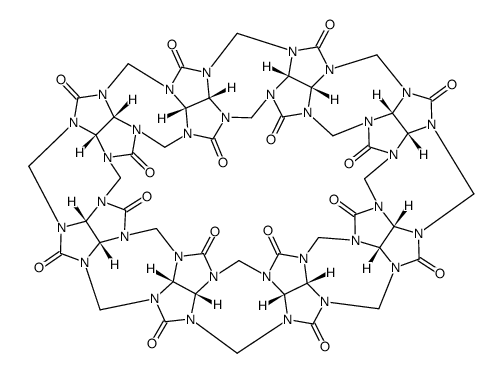
CUCURBIT(8)URIL structure
|
Common Name | CUCURBIT(8)URIL | ||
|---|---|---|---|---|
| CAS Number | 259886-51-6 | Molecular Weight | 1329.10 | |
| Density | 2.71 | Boiling Point | N/A | |
| Molecular Formula | C48H48N32O16 | Melting Point | N/A | |
| MSDS | N/A | Flash Point | N/A | |
Use of CUCURBIT(8)URILCucurbit[8]uril is a potent, low toxicity and orally active supramolecular inducer of protein heterodimerization. Cucurbit[8]uril induces heterodimerization of methylviologen and naphthalene functionalized proteins. Cucurbit[8]uril can induce energy transfer [1][2]. |
| Name | cucurbit[8]uril |
|---|---|
| Synonym | More Synonyms |
| Description | Cucurbit[8]uril is a potent, low toxicity and orally active supramolecular inducer of protein heterodimerization. Cucurbit[8]uril induces heterodimerization of methylviologen and naphthalene functionalized proteins. Cucurbit[8]uril can induce energy transfer [1][2]. |
|---|---|
| Related Catalog | |
| Target |
Protein Heterodimerization[1] |
| In Vitro | Cucurbit[8]uril (0~20 μM; 48 hours; CHO-K1 cells) makes the relative cell viability dropped marginally to 86%[2]. Cucurbit[8]uril indeed selectively induces the heterodimerization of MV–eYFP with Np–eCFP. Cucurbit[8]uril-induced high energy transfer between the proteins is only observed in the presence of all three supramolecular components, allowing the formation of the ternary complex. In the presence of Cucurbit[8]uril, the unspecific protein assembly induced by the methylviologen is inhibited. The ternary system of Cucurbit[8]uril with methylviologen (MV) and naphthalene (NP) can also be successfully used for the formation of selective protein heterodimers of more hydrophobic proteins. The presence of Cucurbit[8]uril as a host molecule is required to prevent MV induced unspecific dimerization with hydrophobic protein surfaces[1]. Cell Viability Assay[1] Cell Line: CHO-K1 cells Concentration: 0~20 μM Incubation Time: 48 hours Result: At the highest investigated concentration of 20 μM after 48 h, the relative cell viability dropped marginally to 86%. |
| In Vivo | Cucurbit[8]uril shows a very low toxicity of the in vivo intravenous injection, as well as oral administration studies on mice[2]. |
| References |
| Density | 2.71 |
|---|---|
| Molecular Formula | C48H48N32O16 |
| Molecular Weight | 1329.10 |
| Exact Mass | 1328.39000 |
| PSA | 376.80000 |
| Appearance of Characters | solid | white |
| InChIKey | CONWISUOKHSUDR-UHFFFAOYSA-N |
| SMILES | O=C1N2CN3C(=O)N4CN5C(=O)N6CN7C(=O)N8CN9C(=O)N%10CN%11C(=O)N%12CN%13C(=O)N%14CN%15C(=O)N%16CN1C1C2N2CN%17C(=O)N(CN%18C(=O)N(CN%19C(=O)N(CN%20C(=O)N(CN%21C(=O)N(CN%22C(=O)N(CN%23C(=O)N(CN1C2=O)C%16C%15%23)C%14C%13%22)C%12C%11%21)C%10C9%20)C8C7%19)C6C5%18)C4C3%17 |
| WGK Germany | 3 |
|---|
| CB8 |
| Q[8] |
| curcurbit[8]uril |
| MFCD03456501 |
| cucurbituril[8] |
| CB[8] |