TT-OAD2
Modify Date: 2025-08-25 11:46:07
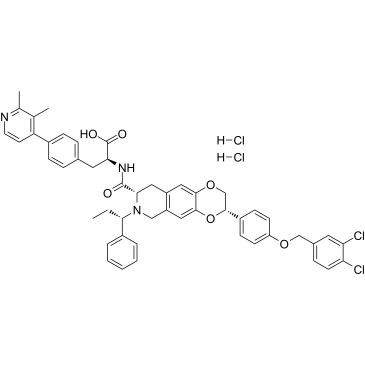
TT-OAD2 structure
|
Common Name | TT-OAD2 | ||
|---|---|---|---|---|
| CAS Number | 2382719-60-8 | Molecular Weight | 929.75 | |
| Density | N/A | Boiling Point | N/A | |
| Molecular Formula | C50H49Cl4N3O6 | Melting Point | N/A | |
| MSDS | N/A | Flash Point | N/A | |
Use of TT-OAD2TT-OAD2 is a non-peptide glucagon-like peptide-1 (GLP-1) receptor agonist with an EC50 of 5 nM. TT-OAD2 has the potential for diabetes treatment[1][2]. |
| Name | TT-OAD2 |
|---|
| Description | TT-OAD2 is a non-peptide glucagon-like peptide-1 (GLP-1) receptor agonist with an EC50 of 5 nM. TT-OAD2 has the potential for diabetes treatment[1][2]. |
|---|---|
| Related Catalog | |
| Target |
EC50: 5 nM (GLP-1 receptor)[2] |
| In Vitro | TT-OAD2 (0-10 μM) inhibits GLP-1- and oxyntomodulin-mediated cAMP, calcium, pERK1/2 and β-arrestin responses in a concentration-dependent manner in HEK293A cells[1]. |
| In Vivo | TT-OAD2 (3 mg/kg; intravenous injection; male human GLP-1 receptor knock-in and knockout mice) treatment induces plasma insulin in an acute IVGTT on humanized GLP-1R knock-in (KI) and GLP-1R knockout (KO) mice[1]. Animal Model: Male human GLP-1 receptor knock-in and knockout mice (6-11 months of age) with intravenous glucose tolerance tests[1] Dosage: 3 mg/kg Administration: Intravenous injection (Single dose) Result: Induced plasma insulin. |
| References |
| Molecular Formula | C50H49Cl4N3O6 |
|---|---|
| Molecular Weight | 929.75 |
| InChIKey | JCHUZLPPFLKGNX-PLFFULENSA-N |
| SMILES | CCC(c1ccccc1)N1Cc2cc3c(cc2CC1C(=O)NC(Cc1ccc(-c2ccnc(C)c2C)cc1)C(=O)O)OCC(c1ccc(OCc2ccc(Cl)c(Cl)c2)cc1)O3.Cl.Cl |