SLF TFA
Modify Date: 2025-08-27 15:03:16
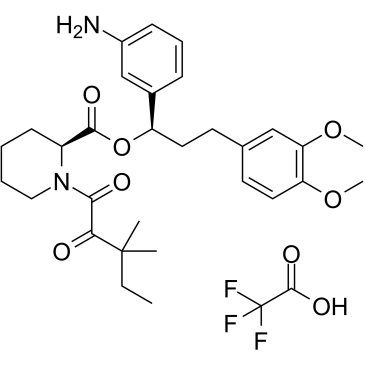
SLF TFA structure
|
Common Name | SLF TFA | ||
|---|---|---|---|---|
| CAS Number | 2378802-47-0 | Molecular Weight | 638.67 | |
| Density | N/A | Boiling Point | N/A | |
| Molecular Formula | C32H41F3N2O8 | Melting Point | N/A | |
| MSDS | N/A | Flash Point | N/A | |
Use of SLF TFASLF TFA is a synthetic ligand for FK506-binding protein (FKBP) with an affinity of 3.1 μM for FKBP51 and an IC50 of 2.6 μM for FKBP12. SLF TFA can be used in the synthesis of PROTAC[1][2][3]. |
| Name | SLF TFA |
|---|
| Description | SLF TFA is a synthetic ligand for FK506-binding protein (FKBP) with an affinity of 3.1 μM for FKBP51 and an IC50 of 2.6 μM for FKBP12. SLF TFA can be used in the synthesis of PROTAC[1][2][3]. |
|---|---|
| Related Catalog | |
| In Vitro | Three scout fragments-KB02, KB03, and KB05 are fused, which cover two different electrophile groups (chloroacetamide and acrylamide) and display broad cysteine reactivity in the human proteome-to the SLF ligand that binds tightly and selectively to FKBP12, a cytosolic prolyl isomerase that has been frequently used to study ligand-induced protein degradation[3]. |
| References |
[1]. Kolos JM, et al. FKBP Ligands-Where We Are and Where to Go? Front Pharmacol. 2018 Dec 5;9:1425. |
| Molecular Formula | C32H41F3N2O8 |
|---|---|
| Molecular Weight | 638.67 |
| InChIKey | HKRBJXCFMLSYKV-KZDWWKKTSA-N |
| SMILES | CCC(C)(C)C(=O)C(=O)N1CCCCC1C(=O)OC(CCc1ccc(OC)c(OC)c1)c1cccc(N)c1.O=C(O)C(F)(F)F |