H-(Gly)3-Lys(N3)-OH
Modify Date: 2025-11-29 08:45:45
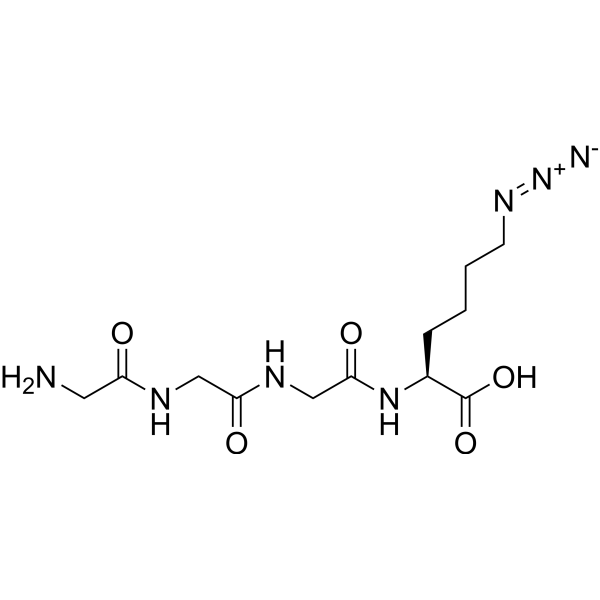
H-(Gly)3-Lys(N3)-OH structure
|
Common Name | H-(Gly)3-Lys(N3)-OH | ||
|---|---|---|---|---|
| CAS Number | 2250437-45-5 | Molecular Weight | 343.34 | |
| Density | N/A | Boiling Point | N/A | |
| Molecular Formula | C12H21N7O5 | Melting Point | N/A | |
| MSDS | N/A | Flash Point | N/A | |
Use of H-(Gly)3-Lys(N3)-OHThe azide function is widely used for coupling to alkyne-containing fragments via the renowned Click reaction. Polyglycine fragments containing up to 7 glycines are reported to bind to surfaces and have potential application in nanotechnology constructs: constructs of Gly7-NHCH2-fragment containing peptides bind on mica surface in aqueous solution[1][2]. |
| Name | H-(Gly)3-Lys(N3)-OH |
|---|
| Description | The azide function is widely used for coupling to alkyne-containing fragments via the renowned Click reaction. Polyglycine fragments containing up to 7 glycines are reported to bind to surfaces and have potential application in nanotechnology constructs: constructs of Gly7-NHCH2-fragment containing peptides bind on mica surface in aqueous solution[1][2]. |
|---|---|
| Related Catalog | |
| References |
| Molecular Formula | C12H21N7O5 |
|---|---|
| Molecular Weight | 343.34 |
| InChIKey | OTAJJAGRBJWUDS-QMMMGPOBSA-N |
| SMILES | [N-]=[N+]=NCCCCC(NC(=O)CNC(=O)CNC(=O)CN)C(=O)O |