Cy5 DBCO chloride
Modify Date: 2025-08-23 09:58:51
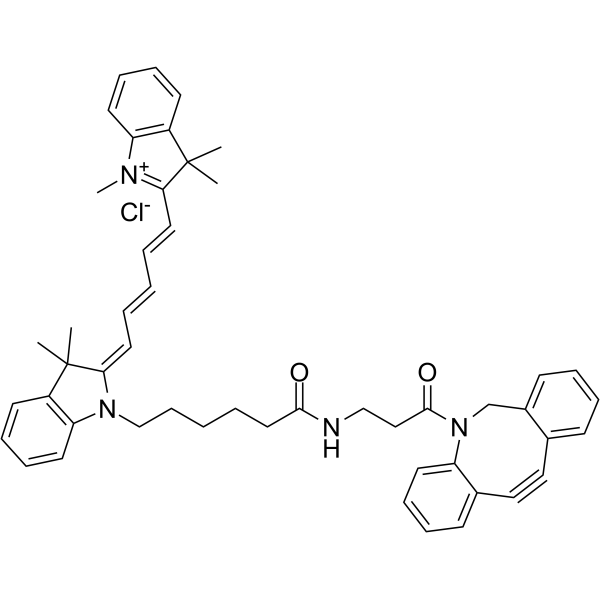
Cy5 DBCO chloride structure
|
Common Name | Cy5 DBCO chloride | ||
|---|---|---|---|---|
| CAS Number | 2182601-72-3 | Molecular Weight | 777.43 | |
| Density | N/A | Boiling Point | N/A | |
| Molecular Formula | C50H53ClN4O2 | Melting Point | N/A | |
| MSDS | N/A | Flash Point | N/A | |
Use of Cy5 DBCO chlorideCy5 DBCO chloride is an azide reaction probe and the addition of DBCO molecules allows the imaging of azide-labelled biomolecules by a copper-free “Click Chemistry” reaction[1]. |
| Name | Cy5 DBCO chloride |
|---|
| Description | Cy5 DBCO chloride is an azide reaction probe and the addition of DBCO molecules allows the imaging of azide-labelled biomolecules by a copper-free “Click Chemistry” reaction[1]. |
|---|---|
| Related Catalog | |
| In Vitro | Cy5 DBCO chloride (2-50 μM) can control the extent of labelling by varying the concentration of DBCO-Cy5 in a dose-dependent manner, with the amount of DBCO-Cy5 bound at the cell surface increasing with increasing DBCO-Cy5 concentration[1]. Guidelines (Following is our recommended protocol. This protocol only provides a guideline, and should be modified according to your specific needs). 1.Incubate the cells at a density of 3×10⁴ cells in a cell culture dish for 3 days and then wash the cells twice with DPBS (pH 7.4). Incubate the cells according to your normal protocol. 2.Incubate the cells with Cy5 DBCO chloride at a final concentration of 20 µM for 1 h at 37°C. 3.After incubation, wash cells with DPBS (pH 7.4) and fix with formaldehyde-glutaraldehyde combination fixative for 15 min at room temperature. 4.After fixation, wash cells twice with DPBS (pH 7.4). Analyze sample on a flow cytometer, fluorescence microscopy, or fluorescence microplate reader. |
| References |
| Molecular Formula | C50H53ClN4O2 |
|---|---|
| Molecular Weight | 777.43 |
| InChIKey | HWIXBRHDYGXXEQ-UHFFFAOYSA-N |
| SMILES | C[N+]1=C(C=CC=CC=C2N(CCCCCC(=O)NCCC(=O)N3Cc4ccccc4C#Cc4ccccc43)c3ccccc3C2(C)C)C(C)(C)c2ccccc21.[Cl-] |