2-(3,6-Bis(dimethylamino)xanthylium-9-yl)-5-((2-(2-(2-(2-(4-(6-methyl-1,2,4,5-tetrazin-3-yl)phenoxy)ethoxy)ethoxy)ethoxy)ethyl)carbamoyl)benzoate
Modify Date: 2025-11-25 12:41:28
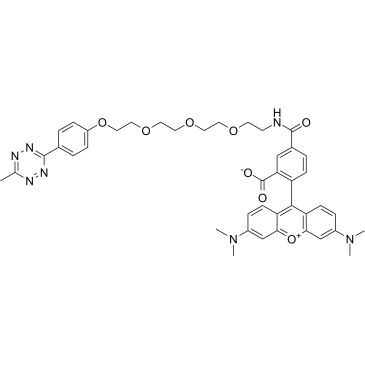
2-(3,6-Bis(dimethylamino)xanthylium-9-yl)-5-((2-(2-(2-(2-(4-(6-methyl-1,2,4,5-tetrazin-3-yl)phenoxy)ethoxy)ethoxy)ethoxy)ethyl)carbamoyl)benzoate structure
|
Common Name | 2-(3,6-Bis(dimethylamino)xanthylium-9-yl)-5-((2-(2-(2-(2-(4-(6-methyl-1,2,4,5-tetrazin-3-yl)phenoxy)ethoxy)ethoxy)ethoxy)ethyl)carbamoyl)benzoate | ||
|---|---|---|---|---|
| CAS Number | 2163772-19-6 | Molecular Weight | 775.85 | |
| Density | N/A | Boiling Point | N/A | |
| Molecular Formula | C42H45N7O8 | Melting Point | N/A | |
| MSDS | N/A | Flash Point | N/A | |
Use of 2-(3,6-Bis(dimethylamino)xanthylium-9-yl)-5-((2-(2-(2-(2-(4-(6-methyl-1,2,4,5-tetrazin-3-yl)phenoxy)ethoxy)ethoxy)ethoxy)ethyl)carbamoyl)benzoateTAMRA-PEG4-methyltetrazine is a PEG-based PROTAC linker that can be used in the synthesis of PROTACs[1]. |
| Name | TAMRA-PEG4-methyltetrazine |
|---|---|
| Synonym | More Synonyms |
| Description | TAMRA-PEG4-methyltetrazine is a PEG-based PROTAC linker that can be used in the synthesis of PROTACs[1]. |
|---|---|
| Related Catalog | |
| Target |
PEGs |
| In Vitro | PROTACs contain two different ligands connected by a linker; one is a ligand for an E3 ubiquitin ligase and the other is for the target protein. PROTACs exploit the intracellular ubiquitin-proteasome system to selectively degrade target proteins[1]. |
| References |
| Molecular Formula | C42H45N7O8 |
|---|---|
| Molecular Weight | 775.85 |
| MFCD28385537 |