(±)-Propionylcarnitine chloride
Modify Date: 2025-08-25 05:44:52
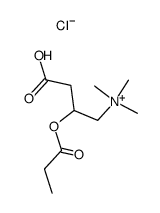
(±)-Propionylcarnitine chloride structure
|
Common Name | (±)-Propionylcarnitine chloride | ||
|---|---|---|---|---|
| CAS Number | 18828-58-5 | Molecular Weight | 253.72300 | |
| Density | N/A | Boiling Point | N/A | |
| Molecular Formula | C10H20ClNO4 | Melting Point | N/A | |
| MSDS | N/A | Flash Point | N/A | |
Use of (±)-Propionylcarnitine chloridePropionyl-DL-carnitine chloride is a carnitine derivative. Propionyl-DL-carnitine chloride can be used for the research of inflammation[1][2][3][4]. |
| Name | (+/-)-propionylcarnitine chloride |
|---|---|
| Synonym | More Synonyms |
| Description | Propionyl-DL-carnitine chloride is a carnitine derivative. Propionyl-DL-carnitine chloride can be used for the research of inflammation[1][2][3][4]. |
|---|---|
| Related Catalog | |
| In Vitro | Propionyl-DL-carnitine chloride shows protection to beta-thalassaemic erythrocytes from oxidative stress[1]. Propionyl-DL-carnitine chloride increases production of 14CO2 from [1-14C]pyruvate and increases the rate of formation of acetyl camitine from pyruvate[2]. Propionyl-DL-carnitine chloride allows the endothelial cells to maintain their functionality and regulatory role on vessel activity for a longer time and decreases the formation of oxygen reactive species due to xanthine oxidase activity on hypoxanthine formed by adenine nucleotide catabolism[4]. |
| In Vivo | Propionyl-DL-carnitine chloride (2 mM/kg; p.o. once daily for 4 weeks) affects plasma and urine total carnitine concentrations of mice[3]. Animal Model: Adult age-matched male C57BL/6 mice[3] Dosage: 2 mM/kg Administration: Oral gavage; 2 mM/kg/day for 4 weeks Result: Increased plasma and urine total carnitine concentrations, but showed no effect on the skeletal muscle carnitine content of mice. |
| Molecular Formula | C10H20ClNO4 |
|---|---|
| Molecular Weight | 253.72300 |
| Exact Mass | 253.10800 |
| PSA | 63.60000 |
| LogP | 1.29110 |
| InChIKey | KTFMPDDJYRFWQE-UHFFFAOYSA-N |
| SMILES | CCC(=O)OC(CC(=O)O)C[N+](C)(C)C.[Cl-] |
| Storage condition | -20°C |
| (±)-Propionylcarnitine chloride |
| O-Propionylcarnitinhydrochlorid |