Prucalopride hydrochloride
Modify Date: 2025-08-27 16:51:43
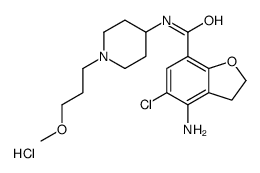
Prucalopride hydrochloride structure
|
Common Name | Prucalopride hydrochloride | ||
|---|---|---|---|---|
| CAS Number | 179474-80-7 | Molecular Weight | 404.33100 | |
| Density | N/A | Boiling Point | N/A | |
| Molecular Formula | C18H27Cl2N3O3 | Melting Point | N/A | |
| MSDS | N/A | Flash Point | N/A | |
Use of Prucalopride hydrochloridePrucalopride hydrochloride is an orally active, selective and specific 5-HT4 receptor agonist (high affinity), with pKis of 8.6 and 8.1 for human 5-HT4a/4b receptors, respectively. Prucalopride hydrochloride improves intestinal motility by promoting regeneration of the intestinal nervous system in rats. Prucalopride hydrochloride also shows anticancer activity by blocking of the PI3K/AKT/mTor signaling pathway. Prucalopride hydrochloride can be used in studies of chronic constipation, pseudo-intestinal obstruction and cancer[1][2][3]. |
| Name | 4-amino-5-chloro-N-[1-(3-methoxypropyl)piperidin-4-yl]-2,3-dihydro-1-benzofuran-7-carboxamide,hydrochloride |
|---|---|
| Synonym | More Synonyms |
| Description | Prucalopride hydrochloride is an orally active, selective and specific 5-HT4 receptor agonist (high affinity), with pKis of 8.6 and 8.1 for human 5-HT4a/4b receptors, respectively. Prucalopride hydrochloride improves intestinal motility by promoting regeneration of the intestinal nervous system in rats. Prucalopride hydrochloride also shows anticancer activity by blocking of the PI3K/AKT/mTor signaling pathway. Prucalopride hydrochloride can be used in studies of chronic constipation, pseudo-intestinal obstruction and cancer[1][2][3]. |
|---|---|
| Related Catalog | |
| References |
| Molecular Formula | C18H27Cl2N3O3 |
|---|---|
| Molecular Weight | 404.33100 |
| Exact Mass | 403.14300 |
| PSA | 80.31000 |
| LogP | 3.98370 |
| InChIKey | KKMOQGWTJRGLNN-UHFFFAOYSA-N |
| SMILES | COCCCN1CCC(NC(=O)c2cc(Cl)c(N)c3c2OCC3)CC1.Cl |
| UNII-M8IYX9Z79V |
| Prucalopride hydrochloride |