Adrenomedullin (human)
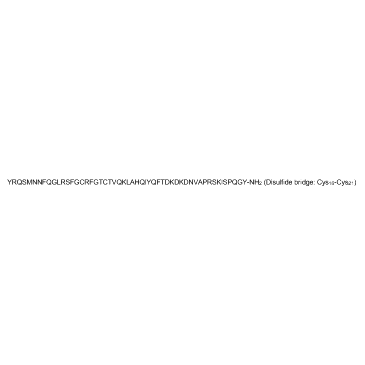
Adrenomedullin (human) structure
|
Common Name | Adrenomedullin (human) | ||
|---|---|---|---|---|
| CAS Number | 148498-78-6 | Molecular Weight | 6028.82 | |
| Density | N/A | Boiling Point | N/A | |
| Molecular Formula | C264H406N80O77S3 | Melting Point | N/A | |
| MSDS | USA | Flash Point | N/A | |
Use of Adrenomedullin (human)Adrenomedullin (AM) (1-52), human is a 52-amino acid peptide, which affects cell proliferation and angiogenesis in cancer. |
| Name | Adrenomedullin (AM) (1-52), human |
|---|
| Description | Adrenomedullin (AM) (1-52), human is a 52-amino acid peptide, which affects cell proliferation and angiogenesis in cancer. |
|---|---|
| Related Catalog | |
| In Vitro | To explore the effect of Adrenomedullin (AM) (1-52), human on astroglioma cells, CRT-MG cells are incubated in the absence or presence of Adrenomedullin (AM) (1-52), human (ADM1-52) for 48 h in a medium containing 1% FBS, and wound-healing assay is performed. The number of cells migrating to the wound region significantly increases in the ADM1-52-treated cells, in a dose-dependent manner, compared to the untreated cells[1]. |
| Cell Assay | CRT-MG cells are scraped off the bottom of a culture plate using a pipette tip to create a cell-free area. The cell culture is washed with PBS to remove cell debris and then incubated with oncostatin M (OSM), Adrenomedullin (AM) (1-52), human (ADM1-52; 0.1 μM and 0.5 μM) for 48 h in 1% FBS DMEM. The wound area is photographed after scratching for control. The number of cells migrating into the initial wound area is counted at 48 h after scratching[1]. |
| References |
| Molecular Formula | C264H406N80O77S3 |
|---|---|
| Molecular Weight | 6028.82 |
| Appearance of Characters | powder |
| Storage condition | −20°C |
| Personal Protective Equipment | Eyeshields;Gloves;type N95 (US);type P1 (EN143) respirator filter |
|---|---|
| RIDADR | NONH for all modes of transport |
| WGK Germany | 3 |
| RTECS | AV6800000 |
|
Intermedin1-53 attenuates vascular smooth muscle cell calcification by inhibiting endoplasmic reticulum stress via cyclic adenosine monophosphate/protein kinase A pathway.
Exp. Biol. Med. (Maywood.) 238(10) , 1136-46, (2013) We previously reported that endoplasmic reticulum (ER) stress-mediated apoptosis participated in vascular calcification. Importantly, a novel paracrine/autocrine peptide intermedin1-53 (IMD1-53) in th... |
|
|
The effect of intermedin on angiotensin II and endothelin-1 induced ventricular myocyte hypertrophy in neonatal rat.
Clin. Lab. 59(5-6) , 589-96, (2013) Intermedin (IMD), a novel peptide related to calcitonin gene-related peptide (CGRP) and adrenomedullin (ADM), may have localized actions as a modulator of cardiac function. The aim of the study is to ... |
|
|
Effects of intermedin1-53 on myocardial fibrosis.
Acta Biochim. Biophys. Sin. (Shanghai) 45(2) , 141-8, (2013) Intermedin (IMD) is a member of the calcitonin/calcitonin gene-related peptide (CGRP) family and has similar or more potent cardiovascular actions than adrenomedullin (ADM) and any other CGRP. The aim... |