MJN110
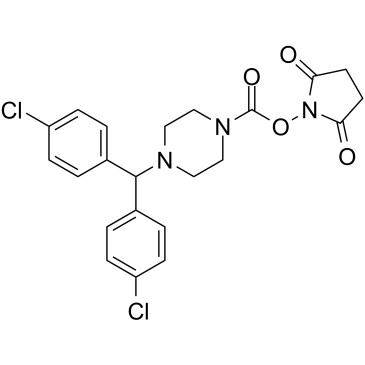
MJN110 structure
|
Common Name | MJN110 | ||
|---|---|---|---|---|
| CAS Number | 1438416-21-7 | Molecular Weight | 462.32600 | |
| Density | 1.47±0.1 g/cm3 | Boiling Point | 561.5±60.0 °C | |
| Molecular Formula | C22H21Cl2N3O4 | Melting Point | N/A | |
| MSDS | Chinese USA | Flash Point | N/A | |
| Symbol |

GHS07 |
Signal Word | Warning | |
Use of MJN110MJN110 is a potent and selective monoacylglycerol lipase (MAGL) inhibitor[1]. MJN110 reduces hepatic macrophage number, inflammatory gene expression and slowes down fibrosis progression[2]. |
| Name | [2,5-dioxopyrrolidin-1-yl 4-(bis(4-chlorophenyl)methyl)piperazine-1-carboxylate] |
|---|---|
| Synonym | More Synonyms |
| Description | MJN110 is a potent and selective monoacylglycerol lipase (MAGL) inhibitor[1]. MJN110 reduces hepatic macrophage number, inflammatory gene expression and slowes down fibrosis progression[2]. |
|---|---|
| Related Catalog | |
| In Vivo | MJN110 (i.p.; 0.0818 mg/kg; twice daily for 5.5 days) reverses chronic constriction injury (CCI)-induced mechanical allodynia and thermal hyperalgesia in a dose-dependent manner. The respective ED50 value (95% confidence limits) is 0.430 (0.233-0.793) mg/kg[1]. Animal Model: Male C57BL/6J mice ranged from 18 to 35 g[1] Dosage: 0.0818 mg/kg Administration: I.p.; twice daily for 5.5 days Result: Reversed CCI-induced mechanical allodynia and thermal hyperalgesia in a dose-dependent manner. |
| References |
| Density | 1.47±0.1 g/cm3 |
|---|---|
| Boiling Point | 561.5±60.0 °C |
| Molecular Formula | C22H21Cl2N3O4 |
| Molecular Weight | 462.32600 |
| Exact Mass | 461.09100 |
| PSA | 70.16000 |
| LogP | 3.71470 |
| InChIKey | BEADRWVIFHOSGN-UHFFFAOYSA-N |
| SMILES | O=C(ON1C(=O)CCC1=O)N1CCN(C(c2ccc(Cl)cc2)c2ccc(Cl)cc2)CC1 |
|
Effect of selective inhibition of monoacylglycerol lipase (MAGL) on acute nausea, anticipatory nausea, and vomiting in rats and Suncus murinus.
Psychopharmacol. Ser. 232(3) , 583-93, (2015) To determine the role of the endocannabinoid, 2-arachodonyl glycerol (2-AG), in the regulation of nausea and vomiting.We evaluated the effectiveness of the potent selective monoacylglycerol lipase (MA... |
|
|
Proteome-wide reactivity profiling identifies diverse carbamate chemotypes tuned for serine hydrolase inhibition.
ACS Chem. Biol. , (2013) Serine hydrolases are one of the largest and most diverse enzyme classes in Nature. Inhibitors of serine hydrolases are used to treat many diseases, including obesity, diabetes, cognitive dementia, an... |
|
|
Evaluation of NHS carbamates as a potent and selective class of endocannabinoid hydrolase inhibitors.
ACS Chem. Neurosci. 4(9) , 1322-32, (2013) Monoacylglycerol lipase (MAGL) is a principal metabolic enzyme responsible for hydrolyzing the endogenous cannabinoid (endocannabinoid) 2-arachidonoylglycerol (2-AG). Selective inhibitors of MAGL offe... |
| MJN110 |
| 2,5-dioxopyrrolidin-1-yl 4-[bis(4-chlorophenyl)methyl]piperazine-1-carboxylate |