LYP-IN-1
Modify Date: 2024-01-31 22:25:30
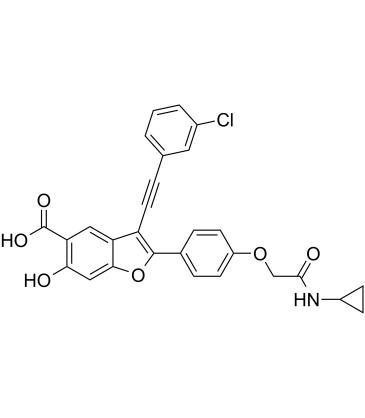
LYP-IN-1 structure
|
Common Name | LYP-IN-1 | ||
|---|---|---|---|---|
| CAS Number | 1404436-51-6 | Molecular Weight | 501.91 | |
| Density | N/A | Boiling Point | N/A | |
| Molecular Formula | C28H20ClNO6 | Melting Point | N/A | |
| MSDS | N/A | Flash Point | N/A | |
Use of LYP-IN-1LYP-IN-1 is a potent, selective and specific LYP inhibitor with a Ki and an IC50 of 110 nM and 0.259 μM, respectively. LYP-IN-1 also has selectivity for a large panel of PTPs, such as SHP1 (IC50=5 μM) and SHP2 (IC50=2.5 μM). LYP-IN-1 exhibits highly efficacious cellular activity in T- and mast cells. LYP-IN-1 can be used for the study of autoimmune disorders[1]. |
| Name | LYP-IN-1 |
|---|
| Description | LYP-IN-1 is a potent, selective and specific LYP inhibitor with a Ki and an IC50 of 110 nM and 0.259 μM, respectively. LYP-IN-1 also has selectivity for a large panel of PTPs, such as SHP1 (IC50=5 μM) and SHP2 (IC50=2.5 μM). LYP-IN-1 exhibits highly efficacious cellular activity in T- and mast cells. LYP-IN-1 can be used for the study of autoimmune disorders[1]. |
|---|---|
| Related Catalog | |
| Target |
IC50: 0.259 μM (LYP) Ki: 110 nM (LYP)[1] |
| In Vitro | LYP-IN-1 has inhibitory activity toward a panel of mammalian PTPs including SHP1, SHP2, PTP-Meg2, FAP1 and PTP-PEST, with IC50 values of 5 μM, 2.5 μM, 0.59 μM, 0.39 μM, and 0.8 μM, respectively[1]. LYP-IN-1 (15 µM) increases both basal and TCR-stimulated phosphorylation of ZAP-70 on Tyr319 in JTAg cells[1]. LYP-IN-1 (15 µM) treatment of mouse thymocytes effectively causes an increase in the activation of double-positive (DP) thymocytes, it increased surface expression of CD69 (a marker of T cell activation) and Nur77[1]. |
| References |
| Molecular Formula | C28H20ClNO6 |
|---|---|
| Molecular Weight | 501.91 |
| InChIKey | IIURSEJMCKFEQG-UHFFFAOYSA-N |
| SMILES | O=C(COc1ccc(-c2oc3cc(O)c(C(=O)O)cc3c2C#Cc2cccc(Cl)c2)cc1)NC1CC1 |