LY3027788 hydrochloride
Modify Date: 2025-08-22 19:00:01
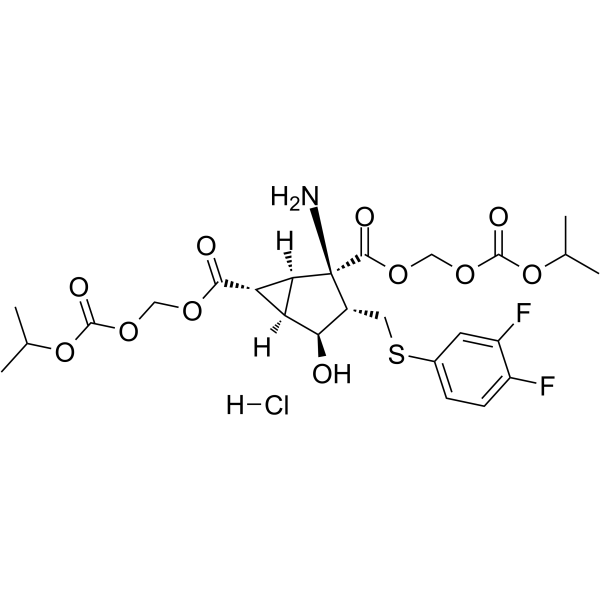
LY3027788 hydrochloride structure
|
Common Name | LY3027788 hydrochloride | ||
|---|---|---|---|---|
| CAS Number | 1377615-55-8 | Molecular Weight | 628.04 | |
| Density | N/A | Boiling Point | N/A | |
| Molecular Formula | C25H32ClF2NO11S | Melting Point | N/A | |
| MSDS | N/A | Flash Point | N/A | |
Use of LY3027788 hydrochlorideLY3027788 hydrochloride, a diester analog of LY3020371 which is an mGlu2/3 receptor antagonist, is a potent and orally active prodrug of LY3020371. LY3027788 hydrochloride has antidepressant efficacy[1][2]. |
| Name | LY3027788 hydrochloride |
|---|
| Description | LY3027788 hydrochloride, a diester analog of LY3020371 which is an mGlu2/3 receptor antagonist, is a potent and orally active prodrug of LY3020371. LY3027788 hydrochloride has antidepressant efficacy[1][2]. |
|---|---|
| Related Catalog | |
| Target |
mGluR2 mGluR3 |
| In Vitro | LY3027788 (4.8-27 mg/kg; a single p.o.) produces antidepressant-like decreases in immobility times in the forced-swim test in mice[1]. LY3027788 (4.8-16 mg/kg; a single p.o.) enhances the locomotor stimulant effects of quinpirole at the dose of 16 mg/kg in the locomotor activity assay in mice[1]. LY3027788 (10-30 mg/kg; a single p.o.) dose dependently increases the wake time of rats without engendering rebound hypersomnolence[1]. LY3027788 (a single p.o.) leads to the rapid and dose-proportionate appearance of the pharmacologically active species LY3020371 in plasma of both mouse (4.8-27 mg/kg) and rat (3-30 mg/kg)[1]. |
| In Vivo | LY3027788 (4.8-27 mg/kg; a single p.o.) produces antidepressant-like decreases in immobility times in the forced-swim test in mice[1]. LY3027788 (4.8-16 mg/kg; a single p.o.) enhances the locomotor stimulant effects of quinpirole at the dose of 16 mg/kg in the locomotor activity assay in mice[1]. LY3027788 (10-30 mg/kg; a single p.o.) dose dependently increases the wake time of rats without engendering rebound hypersomnolence[1]. LY3027788 (a single p.o.) leads to the rapid and dose-proportionate appearance of the pharmacologically active species LY3020371 in plasma of both mouse (4.8-27 mg/kg) and rat (3-30 mg/kg)[1]. Animal Model: Male Sprague-Dawley mice (20-25 g)[1] Dosage: 4.8, 16, 27 mg/kg Administration: A single p.o. (60 minutes prior to testing) Result: Potent and efficacious with a minimal effective dose of 16 mg/kg in the mouse forced-swim assay. The ED60 was 8.2 mg/kg. |
| References |
| Molecular Formula | C25H32ClF2NO11S |
|---|---|
| Molecular Weight | 628.04 |
| InChIKey | FUEQYOZWBYVZQM-GSLULZTOSA-N |
| SMILES | CC(C)OC(=O)OCOC(=O)C1C2C(O)C(CSc3ccc(F)c(F)c3)C(N)(C(=O)OCOC(=O)OC(C)C)C12.Cl |