PMQA
Modify Date: 2024-01-08 19:51:22
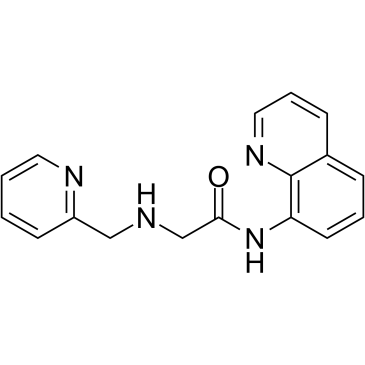
PMQA structure
|
Common Name | PMQA | ||
|---|---|---|---|---|
| CAS Number | 1263820-18-3 | Molecular Weight | 292.34 | |
| Density | N/A | Boiling Point | N/A | |
| Molecular Formula | C17H16N4O | Melting Point | N/A | |
| MSDS | N/A | Flash Point | N/A | |
Use of PMQAPMQA (Zn-green), an 8-aminoquinoline-based ratiometric fluorescent sensor, demonstrates the Zn2+-induced redshift of emission (85 nm). PMQA (Zn-green) is a cell membrane-permeable probe and suitable for imaging Zn2+ in living cells[1]. |
| Name | PMQA |
|---|
| Description | PMQA (Zn-green), an 8-aminoquinoline-based ratiometric fluorescent sensor, demonstrates the Zn2+-induced redshift of emission (85 nm). PMQA (Zn-green) is a cell membrane-permeable probe and suitable for imaging Zn2+ in living cells[1]. |
|---|---|
| Related Catalog | |
| In Vitro | After incubation with PMQA (20 μM) for 1 h, weak green fluorescence appeared, presumably caused by the probe capturing intracellular zinc from its native ligands since PMQA has high affinity for zinc[1]. The response of PMQA to Zn2+ can be reversed by N,N,N’,N’-tetrakis(2-pyridylmethyl)ethylenediamine (TPEN) or EDTA[1]. When the stock solution of PMQA (0.1 mM in Tris Buffer) is kept at room temperature for a week, there is no significant loss of PMQA determined by HPLC analysis[1]. |
| References |
| Molecular Formula | C17H16N4O |
|---|---|
| Molecular Weight | 292.34 |
| InChIKey | ILPCMNKRRUNDLK-UHFFFAOYSA-N |
| SMILES | O=C(CNCc1ccccn1)Nc1cccc2cccnc12 |