Melittin (free acid) trifluoroacetate salt
Modify Date: 2025-08-25 14:42:06
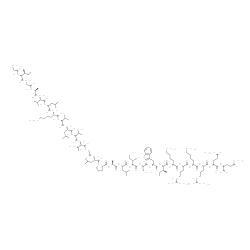
Melittin (free acid) trifluoroacetate salt structure
|
Common Name | Melittin (free acid) trifluoroacetate salt | ||
|---|---|---|---|---|
| CAS Number | 123168-46-7 | Molecular Weight | 2847.448 | |
| Density | 1.4±0.1 g/cm3 | Boiling Point | N/A | |
| Molecular Formula | C131H228N38O32 | Melting Point | N/A | |
| MSDS | N/A | Flash Point | N/A | |
Use of Melittin (free acid) trifluoroacetate saltMelittin free acid is a basic 26-amino-acid polypeptide, the major active ingredient of honeybee venom. Melittin free acid is an activator of phospholipase A2 (PLA2). Melittin free acid has broad-spectrum antifungal activity with MIC values of 0.4-60 μM. Melittin free acid hinders fungal growth by inducing cell apoptosis, repressing (1,3)-β-D-glucan synthase and participating in other pathways[1][2]. |
| Name | Melittin (free acid) trifluoroacetate salt |
|---|---|
| Synonym | More Synonyms |
| Description | Melittin free acid is a basic 26-amino-acid polypeptide, the major active ingredient of honeybee venom. Melittin free acid is an activator of phospholipase A2 (PLA2). Melittin free acid has broad-spectrum antifungal activity with MIC values of 0.4-60 μM. Melittin free acid hinders fungal growth by inducing cell apoptosis, repressing (1,3)-β-D-glucan synthase and participating in other pathways[1][2]. |
|---|---|
| Related Catalog | |
| In Vitro | Melittin free acid 刺激小鼠纤维细胞 (MC5-5)、人成纤维细胞 (D550)、兔主动脉内皮细胞 (CLO)、大鼠肺型肺泡肺细胞 (L-2) 和兔平滑肌细胞 (R-I) 的前列腺素生物合成[1]。 Melittin free acid 刺激 MC5-5 细胞磷脂中花生四烯酸的释放[1]。 Melittin free acid 诱导黄曲霉萌发分生孢子中活性氧的积累[2]。 Melittin 抑制灰霉菌 MUCL 30158 和 CECT 2100 菌株,IC50 值分别为 3.1 和 24 μM[2]。 |
| In Vivo | Melittin (腹腔内接种) 可增加小鼠外周血中 13,14-dihydro-15-keto-PGE2 的水平[1]。 |
| References |
| Density | 1.4±0.1 g/cm3 |
|---|---|
| Molecular Formula | C131H228N38O32 |
| Molecular Weight | 2847.448 |
| Exact Mass | 2845.738281 |
| LogP | -0.28 |
| Index of Refraction | 1.634 |
| InChIKey | APGXIPWPUMTZGN-CTOWXMLOSA-N |
| SMILES | CCC(C)C(NC(=O)CN)C(=O)NCC(=O)NC(C)C(=O)NC(C(=O)NC(CC(C)C)C(=O)NC(CCCCN)C(=O)NC(C(=O)NC(CC(C)C)C(=O)NC(C(=O)NC(C(=O)NCC(=O)NC(CC(C)C)C(=O)N1CCCC1C(=O)NC(C)C(=O)NC(CC(C)C)C(=O)NC(C(=O)NC(CO)C(=O)NC(Cc1c[nH]c2ccccc12)C(=O)NC(C(=O)NC(CCCCN)C(=O)NC(CCCNC(=N)N)C(=O)NC(CCCCN)C(=O)NC(CCCNC(=N)N)C(=O)NC(CCC(N)=O)C(=O)NC(CCC(N)=O)C(=O)O)C(C)CC)C(C)CC)C(C)O)C(C)O)C(C)C)C(C)C.O=C(O)C(F)(F)F |
| L-Glutamine, glycyl-L-isoleucylglycyl-L-alanyl-L-valyl-L-leucyl-L-lysyl-L-valyl-L-leucyl-L-threonyl-L-threonylglycyl-L-leucyl-L-prolyl-L-alanyl-L-leucyl-L-isoleucyl-L-seryl-L-tryptophyl-L-isoleucyl-L-lysyl-L-arginyl-L-lysyl-L-arginyl-L-glutaminyl- |
| Glycyl-L-isoleucylglycyl-L-alanyl-L-valyl-L-leucyl-L-lysyl-L-valyl-L-leucyl-L-threonyl-L-threonylglycyl-L-leucyl-L-prolyl-L-alanyl-L-leucyl-L-isoleucyl-L-seryl-L-tryptophyl-L-isoleucyl-L-lysyl-L-arginyl-L-lysyl-L-arginyl-L-glutaminyl-L-glutamine |